
Ouroboros Forces Developers to Clarify Before AI Writes a Single Line
Ouroboros is an open-source Agent OS that interviews you before writing a single line of code, using math to block premature builds until your spec is clear enough.
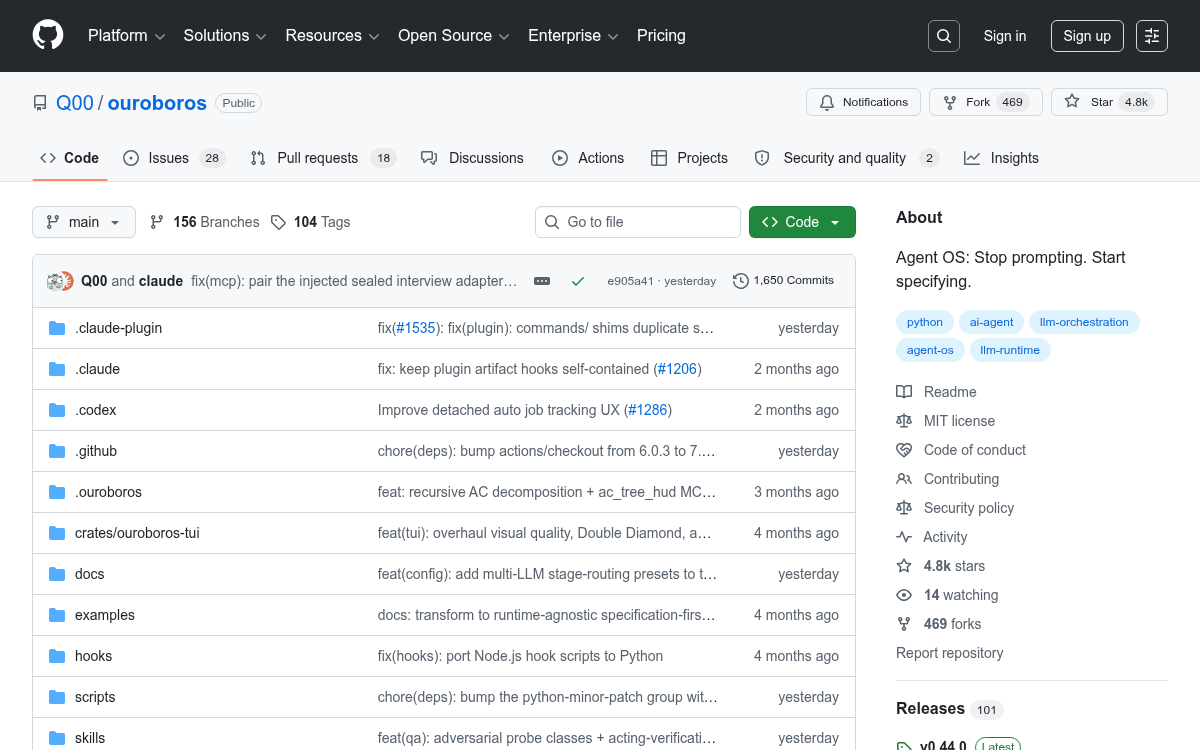
Takeaways
- Ouroboros is a free, open-source Agent OS that runs a Socratic interview before generating any code, blocking builds until ambiguity scores below 0.2.
- It works as a runtime layer on top of Claude Code, Codex CLI, Copilot, Gemini, Kiro, and 5 other AI coding CLIs via MCP.
- A 3-stage automated evaluation gate (Mechanical → Semantic → Multi-Model Consensus) replaces manual code review.
- An evolutionary loop refines the spec across up to 30 generations, stopping only when ontology similarity hits 95% across consecutive runs.
- Nine specialized agents (Socratic Interviewer, Ontologist, Contrarian, Simplifier, etc.) are loaded on-demand to handle different phases of the workflow.
- Install via
pip install ouroboros-ai[all]or a one-line curl script; MIT licensed with 4,500+ GitHub stars.
Ouroboros starts from a simple, uncomfortable observation: most AI coding fails at the input, not the output. The bottleneck is not AI capability -- it is human clarity. You give a vague prompt, the agent guesses, and you spend the next three hours undoing its confident mistakes. Ouroboros is a framework built to fix that -- not by making the AI smarter, but by forcing you to be clearer before any code runs.
Ouroboros is a local-first runtime layer that turns non-deterministic agent work into a replayable, observable, policy-bound execution contract. It replaces ad-hoc prompting with a structured specification-first workflow: interview, crystallize, execute, evaluate, evolve. It has crossed 4,500 GitHub stars and is actively maintained, with 90 releases shipped since launch.
The Interview That Blocks Bad Code
The core mechanic is a Socratic interview that runs before any code is generated. The agent asks probing questions -- not just "what do you want to build?" but deeper ones like "what IS a task, really? Is it deletable or archivable? Solo or team?" -- until it has surfaced every hidden assumption in your idea.
But the interview does not end when you feel ready. It ends when the ambiguity score drops to 0.2 or below and Ouroboros declares the session READY. The score is computed mathematically:
- Goal Clarity (40% weight): Is the goal specific and actionable?
- Constraint Clarity (30% weight): Are limitations and boundaries defined?
- Success Criteria (30% weight): Are outcomes measurable?
Each dimension is scored 0 to 1 by the LLM at temperature 0.1 for reproducibility, then combined into a single ambiguity number. The threshold of 0.2 is not arbitrary: at 80% weighted clarity, the remaining unknowns are small enough that code-level decisions can resolve them. Above that threshold, you are still guessing at architecture.
The Loop That Eats Its Own Tail
The architecture is: Interview -> Seed -> Execute -> Evaluate, feeding back into an evolutionary loop. The output of evaluation becomes the input for the next generation, until the system truly knows what it is building. Each phase has a specific job: