
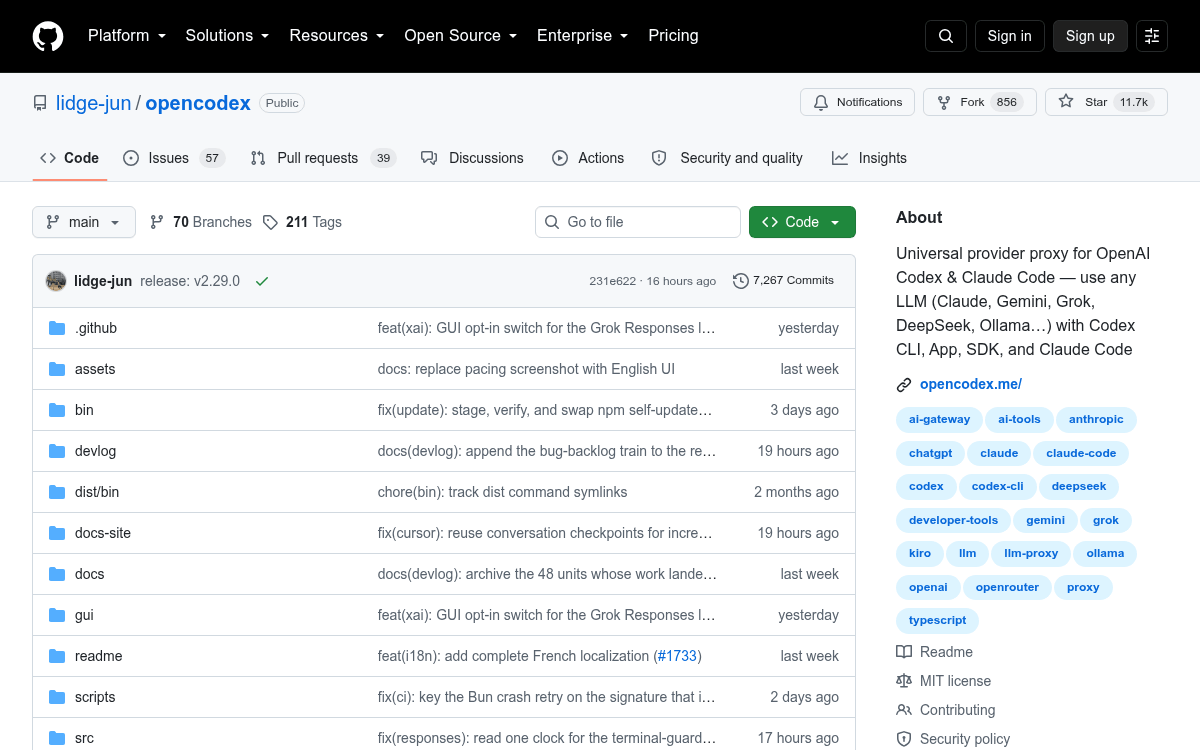
opencodex Hits 11K Stars Breaking Codex and Claude Code Model Lock-In
A local proxy that lets Codex CLI and Claude Code talk to Claude, Gemini, Grok, DeepSeek, Kimi, Ollama and 40+ other LLMs.
Takeaways
- Opencodex is an MIT-licensed local proxy that lets Codex and Claude Code run on any LLM
- Five adapters cover Anthropic, Gemini, Azure, OpenAI Responses, and any Chat Completions endpoint, 40+ providers
- OAuth login for Anthropic, xAI, and Kimi means no API keys needed for your existing subscriptions
- Non-OpenAI models get web search and image understanding via a gpt-5.4-mini sidecar
- Install with
npm install -g @bitkyc08/opencodex, runs on Bun on macOS, Linux, and Windows - Docs and dashboard live at lidge-jun.github.io/opencodex, project has 11k+ GitHub stars
OpenAI's Codex and Anthropic's Claude Code are two of the most polished coding agents around, but each is welded to its parent model. A new open-source project called opencodex tries to break that lock-in by sitting between the client and the provider, translating requests on the fly so you can point either tool at whichever model you actually want.
The repo has climbed past 11,000 stars and describes itself as a universal provider proxy. It runs locally and translates Codex's Responses API into whatever your provider speaks, with streaming, tool calls, reasoning tokens, and images all flowing in both directions.
One port, every wire format
The core trick is protocol translation. Five adapters cover Anthropic Messages, Google Gemini, Azure, OpenAI Responses passthrough, and every OpenAI-compatible Chat Completions endpoint, which adds up to 40+ providers out of the box. When Codex fires off a request to /v1/responses, opencodex reshapes it into the format the target backend expects and streams the reply back in the shape Codex is waiting for.
Auth works the same way. OAuth support for xAI, Anthropic, and Kimi lets you sign in with an existing account, tokens auto-refresh, and you can also forward your codex login, paste an API key, or use environment variable references. That is the piece that unlocks the use case which put the project on many developers' radar: wiring a Kimi or Claude subscription you already pay for into Codex without touching an API key.