
OpenCLI Hits 26K Stars Giving AI Agents Real Browser Sessions Without Screenshots
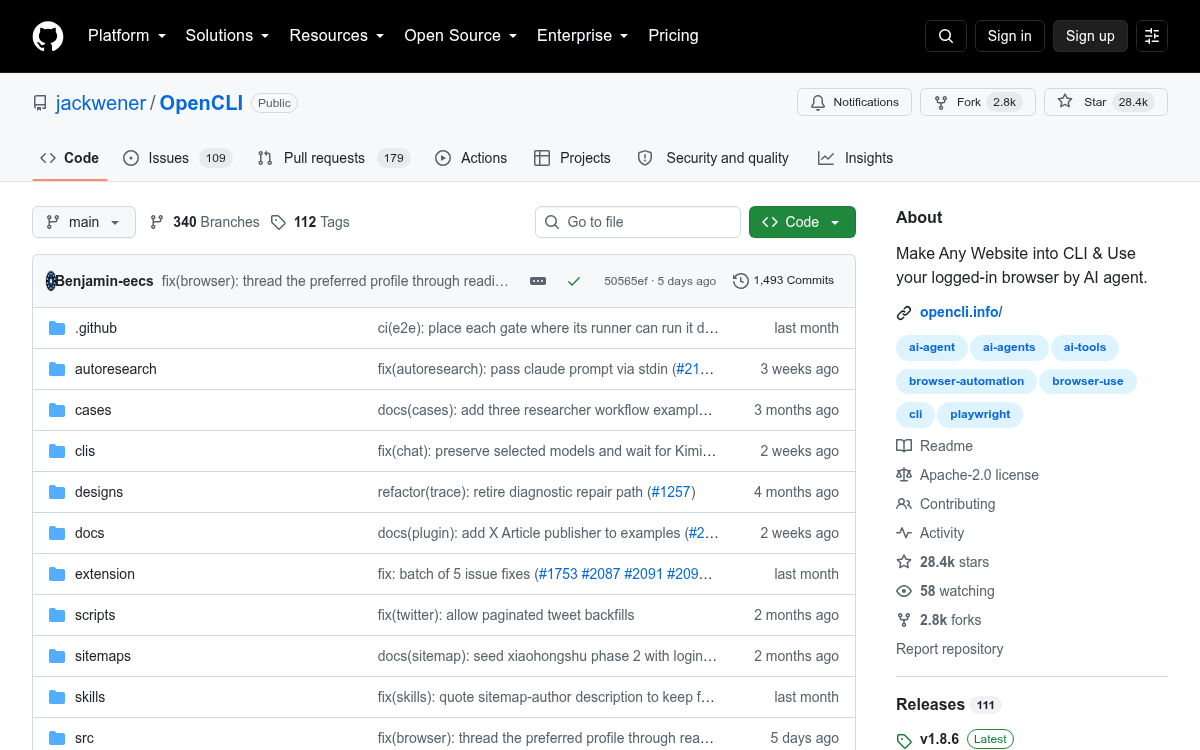
OpenCLI turns any website, Electron app, or local binary into a deterministic command that AI agents can drive through your logged-in Chrome session.
Takeaways
- OpenCLI wraps websites, Electron apps, and local binaries behind a single unified CLI for agents.
- Attaches to your logged-in Chrome via a Browser Bridge extension, reusing existing sessions and cookies.
- Ships built-in adapters for 100+ sites including Twitter, Reddit, LinkedIn, Amazon, Bilibili, and Xiaohongshu.
- Agents read structured DOM snapshots instead of screenshots, cutting token cost and improving reliability.
- Skills like
opencli-adapter-authorandopencli-autofixlet agents write and repair adapters themselves. - Apache 2.0 licensed, supports JSON/YAML/CSV output and Unix sysexits.h exit codes for scripting.
A new open source project called OpenCLI is betting that the future of agent tool use is plain command lines, not screenshots and pixel clicks. It wraps websites, browser tabs, Electron apps, and local binaries behind a single opencli command that both humans and AI agents can call, and it has quietly picked up over 26,000 stars on GitHub.
The core idea is deceptively simple. OpenCLI gives you one surface for three kinds of automation: built-in adapters for sites like Bilibili, Zhihu, Xiaohongshu, Reddit, HackerNews, and Twitter/X; a browser skill for Claude Code, Cursor, and similar tools that lets agents operate any website; and a guided workflow for writing new adapters end-to-end. It also works as a CLI hub for local tools such as gh, docker, longbridge, tg, discord, wx, and ntn (Notion), plus desktop app adapters for Electron apps like Cursor, Trae CN, Codex, Antigravity, ChatGPT, and Trae SOLO.
Reusing the browser you already logged into
What separates OpenCLI from Playwright-style automation is that it never spins up a fresh headless browser. It attaches to your real, logged-in Chrome through a lightweight Browser Bridge extension plus a small local daemon that auto-starts when needed. Cookies, sessions, 2FA state, and enterprise SSO are already handled, because you handled them yourself when you logged in this morning.
For an agent, that changes what is realistic. Instead of asking Claude to solve a login captcha on LinkedIn, you let the agent piggyback on the session you already have. The daemon exposes a local endpoint on