
OpenBMB's StaffDeck Treats AI Agents Like Real Employees With Job Titles
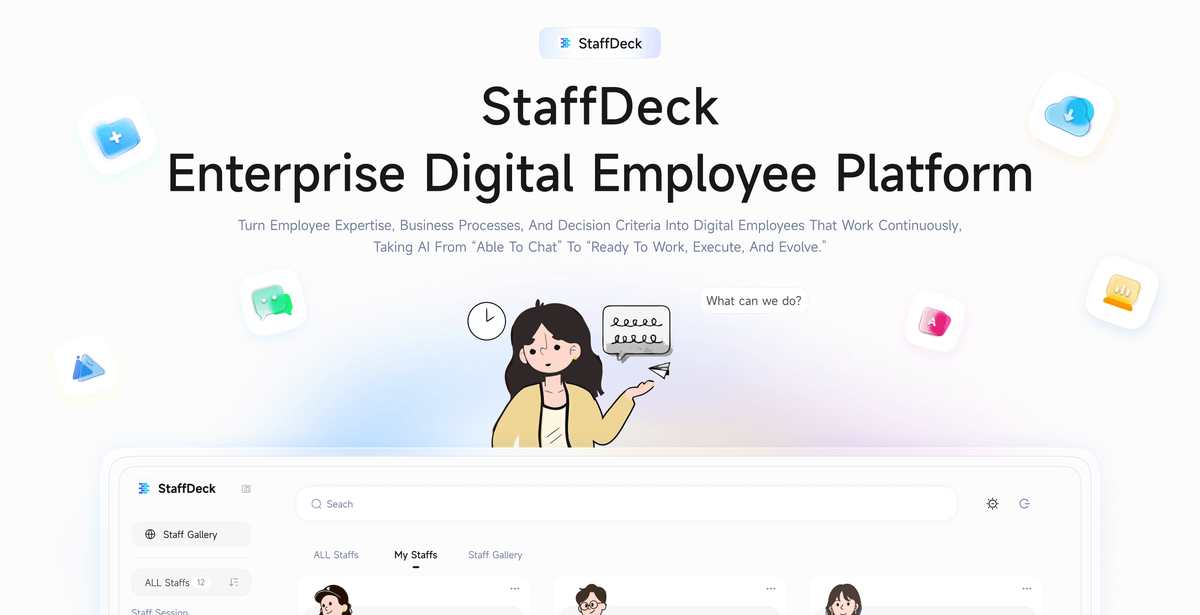
OpenBMB open-sources StaffDeck, a platform that turns business SOPs and knowledge into persistent, auditable AI agents with employee IDs and work records.
Takeaways
- Open-sourced: OpenBMB released StaffDeck, an enterprise platform for building AI agents modeled as formal employees with IDs, roles, and work records.
- Key innovation: State-machine-driven SOPs let agents switch between multiple active workflows mid-conversation while preserving full context, no code required to author new processes.
- Hierarchical RAG: Document-structure-aware retrieval indexes documents at chapter, page, and summary levels, with source citations and relevance scores for every answer.
- Closed feedback loop: Every API call and response is traced; negative feedback auto-classifies the failure and points admins to the exact SOP node to fix.
- Model-agnostic: Works with any OpenAI-compatible endpoint; desktop installers available for macOS, Windows, and Linux with no GPU required by the app itself.
- License and status: AGPL-3.0, currently at v0.1.1-beta.1; group chat between agents and fine-grained approval policies are still on the roadmap.
StaffDeck is an open-source platform from OpenBMB that reframes how enterprises deploy AI agents. Instead of a chatbot you prompt on demand, each AI agent gets a job title, an employee ID, a capability profile, and a work history. The idea is to treat AI the way you treat a new hire: onboard it with standard operating procedures, give it access to the right knowledge, and hold it accountable through logs and feedback.
The structural problem it targets
Most enterprise AI deployments stall at the demo stage because a general-purpose LLM has no memory of yesterday's decisions, no defined scope, and no mechanism to improve from mistakes. Every conversation starts from zero. StaffDeck assigns each agent a name, a position, an employee ID, capability boundaries, and work records, turning individual expertise and institutional processes into something the organization owns and can iterate on.
Three technical pillars
StaffDeck is built around three core mechanisms that together address the reliability gap in enterprise agents.
State-machine-driven SOPs. Pure free-form agents handle surprises but lose track of multi-step processes. Pure workflow engines are predictable but brittle. StaffDeck uses state machines to execute complex processes accurately, supporting real-time switching across multiple flows with context preservation, visual editing, version management, and branch evolution. Each SOP maps to a deterministic state machine, so an agent can switch between multiple active workflows mid-conversation while retaining everything collected in the previous flow. A request like "file my travel reimbursement and check my remaining budget" triggers two separate SOP flows sequentially, with context shared between them and no repeated data entry required.
Business users describe a process in plain language, and the system compiles it into a structured flowchart with information-collection nodes, conditional branches, tool calls, and human-escalation points. No code required to author a new SOP.