
OpenAlice Gives AI Coding Agents a Full Trading Desk to Run
OpenAlice turns coding agents like Claude Code into local trading desks — file-driven, approval-gated, and free to self-host across crypto, equities, and macro.
 Pro
Takeaways
- OpenAlice is a free, self-hosted AI trading agent workspace that gives coding agents like Claude Code a file-based trading environment — 5,900+ GitHub stars.
- The core innovation is Trading as Git (TaG): orders are staged, committed, and require human approval before hitting a broker — creating a full audit trail.
- Market data runs on a TypeScript-native OpenBB engine covering equities, crypto, forex, commodities, and macro — no external sidecar needed.
- Supports Claude Code, Codex, opencode, and Pi as agent backends; switches between Claude Code CLI and Vercel AI SDK at runtime without a restart.
- Broker execution covers CCXT exchanges (Bybit, Binance, OKX) and Alpaca for US equities — both paper and live trading — but the layer is still beta.
- Free under AGPL-3.0; get started with
git clone+pnpm dev; full docs at openalice.ai/docs.
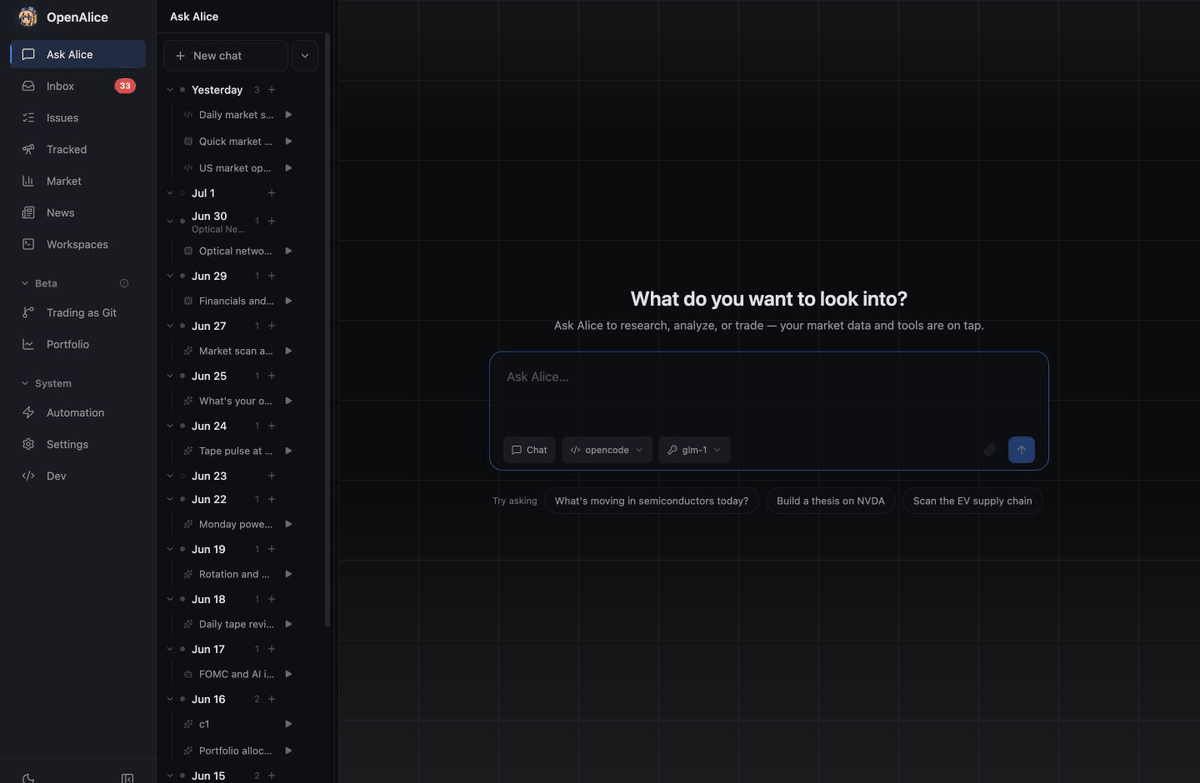
OpenAlice is an open-source, self-hosted trading agent workspace that crossed 5,900 GitHub stars and nearly 1,000 forks. The pitch is deceptively simple: instead of building a bespoke AI trading system from scratch, OpenAlice gives the coding agents you already use , Claude Code, Codex, opencode, or Pi , a trading-shaped environment to work inside. Research, tracking, scheduling, and order execution all happen through the same file-based primitives those agents already understand.
The system is file-driven: Markdown defines persona and tasks, JSON defines config, and JSONL stores conversations. Both humans and AI control Alice by reading and modifying files. There is no database to provision, no cloud dependency to manage. No database, no containers, just files.
The problem it actually solves
Coding agents became productive fast because software development already has a well-defined collaboration substrate: git, issues, markdown docs, terminals, and reproducible project folders. An agent can walk into that world and immediately know how to inspect, modify, review, and report work.
Trading has never had that shape. A trader might read news, browse charts, hold broker positions, and keep private notes, but the work is rarely organized as a system a human and multiple AI agents can share. OpenAlice maps trading work onto the tools coding agents already understand:
- Workspaces , each task gets its own git repo, terminal session, and native agent CLI
- Issue Board , trading work becomes self-describing markdown tasks, similar to Linear tickets, with optional schedule metadata for automation
- Tracked Entities , tickers, sectors, theses, people, and risks live in a durable Obsidian-style memory graph with
[[wikilinks]] - Inbox , finished work is delivered as durable reports instead of disappearing into chat history
- Market Tools , data, news, fundamentals, technical analysis, and account state exposed through CLIs and local tools
- Trading as Git (TaG) , account actions are staged, committed, reviewed, and pushed through an approval gate

Trading as Git: the key safety primitive
The most interesting architectural idea in OpenAlice is Trading as Git (TaG). TaG is the version control system for portfolios that gives Alice memory, discipline, and the ability to execute complex multi-round strategies. Concretely, an agent cannot fire orders directly at a broker. Instead, it stages an operation, commits it with a message, and waits at a push wall.
Under the default manual-approval policy, you turn down or approve a pending commit from the Web UI instead of letting it go through automatically. Either way, operations are recorded as user-rejected in the history, so Alice sees what was turned down and why, which informs future decisions. This means the agent builds up a git-style audit trail of every trade intent, not just the ones that executed.
It also creates a clean architecture boundary: Alice can run where research and agent work are convenient, while the Unified Trading Account (UTA) can run on trusted hardware that holds exchange keys.

What's under the hood
Market data is powered by a TypeScript-native OpenBB engine with no external sidecar required, covering equity, crypto, commodity, currency, and macro data with unified symbol search and a technical indicator calculator. Equity research covers company profiles, financial statements, ratios, analyst estimates, earnings calendars, insider trading, and market movers. News is handled through background RSS collection with archive search tools.
On the AI provider side, dual AI providers , Claude Code CLI or Vercel AI SDK , switch at runtime via ai-provider.json. The Vercel AI SDK path supports any compatible provider: Anthropic, OpenAI, Google, and others. The Claude Code path spawns it as a subprocess, giving the agent full tool access without needing a separate API key.
Broker support through the Unified Trading Account (UTA) layer includes:
- Crypto , powered by CCXT, defaulting to Bybit demo trading, with support for any CCXT-compatible exchange (Binance, OKX, etc.)
- US Equities , powered by Alpaca, supporting both paper and live trading, toggled via
data/config/securities.json - Additional brokers , IBKR and Longbridge are listed as supported in the UTA layer
How to get started
OpenAlice is free and open-source under the AGPL-3.0 license. The fastest path to running it:
git clone https://github.com/TraderAlice/OpenAlice.git
cd OpenAlice
pnpm install
pnpm dev
That spins up the UI at http://localhost:5173. You also need at least one agent CLI installed and authenticated , claude, codex, opencode, or pi. macOS users can grab a signed desktop build. Docker Compose is available for server or always-on deployments. Full docs live at openalice.ai/docs.
Where it shines, where it doesn't
OpenAlice is the strongest option for solo traders running AI-driven crypto and equity desks locally when file-based control and hot-reload matter over raw speed. Its CCXT/OpenBB stack delivers production-grade data and execution at zero cost, though Node.js limits high-frequency trading use cases.
The research and tracking layer is production-ready today. The broker execution layer is explicitly beta , the team recommends starting with simulator, paper, demo, or testnet accounts before touching live funds. OpenAlice is experimental software in active development, with many features and interfaces incomplete and subject to breaking changes. Do not use it for live trading with real funds unless you fully understand and accept the risks involved.
Why this matters beyond the headline
The deeper shift OpenAlice represents is not just another trading bot. It is a bet that the right abstraction for AI trading agents is not a purpose-built trading framework , it is the same file-and-git substrate that made coding agents useful. The same read/write primitives that power vibe coding transfer directly to vibe trading.
The target audience is solo indie traders managing personal portfolios who need automated research, execution, and risk checks without cloud dependencies or subscriptions, and quant developers prototyping strategies locally with CCXT and OpenBB integrations requiring hot-reload for tools and providers. If that describes you, OpenAlice is worth a serious look , just keep the approval gate on.

