
OpenAI's MLE-bench Leaderboard Jumps from 17% to 64% in Two Years
OpenAI's benchmark of 75 Kaggle competitions has gone from bronze medals in 16.9% of tasks to 64% in under two years.
Takeaways
- MLE-bench evaluates AI agents on 75 real Kaggle competitions with human leaderboard baselines.
- Top agents now earn medals in 64% of tasks, up from 16.9% at launch.
- Famou-Agent 2.0 on Gemini-3-Pro-Preview leads the main leaderboard at 64.44% Any Medal.
- Lite split of 22 competitions (158GB) lets teams evaluate without the full 3.3TB dataset.
- Submissions are paused while OpenAI builds a fairer evaluation process ahead of v2.
- Known data leakage issues in several competitions will be fixed in the v2 release with version tagging.
Two years ago, the best AI agent could earn a Kaggle bronze medal in just under 17% of machine learning engineering tasks. Today, the top entry on OpenAI's MLE-bench leaderboard is clearing 64%. A benchmark that once looked like an aspirational stretch goal is starting to saturate, and the pace of that shift is worth attention if you build ML tooling, evaluate agents, or care about where autonomous coding is headed.
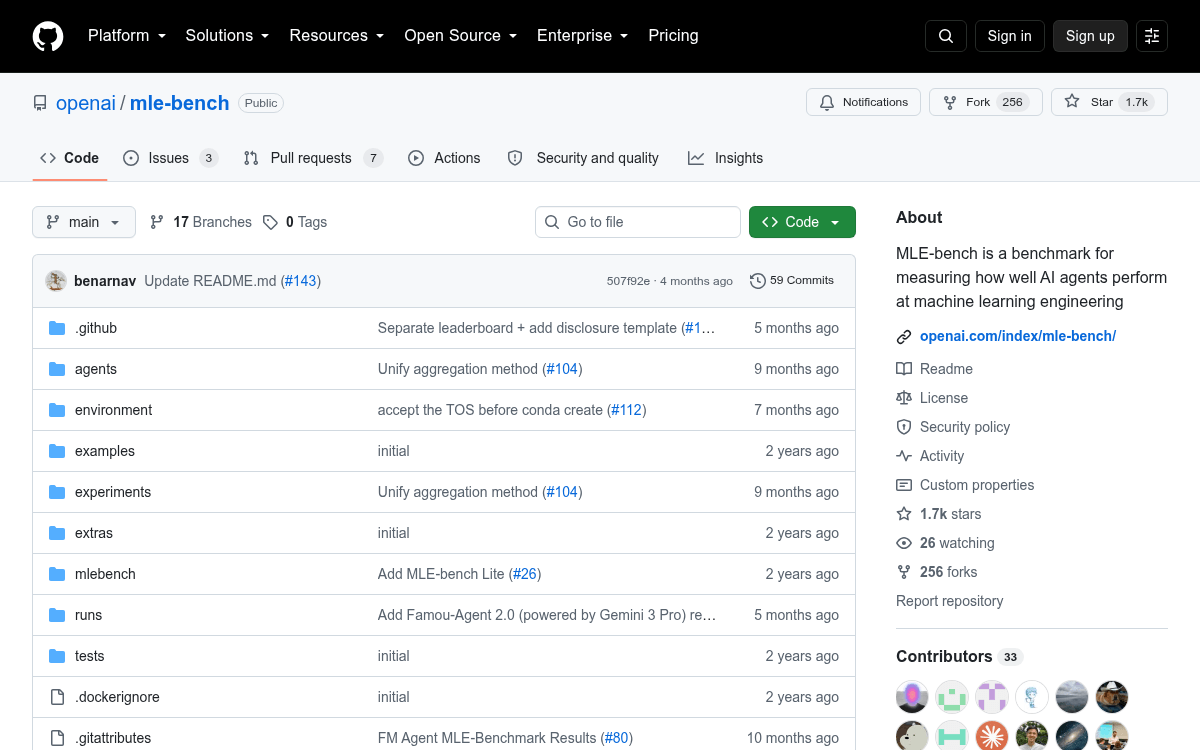
MLE-bench measures how well AI agents perform at machine learning engineering. It curates 75 ML engineering competitions from Kaggle, creating a diverse set of challenging tasks that exercise real-world skills like training models, preparing datasets, and running experiments. Human baselines come straight from Kaggle's public leaderboards, so agents are compared against actual competitive data scientists rather than synthetic scoring rubrics.
From bronze medals to gold rushes
When the paper first landed, the strongest configuration was OpenAI's o1-preview with AIDE scaffolding, which reached at least bronze level in 16.9% of competitions. The current leaderboard tells a very different story. Baidu's Famou-Agent 2.0 running on Gemini-3-Pro-Preview now hits 64.44% Any Medal across all difficulty splits, followed closely by AIBuildAI on Claude-Opus-4.6 at 63.11% and Google Cloud AI Research's MARS+ system at 62.67%.
The scaling is not uniform. On the Low complexity split (the "Lite" set), leaders are pushing into the 80% range, while the High complexity split still tops out around 46%. One experimental submission using an ensemble of Claude-Opus-4.5, Claude-Sonnet-4.5, GPT-5.2-Codex, and Gemini-3-Pro-Preview reached 77.78% overall, though that entry uses test-set feedback and sits in a separate leaderboard for non-comparable runs.