
OpenAI's Dimillian Releases 16 Free Codex Skills for Apple Developers
Thomas Ricouard, a developer experience engineer at OpenAI, open-sourced 16 battle-tested Codex skills covering Apple platform development, multi-agent code review, and SwiftUI workflows.
 Pro
Takeaways
- Thomas Ricouard (Dimillian), a Developer Experience engineer at OpenAI, open-sourced 16 personal Codex skills under the MIT license.
- The collection is Apple-platform-heavy, covering SwiftUI performance, Swift 6.2+ concurrency, iOS debugging via XcodeBuildMCP, and iOS 26 Liquid Glass APIs.
- Two standout "swarm" skills run four parallel read-only agents for diff review and bug investigation, returning ranked, prioritized results.
- Installation is a single copy of skill folders into
~/.codex/skills/; each skill is self-contained with aSKILL.mdtrigger file. - The repo has crossed 3,900 GitHub stars, reflecting strong demand for ready-made Codex workflow tooling.
- General-purpose skills like batch refactor orchestration, App Store changelog generation, and React performance auditing work on any stack.
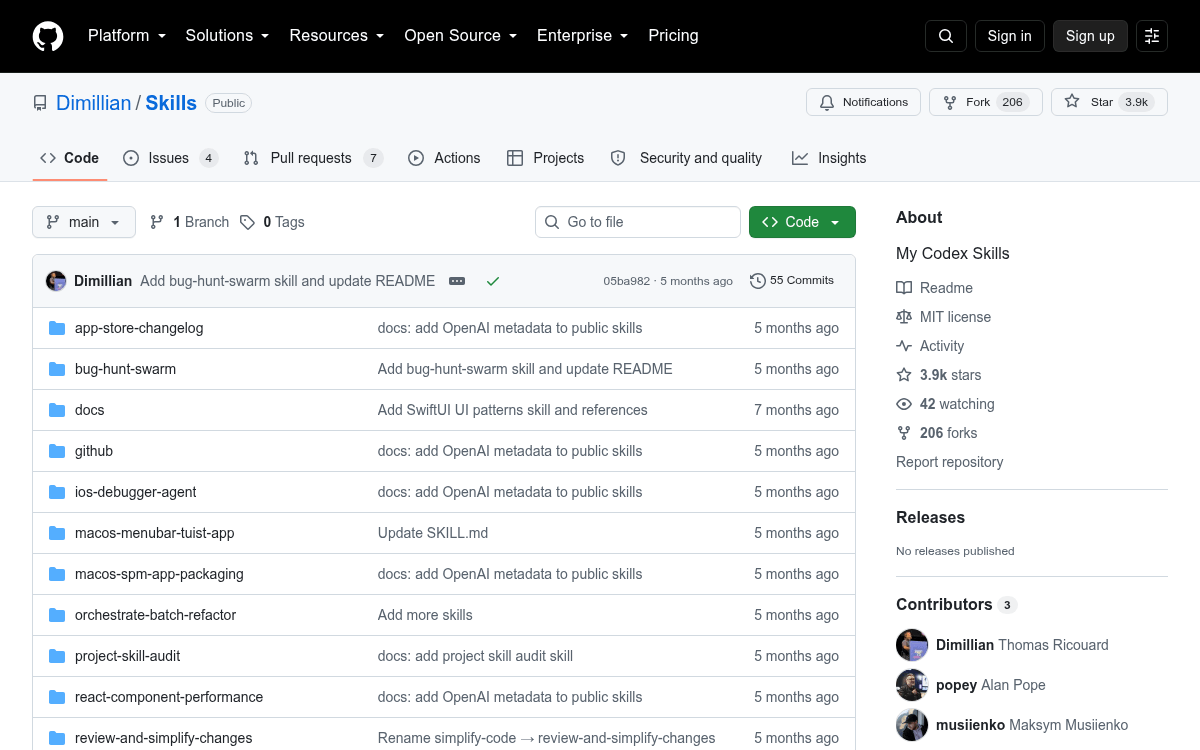
Thomas Ricouard , known online as Dimillian, the engineer behind the open-source SwiftUI Mastodon client IceCubesApp and a Developer Experience engineer at OpenAI , has published his personal collection of Codex skills as a free, MIT-licensed repository. The Skills repo has already crossed 3,900 stars, a signal that Apple platform developers have been hungry for exactly this kind of ready-made agentic tooling.
What even is a Codex skill?
A Codex skill is a self-contained folder that teaches OpenAI's Codex agent to execute a specific workflow reliably, every time.
Skills are folders of instructions , a SKILL.md file plus optional scripts , that teach Codex to do a specific task the same way every time.
Instead of re-explaining your deploy process, your test conventions, or your research workflow in every session, you package the procedure once and Codex pulls it in whenever the task matches.
Skills use progressive disclosure to manage context efficiently: Codex starts with each skill's name, description, and file path , and only loads the full instructions when the skill is actually triggered. The system caps the initial skills list at approximately 8,000 characters to prevent context overflow, and if many skills are installed, Codex shortens descriptions automatically.
What's in the collection
Ricouard ships 16 skills, split roughly between Apple-platform-specific tasks and general engineering workflows. The Apple-focused ones are the most distinctive part of the collection:
- iOS Debugger Agent , uses XcodeBuildMCP to build, launch, and debug an iOS app on a simulator, including UI inspection, screenshots, and log capture.
- SwiftUI Liquid Glass , implements or refactors SwiftUI code to use the iOS 26+ Liquid Glass APIs with correct modifier ordering and fallbacks.
- Swift Concurrency Expert , reviews and fixes Swift 6.2+ concurrency issues like actor isolation problems,
Sendableviolations, and data-race diagnostics. - SwiftUI Performance Audit , audits runtime performance focusing on invalidation storms, identity churn, and layout thrash.
- SwiftUI View Refactor , refactors view files toward smaller subviews, MV-style data flow, and correct Observation usage.
- macOS SwiftPM App Packaging , scaffolds, builds, packages, signs, and optionally notarizes SwiftPM-based macOS apps without needing an Xcode project.
- App Store Changelog , generates user-facing release notes from git history by filtering for user-visible changes and rewriting them into concise "What's New" bullets.
The general-purpose skills are equally useful for any codebase:
- Bug Hunt Swarm , runs a four-agent read-only investigation covering reproduction, code-path tracing, regression hunting, and root-cause ranking.
- Review Swarm , a four-agent diff review targeting behavioral regressions, security risks, performance issues, and test coverage gaps.
- Orchestrate Batch Refactor , plans and executes large refactors with dependency-aware parallel analysis.
- Project Skill Audit , analyzes past Codex sessions and existing conventions to recommend the highest-value new skills to add.
- React Component Performance , diagnoses slow React components by finding re-render churn, unstable props, and list bottlenecks.
The swarm pattern is the real highlight
The most architecturally interesting skills are the two "swarm" entries. Rather than a single agent reviewing a diff or chasing a bug, these skills orchestrate multiple parallel read-only agents, each focused on a different failure mode. The Bug Hunt Swarm, for example, runs four agents simultaneously , one for reproduction, one for code-path tracing, one for regression detection, and one for finding the fastest proof step , then returns a ranked root-cause path. This is a practical implementation of multi-agent parallelism (running several specialized sub-agents in parallel rather than one generalist in sequence) that most people haven't tried building themselves.
How to install
Skills live in $CODEX_HOME/skills (default ~/.codex/skills). Each subfolder needs a SKILL.md with name and description frontmatter.
To use Ricouard's collection, clone the repo and drop the skill folders into that directory:
git clone https://github.com/Dimillian/Skills
cp -r Skills/* ~/.codex/skills/
Each skill is self-contained, so you can cherry-pick only the ones relevant to your stack. With Skills, you can teach Codex your team's standards, workflows, and ways of working, and Codex applies them consistently across tasks so it can contribute more effectively with less supervision.
Who this is for
The collection is narrowly useful if you work on Apple platforms , the SwiftUI and Swift Concurrency skills alone make it worth cloning. But the swarm-based review and bug-hunt skills, and the batch refactor orchestrator, are stack-agnostic and immediately applicable to any project running Codex. The React performance skill is a bonus for anyone doing cross-platform work.
The repo is free, MIT-licensed, and open to contributions. Given that Ricouard built it from his own day-to-day workflows at OpenAI, it's as close to a "how the team actually uses Codex" reference as the community has right now. The GitHub Pages site also has a browsable version of the skill catalog if you want to preview before cloning.
