
OpenAI's Cookbook Hits 74k Stars as the Go-To Shortcut for Real Production Code
OpenAI's official cookbook repo has crossed 74K stars, packing runnable recipes for Codex, the Agents SDK, evals, and Realtime audio.
 Pro
Takeaways
- OpenAI's openai-cookbook repo crosses 74K stars, 12.5K forks, MIT-licensed.
- Covers Responses API, Agents SDK, Realtime, Codex, evals, fine-tuning, and gpt-oss.
- Recent recipes include per-run spending controllers, Whisper-to-GPT-Transcribe migration, and audio diarization.
- Content is 93% Jupyter Notebooks with runnable end-to-end examples and per-topic requirements files.
- Hosted at cookbook.openai.com with searchable topic filters and prompting guides.
- Contributions gated by CI notebook validation and a docs-editor skill review pass.
If you've ever wanted a shortcut past the docs and into working code, openai/openai-cookbook is where the OpenAI team puts its most practical material. The repository holds example code and guides for accomplishing common tasks with the OpenAI API, and it has quietly grown into one of the largest open collections of production-oriented LLM patterns on GitHub.
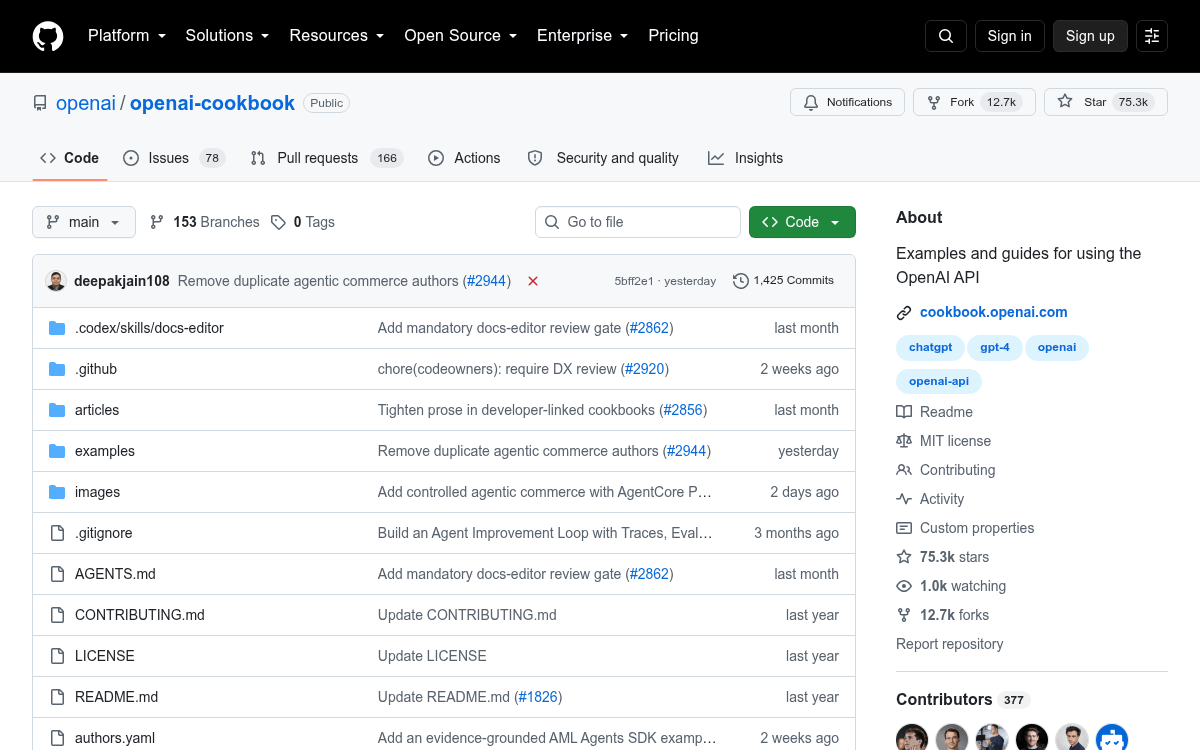
The numbers say a lot about how heavily it gets used as a reference. The repo now sits at roughly 74k stars with 12.5k forks and nearly a thousand watchers, and the content is almost entirely Jupyter Notebook (93.1%) with the rest in MDX for the hosted site at cookbook.openai.com. It is MIT-licensed, so anything you copy out can go straight into commercial code.
What's actually inside
The repo is split into three top-level folders: examples/ for runnable notebooks, articles/ for narrative guides, and images/ for shared diagrams. Notebooks and Python scripts live under examples/<topic>/, grouped into topic subfolders like examples/agents_sdk/, while narrative guides and long-form docs live in articles/. A registry.yaml file controls what shows up on the hosted cookbook site.
Recipes span the full surface area of the platform. A quick scan of the current index shows guides for the Responses API, the Agents SDK, Realtime audio, Codex, evals, fine-tuning, image and video generation, structured outputs, RAG, MCP servers, and the open-weight gpt-oss family. Recent additions worth flagging: