
OpenAI Open-Sources Symphony After a Fivefold Rise in Code Contributions
OpenAI open-sources Symphony, a spec for running unlimited Codex agents from your issue tracker — no babysitting required
Takeaways
- Symphony open-sourced: OpenAI released Symphony, a spec for running unlimited autonomous Codex agents from a Linear issue tracker.
- 500% PR increase: Internal OpenAI teams saw a fivefold rise in merged pull requests within the first three weeks of using Symphony.
- Spec-first design: The core artifact is a SPEC.md file — feed it to any coding agent to get a custom implementation in any language.
- Proof of work: Agents must produce green CI, specialist reviews, and video walkthroughs before a ticket moves to Human Review — no mid-flight steering.
- Elixir reference implementation: Built on Erlang/BEAM for fault-tolerant concurrency; supports up to 10 concurrent agents by default with exponential retry backoff.
- No product commitment: OpenAI explicitly states Symphony is an engineering preview with no roadmap, support channel, or SLA — teams own their own deployments.
There is a hard ceiling on how many AI coding agents a single engineer can manage at once. OpenAI engineers hit it themselves: each person would open a few Codex sessions, assign tasks, review output, steer the agent, and repeat. Most people could comfortably manage three to five sessions before context switching became painful. Beyond that, productivity dropped. The agents were fast. The humans were the bottleneck.
So OpenAI built a fix, used it internally, saw a fivefold rise in merged code contributions within weeks, and then open-sourced it. The project is called Symphony, available now under an Apache 2.0 license.
Your issue tracker as a control plane
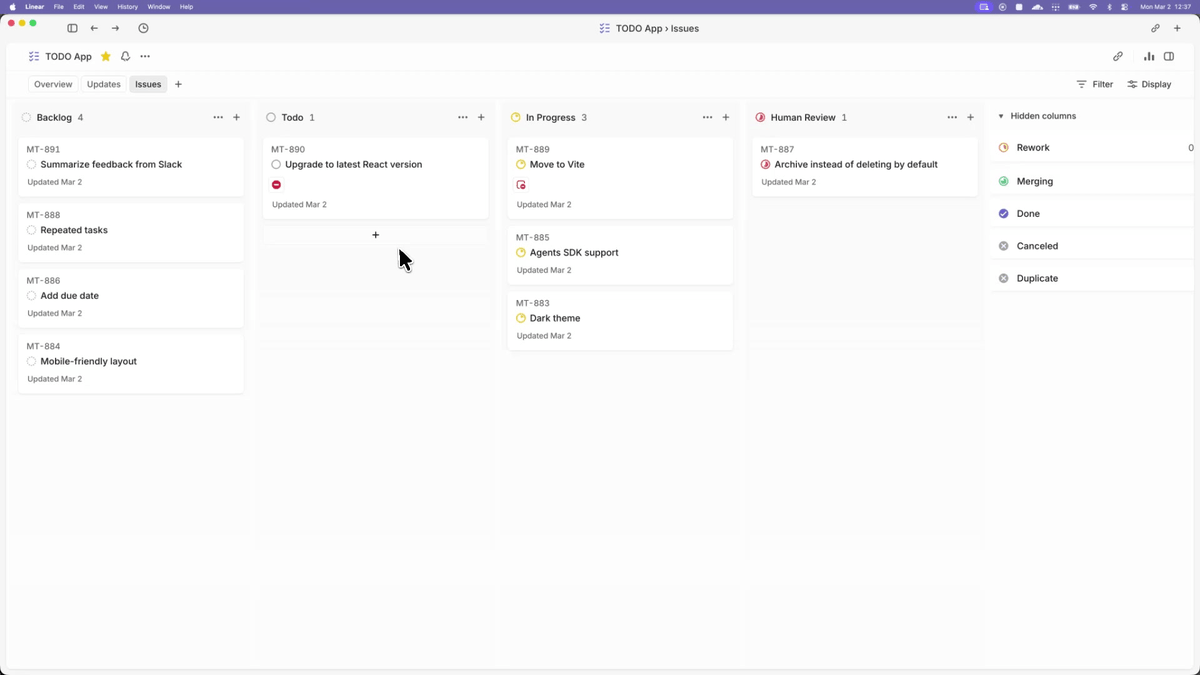
Symphony is an open-source specification, primarily a SPEC.md file, that describes how to turn a project management board into a continuous dispatch system for coding agents. The core idea: for every open task in your issue tracker, guarantee that a Codex agent is running in its own isolated workspace. Symphony connects to task boards such as Linear, assigns each open ticket to an autonomous agent, and keeps those agents running continuously, restarting if interrupted and advancing tasks until completion.
At a practical level, Symphony changes how work moves through a software team. Instead of engineers prompting an AI step by step, tasks are queued, picked up by agents, and executed independently, with humans reviewing the output at the end. The shift is from supervising sessions to managing work.
Proof of work, not prompting
The mechanism that makes this safe to trust is what the team calls a "proof of work" packet. Before an agent moves a ticket to Human Review, it must produce:
- Green CI: all tests pass
- Specialist agent reviews covering security, safety, and reliability