
Open-Source Serena Gives AI Coding Agents IDE-Level Intelligence Across 40 Languages
Serena gives AI coding agents IDE-level semantic code understanding via LSP and MCP, slashing token waste and refactoring errors on large codebases
Takeaways
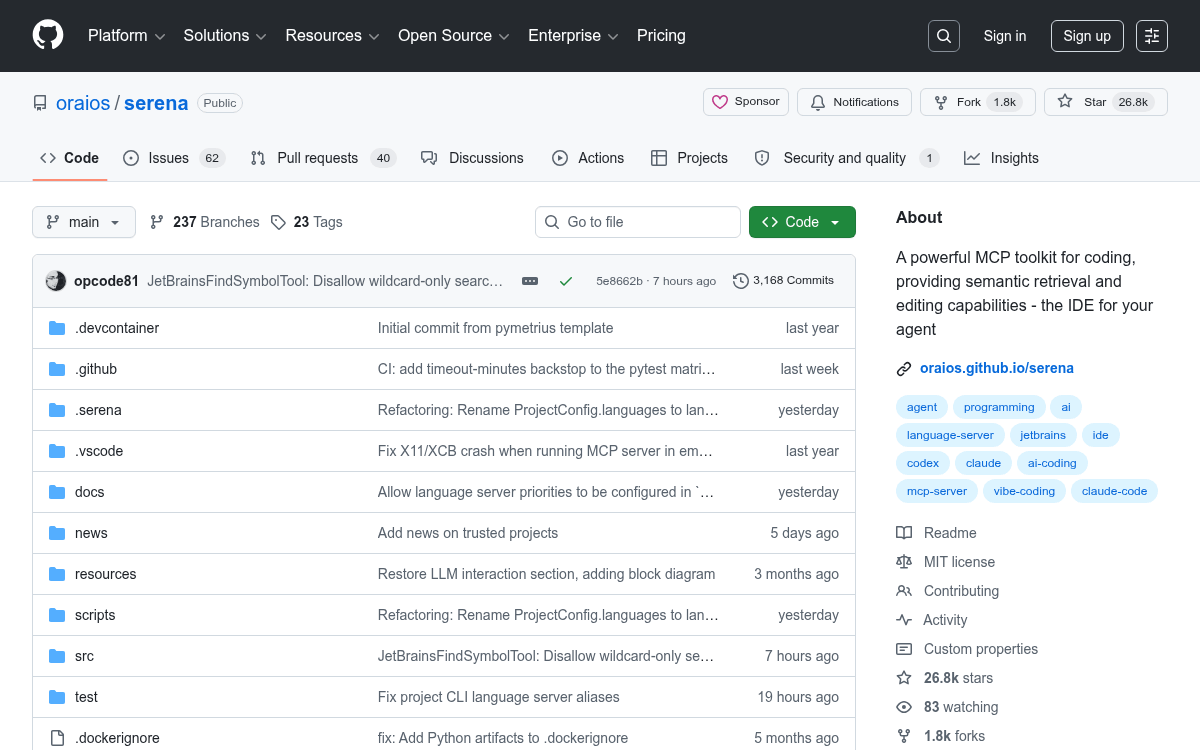
- What it is: Serena is a free, MIT-licensed MCP server that gives AI coding agents IDE-level semantic code understanding via LSP.
- Key capability: Symbol-level navigation and editing (find references, rename, refactor) across 40+ languages without reading full files.
- Benchmark result: On a 36K-line Java codebase, Serena completed a full refactor with all 1,017 tests passing; vanilla Claude and Claude Code's built-in LSP both failed.
- Two backends: Free LSP backend for 40+ languages, or a paid JetBrains plugin for deeper refactoring and interactive debugging.
- Works everywhere: Compatible with Claude Code, Codex, Cursor, Gemini-CLI, VS Code Copilot, and any MCP-compatible client.
- Limitation: Overhead makes it slower and more expensive than vanilla Claude for simple read-only queries -- best reserved for complex edits and refactors.
Serena is an open-source MCP toolkit that gives AI coding agents the same code intelligence a developer gets from an IDE. Rather than letting Claude Code or Codex read whole files line by line, Serena plugs in symbol-level navigation, cross-file refactoring, and semantic search over the Model Context Protocol. The practical payoff: fewer hallucinated method names, less wasted context, and agents that finish complex refactors instead of stalling out.
Why agents hit a wall without it
Most AI coding agents navigate code the way a developer would without an IDE: reading whole files, grepping for strings, counting line numbers. At scale, that burns context fast. Reddit threads in r/ClaudeAI describe the same pattern repeatedly: agents waste their entire context window reading files when they only need one function.
Serena fixes this by routing agent requests through a Language Server Protocol (LSP) backend, the same protocol that powers autocomplete and go-to-definition in VS Code and JetBrains. LSP gives the agent a structured, semantic view of the codebase: what symbols exist, where they're referenced, what their types are, and how they relate. No full-file reads required.
How it works under the hood
Serena wraps LSP capabilities as MCP tools that any compatible client can call. The agent calls tools like find_symbol, find_referencing_symbols, or replace_symbol_body and gets back structured, precise results without touching LSP internals directly.
Two backends are available:
- Language Server backend (free, default): Uses open-source LSP servers. Covers over 40 languages including Python, TypeScript, Go, Rust, Java, C/C++, Kotlin, and Swift.