
Open Source Plugin Brings Claude Code and Gemini CLI Into Obsidian
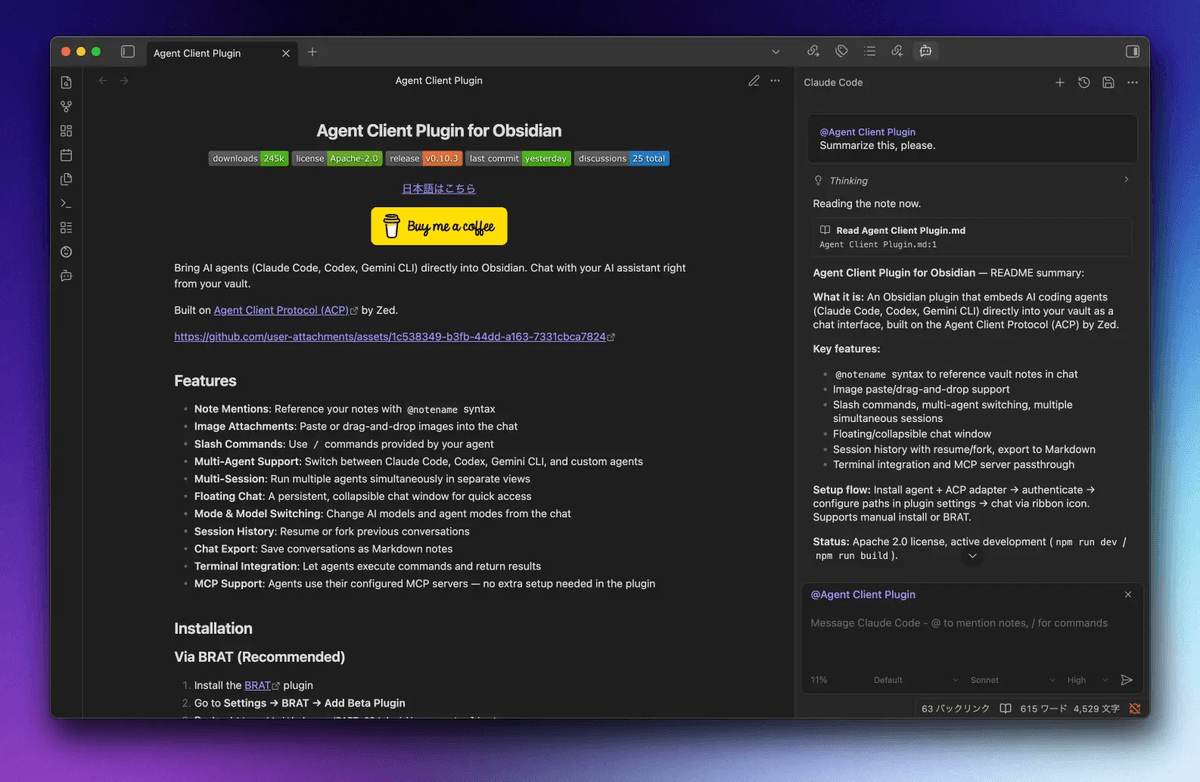
An Obsidian plugin wires Claude Code, Codex, and Gemini CLI straight into your vault through Zed's open Agent Client Protocol.
Takeaways
- New Obsidian plugin obsidian-agent-client embeds Claude Code, Codex, and Gemini CLI in your vault
- Built on Zed's open Agent Client Protocol, a JSON-RPC 2.0 standard for editor-agent communication
- Supports @note mentions, image drops, slash commands, terminal execution, and MCP passthrough
- Multi-session, multi-agent panels plus a floating chat window and Markdown export
- Requires installing the agent CLI and its ACP adapter separately, then pointing settings at the binaries
- Apache 2.0 licensed, available in the Obsidian Community Plugins directory or via BRAT for pre-releases
Coding agents have mostly lived inside code editors, leaving knowledge workers who spend their day in Obsidian to copy and paste between windows. A new open source plugin closes that gap by pulling Claude Code, Codex, and Gemini CLI directly into the Obsidian sidebar, using the same protocol Zed uses to talk to agents.
obsidian-agent-client is distributed through the Obsidian Community Plugins directory under Apache 2.0. It builds on the Agent Client Protocol (ACP), an open standard created by Zed Industries and released in August 2025, which uses JSON-RPC 2.0 over stdin/stdout as a universal interface between agents and editors. In practice, the same agent binary that powers Zed's AI panel can now drive a chat panel inside your notes vault.
ACP, or LSP for agents
ACP is often described as LSP for coding agents. Before it existed, every agent-editor combination required a custom integration. Claude Code worked in VS Code. Gemini worked in Gemini's own interface. Goose required a bespoke Neovim plugin. By speaking ACP, an editor gets the whole catalog of agents for free, and the Obsidian plugin is one of the first non-IDE clients to take advantage of that.