
Open-Source Executor Cuts 1,640 AI Tools Down to One With 3.1k Stars
Executor is an open source MCP gateway that funnels every OpenAPI, GraphQL, and MCP tool through one endpoint, cutting agent context bloat by 99 percent.
Takeaways
- Executor is an open source MCP gateway unifying OpenAPI, GraphQL, and MCP tools behind one endpoint
- Cuts prompt size from ~278,800 tokens for 1,640 tools down to ~1,044 tokens for one tool
- Uses code-mode MCP: agent writes TypeScript that searches and calls tools on demand
- Credentials injected host-side into outbound requests, never enter the sandbox or model
- Ships as Cloud, CLI, desktop app, Docker self-host, or Cloudflare Worker
- MIT licensed with free tier, $150/mo Team plan, and metered $0.20 per 1,000 executions
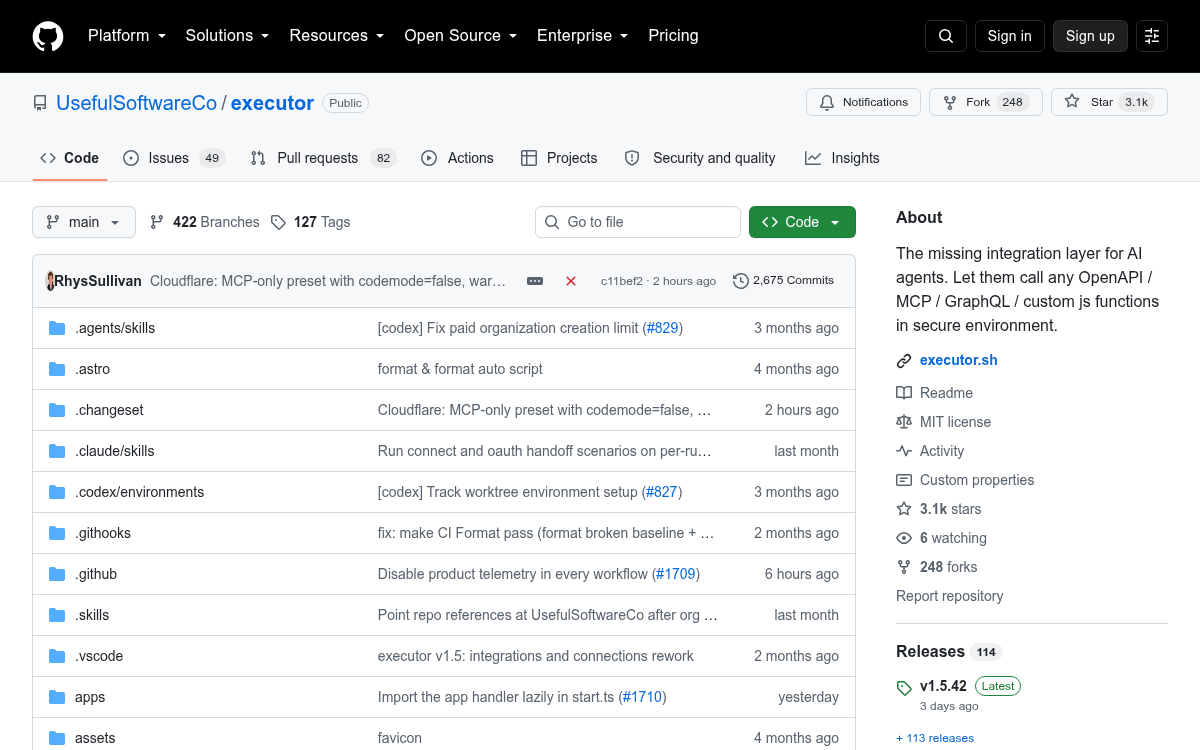
Wiring integrations into AI agents has become a copy-paste tax. Every client from Claude Code to Cursor to Codex needs its own API keys, its own MCP server configs, and its own idea of what tools are safe to call. Executor is an open source project trying to be the layer that sits between all of them, and it just crossed 3.1k GitHub stars.
Executor bills itself as an integration platform and MCP gateway for AI agents. Configure every integration once (MCP servers, OpenAPI specs, GraphQL APIs) with authentication and per-tool policies, then use that one catalog from any MCP-compatible agent. Any client that speaks MCP connects to the same endpoint and gets the same tools with the same guardrails.
Killing the context window tax
The pitch is easiest to see in raw token counts. Connect everything you use and Executor still shows the model a single tool. It searches your catalog and loads a tool's schema only when the code actually calls it, so the prompt never balloons.
The numbers the team publishes: without Executor, 1,640 tools weigh in at roughly 278,800 tokens. With Executor, one tool costs about 1,044 tokens. Executor exposes a code-mode MCP where the agent writes short TypeScript that searches, describes, and calls tools on demand, instead of stuffing every schema into the system prompt.