
Open-Source Codeg Unifies Claude, Codex, and Gemini Into One Desktop
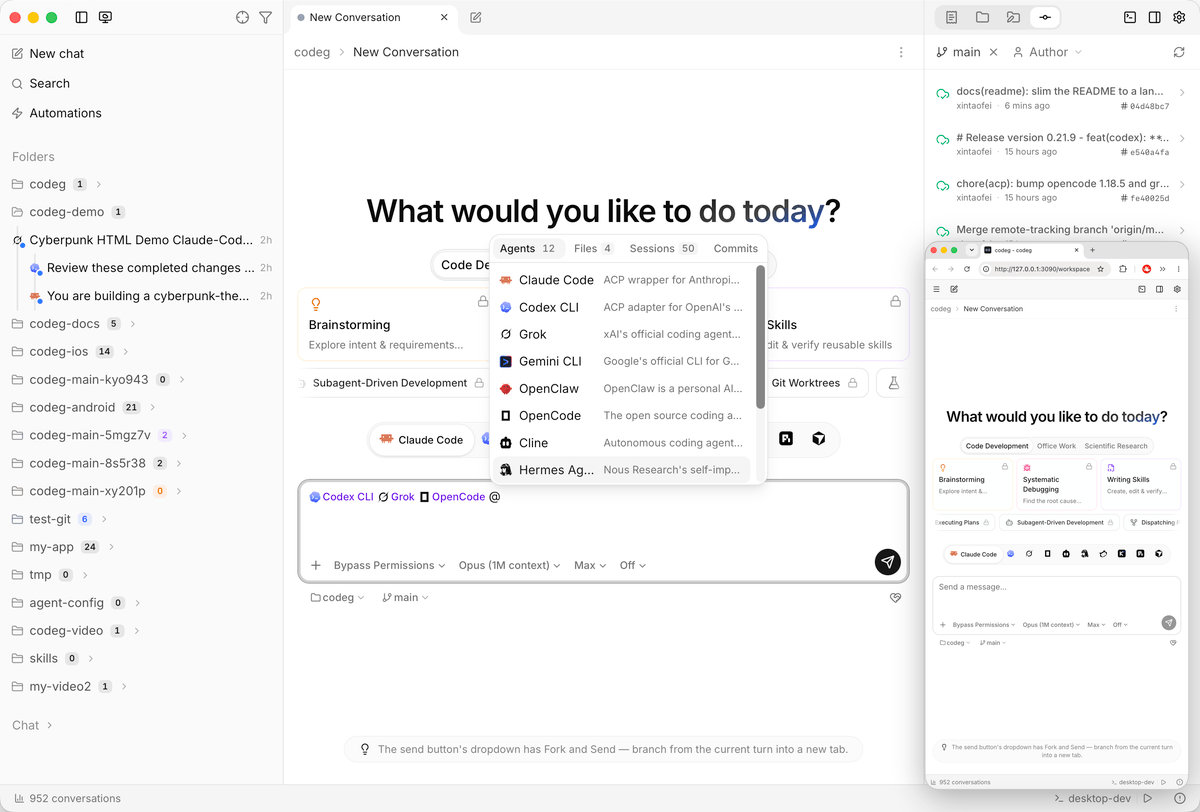
Codeg pulls Claude Code, Codex, Gemini CLI, and half a dozen other coding agents into one workspace with delegation and shared history.
Takeaways
- Codeg aggregates sessions from Claude Code, Codex, OpenCode, Gemini CLI, Cline, and others into one workspace: repo
- Multi-agent delegation via ACP lets one agent call another mid-task through a
codeg-mcpcompanion binary - Ships as Tauri desktop app, standalone
codeg-server, or Docker image with token auth and volume mounts - Reads agent state directly from disk paths like
~/.claude/projectsand~/.codex/sessions - Bundles officecli for editing .docx/.xlsx/.pptx with live preview, plus automations, chat channels, and project scaffolding
- Apache-2.0 licensed, ~1.8k stars, TypeScript plus Rust, includes in-place server updates with auto-rollback
If you have been jumping between Claude Code in one terminal, Codex CLI in another, and a Gemini CLI window on the side, an open-source project called Codeg wants to consolidate the mess. It is a Tauri desktop app plus optional self-hosted server that aggregates conversation history from every major coding agent into a single workspace, then lets those agents delegate tasks to one another during a session.
The project pulls Claude Code, Codex CLI, OpenCode, Gemini CLI, OpenClaw, Cline, Hermes Agent, CodeBuddy, and Kimi Code under one roof, supports conversation aggregation and multi-agent collaboration, and ships as a desktop install or a server/Docker deployment. It is Apache-2.0 licensed and free to run yourself. The repo currently sits around 1.8k stars with a Rust and TypeScript codebase split roughly 50/50.
One inbox for every agent CLI
The core trick: each supported agent already writes its session state to a predictable place on disk. Codeg reads those directories directly instead of proxying the CLIs, so you get the real transcripts without any middleware.

Here is what it scans by default:
~/.claude/projectsfor Claude Code~/.codex/sessionsfor Codex CLI