
Open-Source Bindu Turns Any AI Agent Into a Paid Microservice
Bindu wraps any AI agent in one function call, giving it cryptographic identity, A2A protocol compliance, and built-in crypto payments out of the box.
Takeaways
- One-function wrapper:
bindufy()turns any agent handler into a production microservice with identity, auth, and payments in seconds. - Three security layers by default: mTLS transport, OAuth2 via Ory Hydra, and Ed25519 DID signatures all fire before your handler sees a request.
- A2A protocol compliant: Agents speak Google's Agent-to-Agent standard, now governed by the Linux Foundation with 150+ organizational supporters.
- Built-in crypto payments: x402 payment rails let agents demand USDC on 5 pre-configured EVM chains before running any work.
- Polyglot SDKs: Python, TypeScript, and Kotlin all share the same gRPC core — works with LangChain, CrewAI, Agno, AG2, and more.
- Open source, Apache 2.0: Available now on GitHub with 6,800+ stars and full documentation.
Bindu is an open-source infrastructure layer built around a simple but powerful premise: you already built the agent, now make it a real service. One function call wraps your handler, and what comes out the other side has its own cryptographic identity, speaks the A2A inter-agent protocol, handles OAuth2 auth, and can demand payment in USDC before running a single token. The repo has crossed 6,800 stars and is actively shipping, with 19 releases and over 1,500 commits.
The plumbing nobody wants to write
The problem Bindu solves is unglamorous but real. To actually let an agent loose , talk to other agents, prove who it is, take money for the work , you'd be on the hook for a lot of boring plumbing. It abstracts away the complexity of deployment, authentication, communication protocols, and payment systems by allowing developers to "bindufy" an agent with minimal configuration. That abstraction is the entire value proposition.
The timing matters too. The Agent2Agent Protocol (A2A) is an open communication standard, developed by Google and released on April 9, 2025, that enables AI agents to discover, authenticate, and delegate tasks to other AI agents across different platforms and frameworks. Google donated A2A to the Linux Foundation in June 2025, with AWS, Cisco, Microsoft, Salesforce, SAP, and ServiceNow as founding members. For any operator designing inter-agent integration today, there is essentially no alternative to A2A as of April 2026. Bindu bets on this standard being the backbone of multi-agent systems, and wraps the full compliance layer so you never have to think about it.
One call, full microservice
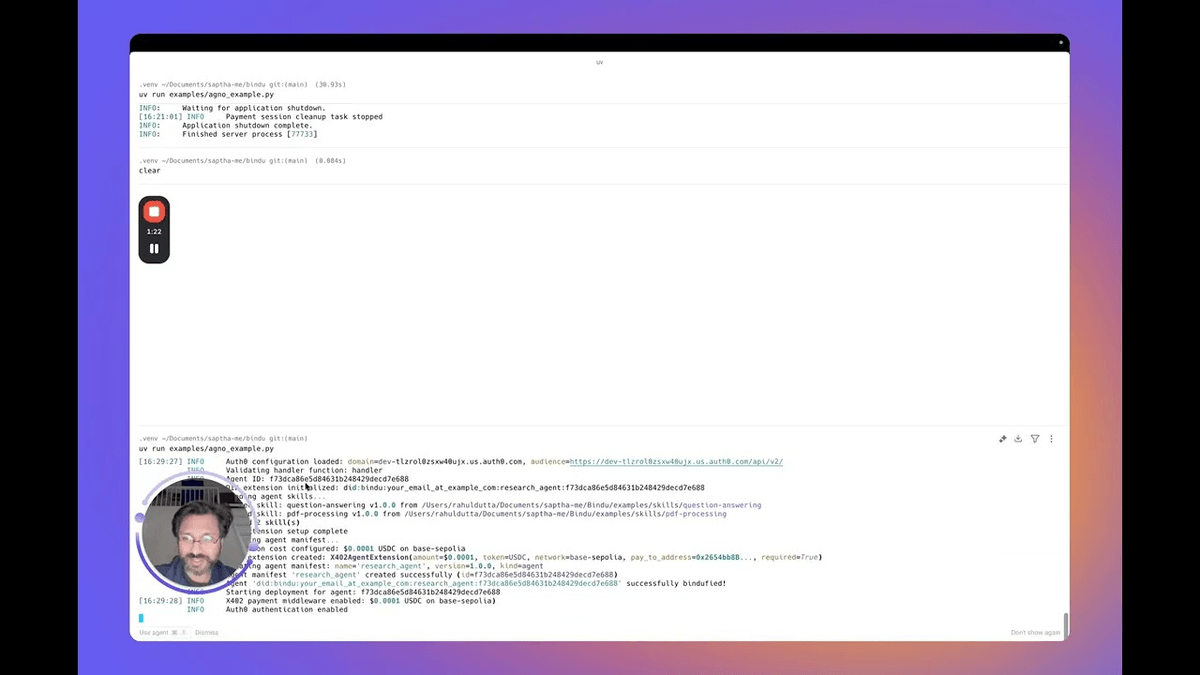
Bindu is all of that plumbing, behind one function call. You wrap your handler with bindufy(), and a few seconds later your agent is online with its own cryptographic identity, speaking A2A, and ready to demand USDC on any EVM chain before it does any work.
Your handler signature stays dead simple:
from bindu.penguin.bindufy import bindufy
from agno.agent import Agent
from agno.models.openai import OpenAIChat
agent = Agent(
    instructions="You are a research assistant.",
    model=OpenAIChat(id="gpt-4o"),
)
config = {
    "author": "you@example.com",
    "name": "research_agent",
    "description": "Research assistant.",
    "deployment": {"url": "http://localhost:3773", "expose": True},
    "skills": ["skills/question-answering"],
}
def handler(messages: list[dict[str, str]]):
    return agent.run(input=messages)
bindufy(config, handler)