
Open-Source ai-goofish-monitor Hunts Secondhand Deals So You Don't Have To
ai-goofish-monitor uses Playwright and multimodal AI to scan China's largest secondhand marketplace in real time, alerting you only when a listing actually matches your criteria
 Pro
Takeaways
- What it is: ai-goofish-monitor is an open-source Python tool that monitors Xianyu (Goofish) secondhand listings in real time using Playwright and multimodal AI.
- How it works: Playwright scrapes listings as a real browser session; an OpenAI-compatible model analyzes images and text to score each listing against your criteria.
- Key features: Natural language task creation, multi-task concurrency, cron scheduling, price history in SQLite, and notifications via Telegram, Bark, WeChat, and more.
- Setup: Docker-recommended; requires an OpenAI-compatible API key and a Xianyu login session exported via a companion Chrome extension.
- Traction: Over 13,700 GitHub stars and 2,100 forks; the repo has already spawned derivative projects adapting its architecture.
- Limitations: Xianyu-specific (China market only), login sessions expire and need refreshing, and aggressive polling risks account restrictions.
ai-goofish-monitor is an open-source Python tool that automates hunting for deals on Xianyu (also known as Goofish), China's largest secondhand marketplace -- think eBay, but with hundreds of millions of listings and a notoriously noisy feed. The project has pulled in over 13,700 GitHub stars and 2,100 forks, a signal that a lot of people share the same frustration: finding a genuinely good deal on Xianyu by hand is exhausting.
The platform generates massive amounts of product information daily, and traditional manual screening methods are not only inefficient but also prone to missing high-quality products. This tool was built to fix that by combining browser automation with AI-powered analysis -- so instead of you scrolling endlessly, a bot does it and only pings you when something actually matches what you want.
How it actually works
It combines browser automation with AI-based analysis to automatically search, collect, and evaluate newly posted items that match a user's purchase criteria. It uses Playwright to simulate real user interactions with the marketplace, allowing the system to retrieve product data and track updates in near real time. Playwright is a browser automation library -- it spins up a real Chromium browser, logs in as you, and navigates Xianyu exactly like a human would, which helps it avoid bot-detection systems.
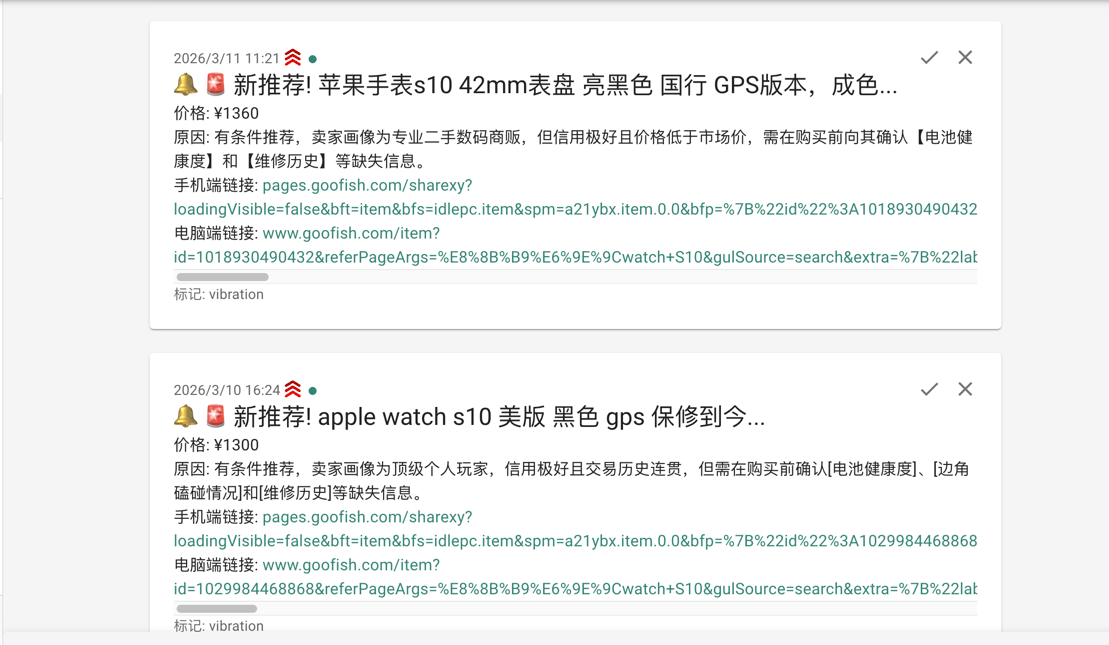
Once a listing is scraped, it gets passed to a multimodal AI model (any OpenAI-compatible API endpoint works -- GPT-4o, Gemini, or a local model). The AI looks at both the product images and the text description, scores the listing against your criteria, and decides whether it's worth surfacing. Deep AI analysis combines product images/text and seller profiling -- so it's not just checking keywords, it's reading the listing the way a knowledgeable buyer would.

The feature set that makes this practical
- Natural language task creation: You only need to describe your purchase requirements in natural language, and it will automatically create monitoring tasks and provide precise recommendations.
- Multi-task concurrency: It can run multiple monitoring tasks simultaneously, each configured with specific keywords, price ranges, and filtering conditions.
- Scheduled and real-time modes: Tasks can run continuously or on a cron schedule -- useful if you want to check for new listings every morning without keeping a server running 24/7.
- Instant notifications: Supports ntfy.sh, WeChat Work bots, Bark, Telegram, and Webhook -- so you get alerted on whatever channel you already use.
- Account and proxy rotation: The system manages multiple Xianyu accounts and rotates proxies with automatic failure retry, reducing the chance of getting rate-limited or blocked.
- Price history tracking: Results and price history are persisted in a local SQLite database, so you can see how a product's price has moved over time before deciding to buy.

Getting it running
A built-in web management interface allows users to create tasks, review results, and manage monitoring rules without relying solely on command line tools. The recommended path is Docker, which bundles Chromium so you don't have to install a browser separately. The minimum config you need is an OpenAI-compatible API key and a Xianyu login session.
Getting the login session is the trickiest part. The project ships a Chrome extension that exports your Xianyu login state as a JSON file, which you then paste into the web UI. After that, the bot authenticates as you and can access the full marketplace.
git clone https://github.com/Usagi-org/ai-goofish-monitor
cd ai-goofish-monitor
cp .env.example .env
# fill in OPENAI_API_KEY, OPENAI_BASE_URL, OPENAI_MODEL_NAME
docker compose up -d
The backend is a FastAPI app; the frontend is a Vite/React UI served from the same port. The results page and export endpoints query SQLite instead of directly scanning jsonl files. The logs page is the first place to inspect login-state expiry, anti-bot issues, or AI call failures.
Where it shines and where it doesn't
The multimodal analysis is the real differentiator here. Keyword matching alone would flag every listing that mentions "MacBook Pro M2" -- including overpriced ones, damaged units, or commercial resellers. The AI layer can read the photos, parse the seller's description for red flags, and score the listing against nuanced criteria like "prefer individual sellers, no visible scratches, original box included."
The weak points are structural. The project asks users to comply with Xianyu's user agreement and robots.txt rules, and warns against frequent requests to avoid burdening the server or having your account restricted. In practice, aggressive polling can get your Xianyu account flagged. The login-state approach also means sessions expire, and you'll need to refresh them periodically -- the logs page will tell you when that happens. The tool is also China-market-specific; Xianyu is not available internationally.
The broader picture
What's interesting about this project is that it's a working example of a pattern that's becoming common: using a multimodal LLM not as the main product, but as a filter inside an automation pipeline. The AI doesn't browse Xianyu -- Playwright does. The AI doesn't send notifications -- the notification layer does. The AI just answers one question: "is this listing worth the user's attention?" That narrow, well-defined role is exactly where LLMs perform reliably.
The project has already inspired derivative work, including a version that strips out the web UI entirely and lets you manage monitoring tasks through natural language conversations with an AI assistant. The core architecture -- browser automation feeding into AI scoring feeding into a notification system -- is reusable for any marketplace that doesn't offer a proper API. The repo is MIT-licensed and free to use.
