
Oh My Hermes Hits 1,000 Stars and Teases a Mixture-of-Models Router
The maintainer of Oh My Hermes teased new orchestration features for the community engineering layer atop Nous Research's Hermes Agent after crossing 1k stars.
Takeaways
- Maintainer of Oh My Hermes teased next features after project crossed 1k stars
- Coming soon: TUI extension, mixture-of-models routing, parallel tool eval calling
- Also planned: ulw-skills reinforcement and simplified model prompting skills
- OMH is an MIT-licensed engineering layer over Nous Research's Hermes Agent
- Ships 103 skills, 8 long-horizon workflows, 4-layer memory, evidence-boundary labels
- Now installable via Homebrew, Bun, and npm as of v1.0.6
The developer behind Oh My Hermes (OMH), an independent engineering extension for Nous Research's Hermes Agent, posted a roadmap update signaling what comes next for the project after it crossed 1,000 GitHub stars. The teased additions include a TUI extension, a mixture-of-models router, parallel tool-eval calling, and reinforced ulw-skills with simplified model prompting.
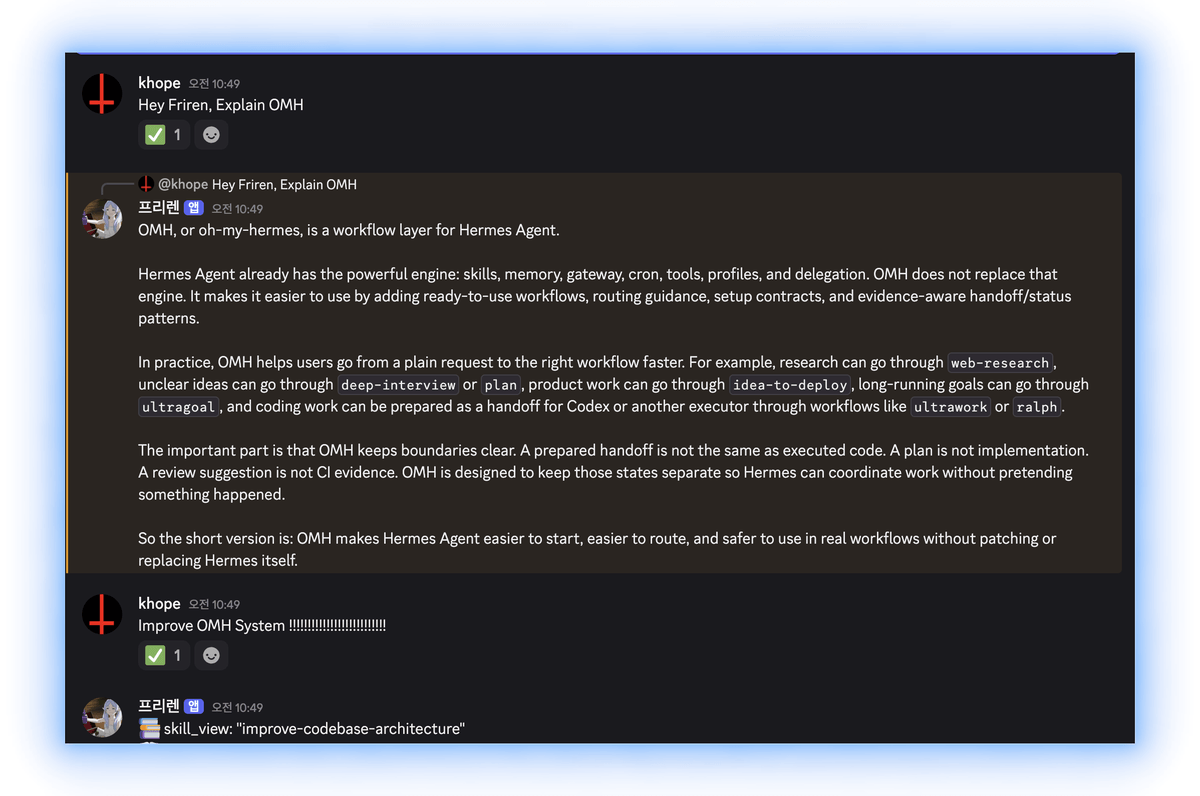
If you haven't run into it yet, Hermes Agent is Nous Research's self-hosted AI agent, billed as the only one with a built-in learning loop that creates skills from experience and improves them during use. OMH sits on top of that runtime as a workflow and orchestration layer. The maintainer's pitch on the project site is blunt: one install, and anyone runs Hermes professionally, with 103 installable skills, 8 long-horizon workflows, and 8 model categories routed per kind of work.
What OMH actually is today
OMH is a Python package (MIT licensed) that installs into an existing Hermes setup without patching the core. The design principle is chat-first skills, workflow contracts, status cards, and handoffs that slot into existing Hermes deployments without breaking them. The user still talks to Hermes in plain language; OMH routes the request to a skill, playbook, or profile, then hands coding work to an executor like Codex, Claude Code, or Hermes itself.