
oh-my-claudecode Turns Claude Into 19 Parallel Agents, Saving 50% on Tokens
oh-my-claudecode turns Claude Code into a full multi-agent team with 19 specialists, parallel execution, and zero configuration — hitting 38k GitHub stars
Takeaways
- What it is: oh-my-claudecode is a free, MIT-licensed multi-agent orchestration layer for Claude Code with 38k+ GitHub stars.
- Core feature: Runs a staged pipeline (
team-plan → team-prd → team-exec → team-verify → team-fix) with 19 specialized agents working in parallel. - Multi-model: Orchestrates Claude, Codex, Gemini, Antigravity, Grok, and Cursor CLI workers in real tmux panes on-demand.
- Cost savings: Smart model routing (Haiku for simple tasks, Opus for complex reasoning) cuts token costs by 30-50%.
- Install: Via Claude Code plugin marketplace or
npm i -g oh-my-claude-sisyphus@latest; requires Claude Max/Pro or an API key. - Limitation: tmux-based CLI workers require each external provider installed separately; vague prompts can waste significant compute.
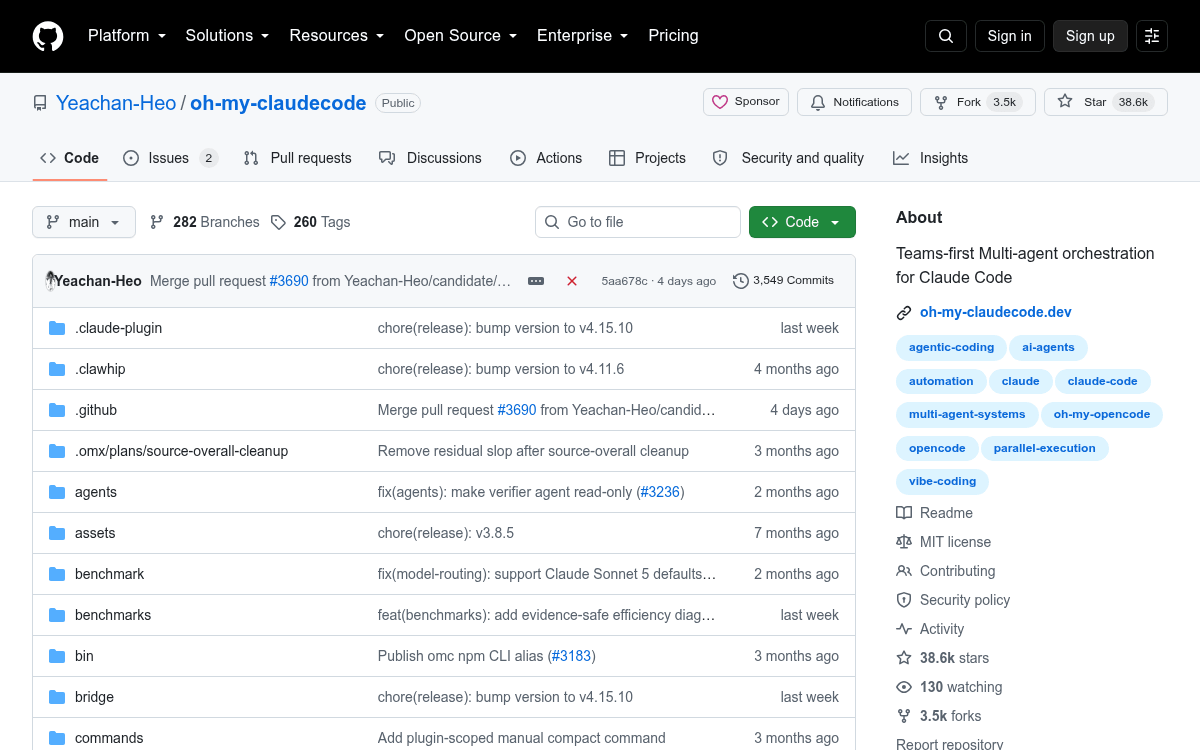
oh-my-claudecode (OMC) is an open-source orchestration layer that sits on top of Claude Code and turns it from a single-threaded AI assistant into a coordinated team of specialized agents. It has crossed 38,000 GitHub stars and 3,400 forks, making it one of the fastest-growing tools in the agentic coding space right now.
The problem it solves
Claude Code is powerful, but it has one glaring weakness: it is single-threaded. Refactor 50 files? Migrate a database schema across 40 components? You are stuck watching Claude work through each file sequentially, burning hours on tasks that should be parallelizable.
For teams trying to leverage multiple AI models simultaneously, the orchestration burden becomes a second job. oh-my-claudecode exists to collapse that complexity into natural language. Instead of memorizing slash commands and workflow patterns, you describe what you want and the framework handles the rest.
How it actually works
The architecture centers on a staged pipeline that runs every time you invoke a team: team-plan → team-prd → team-exec → team-verify → team-fix. This is not just sequential execution , it is a loop.
The fix stage feeds back into verification until the work is confirmed complete, which means OMC will not silently hand you a half-finished result.
OMC spawns multiple Claude agents simultaneously, distributes work, and merges results. From a single idea, analysis, design, planning, execution, QA, and verification all run automatically.
The framework exposes two surfaces: in-session slash commands inside Claude Code (like /team, /autopilot, /ralph) and a terminal CLI (omc team, omc ask, omc setup). They are distinct runtimes , in-session skills use Claude Code's native team workflow, while the CLI spawns real tmux worker panes.
19 agents, smart model routing
OMC ships 19 specialized agents , architect, coder, reviewer, tester, designer, researcher , plus 36 built-in skills covering TDD, code review, refactoring, and deployment. The agents are grouped into three lanes: