
NVIDIA's NemoClaw Locks Down AI Agents So They Can't Steal Your API Keys
NVIDIA open-sources NemoClaw, a sandboxed runtime stack for AI agents with built-in network policy, credential custody, and multi-provider inference routing
 Pro
Takeaways
- NVIDIA open-sourced NemoClaw, an Apache 2.0 reference stack for running AI agents safely inside sandboxed containers.
- Credentials never enter the sandbox: the OpenShell gateway holds API keys on the host and replaces placeholders only at approved egress boundaries.
- Supports three agent runtimes: OpenClaw (default), Hermes, and LangChain Deep Agents Code, with agent-specific CLI aliases and blueprints.
- Inference routing via
inference.localsupports OpenAI, Anthropic, Gemini, NVIDIA Endpoints, Ollama, vLLM, llama.cpp, and custom endpoints. - Install with one command:
curl -fsSL https://www.nvidia.com/nemoclaw.sh | bash, or use a coding agent with the provided starter prompt. - Alpha-stage with 236 open issues; scoped to single-host, single-operator use — not a multi-tenant enterprise platform.
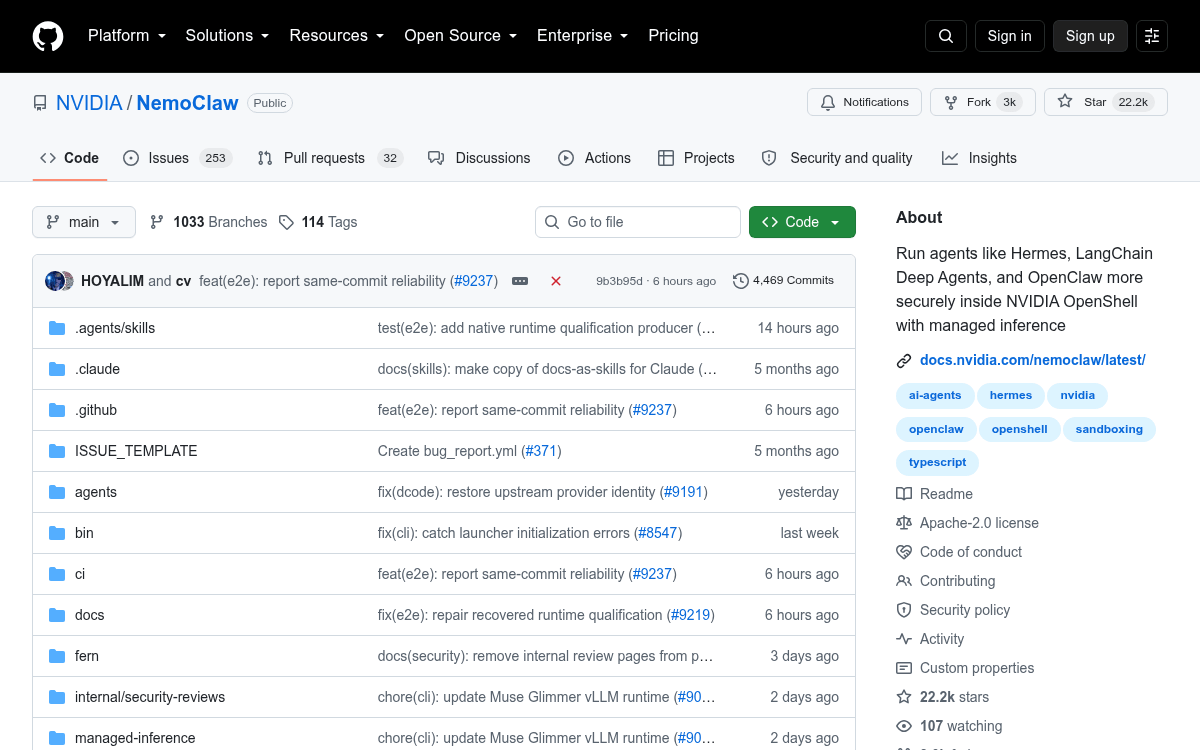
NVIDIA NemoClaw is a new open-source reference stack for running AI agents safely inside containerized sandboxes. The core problem it solves is straightforward: autonomous agents can make arbitrary network requests, access host filesystems, and call any inference endpoint they want. Without guardrails, that creates real security and cost exposure, especially when agents run unattended. NemoClaw wraps the agent runtime in an OpenShell container and puts a policy-enforcing gateway between the agent and the outside world.
The project is currently in alpha, licensed under Apache 2.0, and already has over 6,000 stars on GitHub. It supports three agent runtimes out of the box: OpenClaw (the default), Hermes, and LangChain Deep Agents Code.
The Stack Under the Hood
NemoClaw is not a single tool. It is three things working together:
- A host CLI that handles readiness checks, onboarding, lifecycle management, and operator commands.
- An agent integration layer that is specific to each supported runtime. For OpenClaw, this is a TypeScript plugin that registers the managed inference provider, a
/nemoclawslash command, and runtime context hooks that inject sandbox and policy instructions as system guidance without showing them in the visible chat. - A versioned blueprint, a YAML package containing the sandbox image, agent manifest, network policy, inference profile, and supporting assets. The runner verifies the blueprint digest before applying any changes.
The key architectural decision is that credentials never enter the sandbox. The OpenShell gateway sits between the agent and every upstream service, holding API keys for inference providers and MCP servers on the host side. The agent sees only a placeholder; OpenShell replaces it at the approved egress boundary. This means a compromised or misbehaving agent cannot exfiltrate your Anthropic or OpenAI keys.