
NTU's TradeMaster Collapses the Entire RL Trading Stack Into One Open-Source Platform
NTU's TradeMaster bundles data pipelines, market simulators, 13+ RL algorithms, and a 17-metric evaluation toolkit for quantitative trading experiments.
 Pro
Takeaways
- NTU's TradeMaster is an open-source RL platform covering the full quant trading pipeline, Apache 2.0.
- Includes 13+ RL algorithms: PPO, DQN, SAC, DDPG, plus trading-specific ones like DeepScalper and EIIE.
- Datasets span US, China, HK stocks, crypto, forex, futures with daily and minute-level granularity.
- PRUDEX-Compass evaluates strategies across 6 axes and 17 measures, not just Sharpe ratio.
- AutoML module handles feature generation and hyperparameter tuning automatically.
- Backed by a NeurIPS 2023 paper; installable via pip or runnable in Colab.
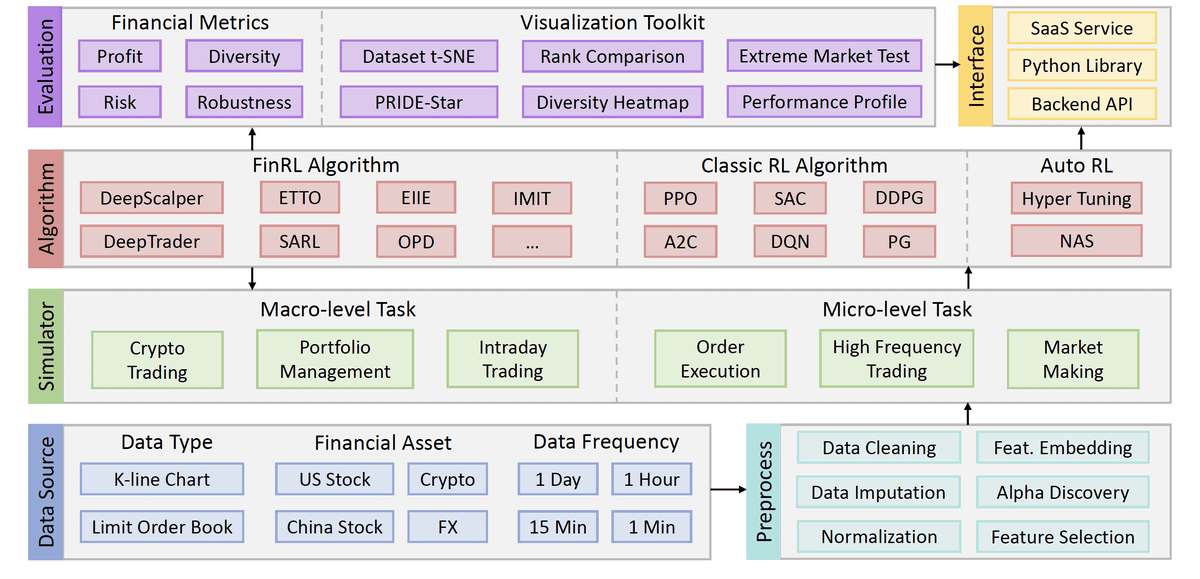
Building a reinforcement learning trading bot usually means stitching together data pipelines, simulators, algorithm implementations, and evaluation code before you write a single line of strategy logic. TradeMaster, from Nanyang Technological University's AMI group, collapses that whole stack into one package. It is an open-source platform for quantitative trading powered by reinforcement learning, covering the full pipeline from algorithm design through deployment.
The project has crossed 3,000 stars on GitHub and is backed by a NeurIPS 2023 paper, with follow-up work at KDD, AAAI, and WWW. It ships under Apache 2.0, installs via pip, and comes with a Colab notebook so you can run the tutorials without any local setup.
What ships in the box
TradeMaster is organized around six modules that map cleanly onto the RL-for-trading workflow: implementations of 9 classic RL algorithms and 7 RL-for-trading algorithms, evaluation measures and visualization toolkits that go beyond pure financial metrics, a GUI on the official website for users without deep coding skills, and an AutoML module for automatic feature selection and hyperparameter tuning.
The data coverage is unusually broad for an academic release:
- US stocks (S&P 500, DJ30) from Yahoo Finance, daily OHLCV back to 2000
- China A-shares (SSE50) and Hong Kong equities (HS30)
- Crypto daily bars plus minute-level Bitcoin limit order book data from Binance
- Foreign exchange and Chinese futures at 5-minute granularity
The classic RL side leans on Ray RLlib, giving you PPO, A2C, Rainbow, SAC, DDPG, DQN, PG, and TD3 out of the box. Layered on top are trading-specific algorithms from published papers, including DeepScalper for intraday trading, DeepTrader and EIIE for portfolio management, ETEO for order execution, and SARL, OPD, and Investor-Imitator for various policy-learning setups.
Simulators and the sandbox
The market simulator module separates this from a plain algorithm zoo. It handles long-cycle, multi-modal K-line and order flow financial data at granularities from minute-level to daily across Chinese equities, US stocks, cryptocurrencies, and forex. The preprocessing pipeline handles cleaning, filling, normalization, automatic feature mining, embedding, and selection as a standardized six-step flow.
Recent additions include EarnHFT and MacroHFT for high-frequency trading, Market-GAN for controllable synthetic market data generation, and FinAgent, a multimodal foundation agent for financial trading published at KDD 2024. A diffusion-model-based tool for imputing missing values in financial time series is also included.
Evaluation beyond Sharpe
One of the more useful contributions is the evaluation toolkit, which the authors call PRUDEX-Compass. It defines 6 axes and 17 measures for FinRL methods, with an inner level that maps relative strength on each axis and an outer level that offers a compact view of which setups and evaluation measures are actually reported in practice.
Inside that framework, PRIDE-Star is a star plot for profitability, risk-control, and diversity, containing the normalized score of 8 measures. If you have ever compared two trading strategies on Sharpe ratio alone and gotten misleading results, this is a more honest way to look at policy performance.

Who this is actually for
TradeMaster is a research and prototyping platform rather than a production trading engine. There is no live broker integration and no low-latency execution layer. What it does well is let you swap in a new environment, plug in an RL algorithm, and get comparable results across seven asset classes with a consistent evaluation harness.
Concretely, the repo is worth pulling if you want to:
- Reproduce recent RL-for-trading papers without reimplementing the baselines
- Prototype a portfolio manager or intraday scalper on realistic data
- Stress-test a policy across different market regimes using the Market Dynamics Modeling tool
- Teach an RL course with concrete financial examples via the Colab tutorials
One caveat worth flagging: the datasets come from Yahoo Finance and other public sources that everyone has access to. Alternative signals such as social media data or companies' voluntary disclosures could strengthen a model, but the team does not currently have the bandwidth to integrate them. If your edge depends on alternative data, you will need to bring that yourself. As an experimentation platform for RL in quantitative finance, this is one of the most complete open-source options currently available.