
Neuphonic's NeuTTS Brings Voice Cloning to Your Device Without Cloud APIs
Neuphonic open-sources NeuTTS, a family of on-device TTS models with instant voice cloning from 3 seconds of audio, running in real-time on phones and laptops without a cloud API.
 Pro
Takeaways
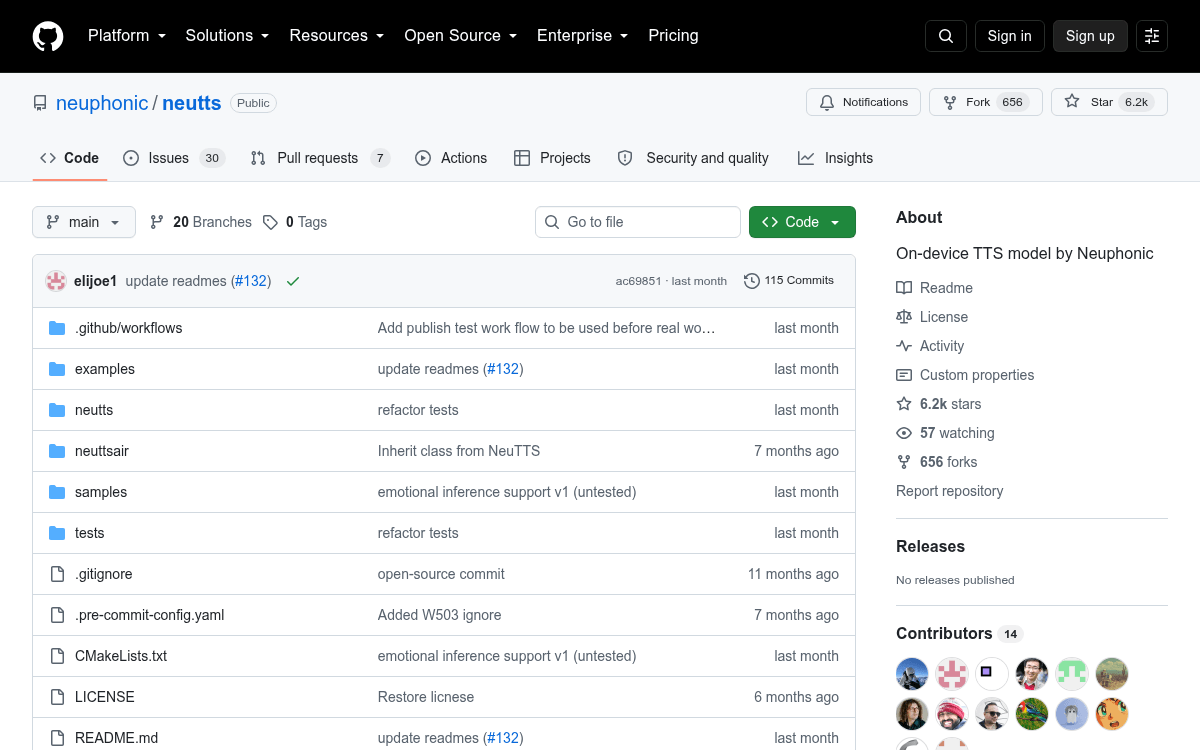
- NeuTTS is open-source: Neuphonic releases a family of on-device TTS models with instant voice cloning on GitHub (6.2k stars).
- Three model tiers: NeuTTS-Air (360M params), NeuTTS-Nano (120M, multilingual), and NeuTTS-2E (emotional control with 7 emotions).
- Cloning from 3 seconds: Zero-shot voice cloning requires only a short WAV clip and its transcript -- no fine-tuning needed.
- Runs on-device: NeuTTS-Nano hits 45 tokens/s on a Galaxy A25 5G CPU; GGUF format plugs into the llama.cpp ecosystem.
- Free to use: NeuTTS-Air is Apache 2.0; Nano and 2E use the NeuTTS Open License; all weights are on Hugging Face.
- Watermarked by default: Every generated audio file embeds a perceptual watermark for provenance tracking.
NeuTTS is Neuphonic's open-source bet that high-quality, voice-cloning TTS belongs on your device, not behind a pay-per-character API. The repo ships a family of models ranging from a 120M-parameter nano variant to a 360M-parameter "Air" model, all built on small LLM backbones and a custom neural audio codec. It has already crossed 6,200 GitHub stars, signaling real developer appetite for local voice AI.
The API lock-in problem it's solving
State-of-the-art voice AI has been locked behind web APIs for too long. That's not just a marketing line -- it describes a real constraint. Every call to ElevenLabs or a similar service means latency, a usage bill, and your audio data leaving your infrastructure. Neuphonic's speech foundation models run locally -- private, secure, and lightning-fast -- without the need for GPUs or cloud dependence, enabling natural, responsive conversations anywhere: online or offline, on devices or at the edge.
The timing is right. As of 2026, the quality gap between open-source and commercial TTS is nearly closed: the best open-source TTS reaches 4.7 MOS versus the top commercial API at 4.8 MOS. NeuTTS enters a competitive open-source field that already includes Kokoro, Chatterbox, and Piper -- but it's one of the few that combines voice cloning, multilingual support, and genuine edge-device performance in a single package.
Three models, one architecture
The NeuTTS family currently has three variants, each targeting a different tradeoff between size, speed, and capability:
- NeuTTS-Air (~360M active parameters) -- the quality flagship, English-only, Apache 2.0 licensed, streaming via GGUF
- NeuTTS-Nano (~120M active parameters) -- a speech foundation model 3x smaller than NeuTTS Air, that runs on CPU in real-time, with instant voice cloning. Available in English, Spanish, German, and French
- NeuTTS-2E (~125M active parameters) -- an emotional English model with 4 fixed speakers and 7 controllable emotions: angry, disgusted, fearful, happy, neutral, sad, and surprised
NeuTTS is a collection of open-source, on-device TTS speech language models with instant voice cloning, built off LLM backbones, bringing natural-sounding speech, real-time performance, built-in security, and speaker cloning to your local device. The architecture is deliberately simple: a small language model backbone that generates audio tokens, paired with NeuCodec -- their custom 50Hz neural audio codec that compresses audio into a single codebook at low bitrates.
Voice cloning from 3 seconds of audio
The NeuTTS Nano Multilingual Collection delivers strong naturalness and cloning quality at a fraction of the compute, making them ideal for embedded voice agents, assistants, toys, and privacy-sensitive applications. The cloning mechanism is zero-shot: you pass a reference audio clip and its transcript, and the model synthesizes new text in that speaker's voice. No fine-tuning required.
For best results, the reference audio should be:
- Mono, 16--44 kHz, saved as a
.wav - 3--15 seconds long
- Clean speech with minimal background noise
- Continuous monologue (few pauses), so the model can capture tone effectively
The model encodes the reference once and reuses it, so repeated inference with the same speaker adds essentially no overhead.
Real-time on a mid-range phone
The benchmarks below are for Q4-quantized models (4-bit weights) using llama.cpp on CPU and vLLM on GPU. Note these numbers cover only the speech language model -- the codec adds additional compute on top.
| Device | NeuTTS-Air | NeuTTS-Nano |
|---|---|---|
| Galaxy A25 5G (CPU) | 20 tokens/s | 45 tokens/s |
| AMD Ryzen 9 HX 370 (CPU) | 119 tokens/s | 221 tokens/s |
| iMac M4 16GB (CPU) | 111 tokens/s | 195 tokens/s |
| RTX 4090 (GPU) | 16,194 tokens/s | 19,268 tokens/s |
The Nano model hitting 45 tokens/s on a budget Android phone is the number that matters most for edge deployment. At 50Hz audio, that's enough for real-time generation with headroom to spare on a laptop-class CPU.
Getting started in one pip install
The simplest path is a single install followed by a few lines of Python:
pip install neuttsfrom neutts import NeuTTS
import soundfile as sf
tts = NeuTTS(
backbone_repo="neuphonic/neutts-nano",
backbone_device="cpu",
codec_repo="neuphonic/neucodec",
codec_device="cpu"
)
ref_codes = tts.encode_reference("samples/jo.wav")
ref_text = open("samples/jo.txt").read().strip()
wav = tts.infer("Hello from your local device.", ref_codes, ref_text)
sf.write("output.wav", wav, 24000)For streaming (audio plays as it generates), you need GGUF models and llama-cpp-python. The repo includes platform-specific install commands for Apple Silicon, Linux/OpenBLAS, and Windows. For the emotional model, the API is just as clean:
from neutts import NeuTTS2E
import soundfile as sf
tts = NeuTTS2E()
wav = tts.infer("I can't believe it's finally here!", speaker="emily", emotion="happy")
sf.write("output.wav", wav, 24000)
All models are available on Hugging Face in both full PyTorch and GGUF (Q4 and Q8) formats. The GGUF variants plug directly into the llama.cpp ecosystem, which means they benefit from all the hardware acceleration work that ecosystem already supports.
Where it fits -- and where it doesn't
NeuTTS is a strong fit when you need:
- Privacy-sensitive deployments -- healthcare, legal, enterprise apps where audio cannot leave the device
- Offline-capable products -- toys, embedded assistants, IoT devices with no guaranteed connectivity
- Voice cloning without a cloud bill -- personalized assistants or accessibility tools that adapt to a user's own voice
- Compliance-safe pipelines -- regulated industries where third-party API data sharing is a liability
The context window caps at 2048 tokens, which covers roughly 30 seconds of audio including the reference prompt. That rules it out for long-form audiobook narration in a single pass. Among open-source engines, NeuTTS supports output streaming , but streaming requires the GGUF format -- the PyTorch backbone doesn't support it yet. Language coverage is also limited to English, Spanish, German, and French for now.
Responsibility baked in
Every audio file NeuTTS generates is watermarked by default using the Perth perceptual watermark -- an inaudible signal embedded below the threshold of human perception. This is a meaningful design choice: voice cloning at this quality level, running entirely offline, is exactly the kind of capability that needs provenance tracking built in from day one. Generation is also seeded and reproducible -- every call prints its seed, so you can recover a specific output take by rerunning with that seed.
The bigger shift
Open-source TTS in 2026 is not one project -- it is a whole stack of competing approaches, and some of them are now legitimately good enough to matter for real products, local workflows, and privacy-sensitive deployments. NeuTTS sits in a distinct niche within that stack: it's one of the only open models combining voice cloning, multilingual support, emotional control, and a GGUF-native path to edge devices simultaneously. The assumption that voice cloning requires a cloud API is becoming harder to defend.
 X X post by @alphasignal