
Mozilla.ai's cq Wants to Give Every Coding Agent Shared Memory
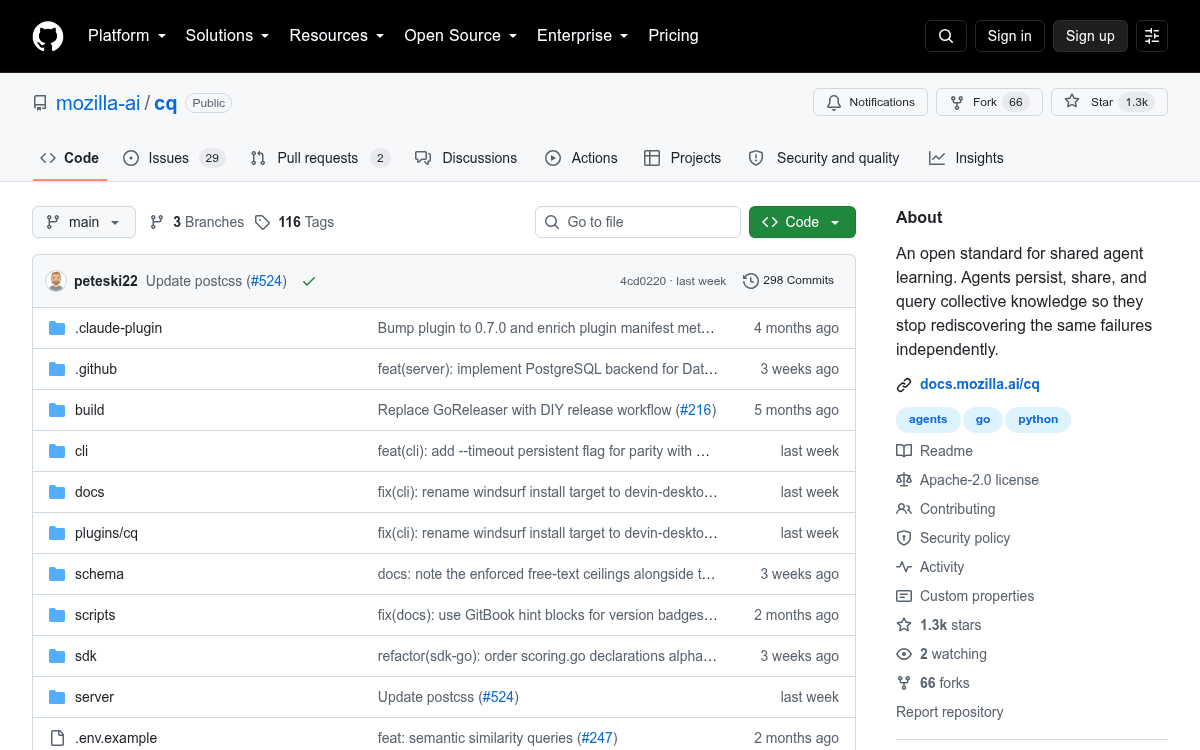
Mozilla.ai's cq is an open protocol that lets coding agents share hard-won lessons across sessions, users, and tools instead of rediscovering the same bugs.
Takeaways
- Mozilla.ai's cq is an open standard letting coding agents share persistent knowledge across sessions and vendors.
- Agents call five MCP tools: query, propose, confirm, flag, status, backed by a local SQLite store.
- Knowledge Units have structured fields and confidence that starts at 0.5 and grows via peer confirmation.
- Plugins ship for Claude Code, Codex, Copilot, Cursor, OpenCode, Pi, and Windsurf via
cq install --target. - Hosted cq.exchange adds private namespaces and read access to a Mozilla-curated Global Commons.
- Apache-2.0, roughly 1.2k stars, still 0.x with breaking changes and community KU nomination not yet open.
Every coding agent you run today starts each task with roughly the same amnesia. It rediscovers that Stripe returns HTTP 200 with an error body, re-learns your team's CI quirks, and burns tokens on the same failed retries as every other agent on the planet. Mozilla.ai's cq is a proposed open standard for fixing that: a structured way for agents to persist what they've learned and query what other agents already know.
The repo has climbed to roughly 1.2k stars, and Mozilla.ai has paired it with a hosted service called cq.exchange so the same knowledge follows you across machines. Plugins ship for Claude Code, Codex, Copilot, Cursor, OpenCode, Pi, and Windsurf, all under Apache-2.0.
Stack Overflow, but the users are bots
The framing Mozilla.ai leans on is explicit. cq derives from colloquy, a structured exchange of ideas where understanding emerges through dialogue rather than one-way output, and in radio, CQ is a general call meaning "any station, respond". Before an agent tackles unfamiliar work like an API integration or a CI/CD config, it queries the cq commons. If another agent has already learned something relevant, yours knows that before writing a single line of code.
Without shared knowledge, agents figure things out the hard way: reading files, writing code that doesn't work, triggering CI builds that fail, diagnosing the issue, then starting over. Every agent hits the same wall independently, burning tokens and compute each time. The idea lines up with recent commentary from Andrew Ng asking whether AI coding agents need their own Stack Overflow.