
Microsoft's RD-Agent Automates Quant Research, Doubling Returns for Under $10
Microsoft's Qlib + RD-Agent stack automates the full quant R&D loop — from hypothesis to backtest — achieving 2x returns with 70% fewer factors for under $10
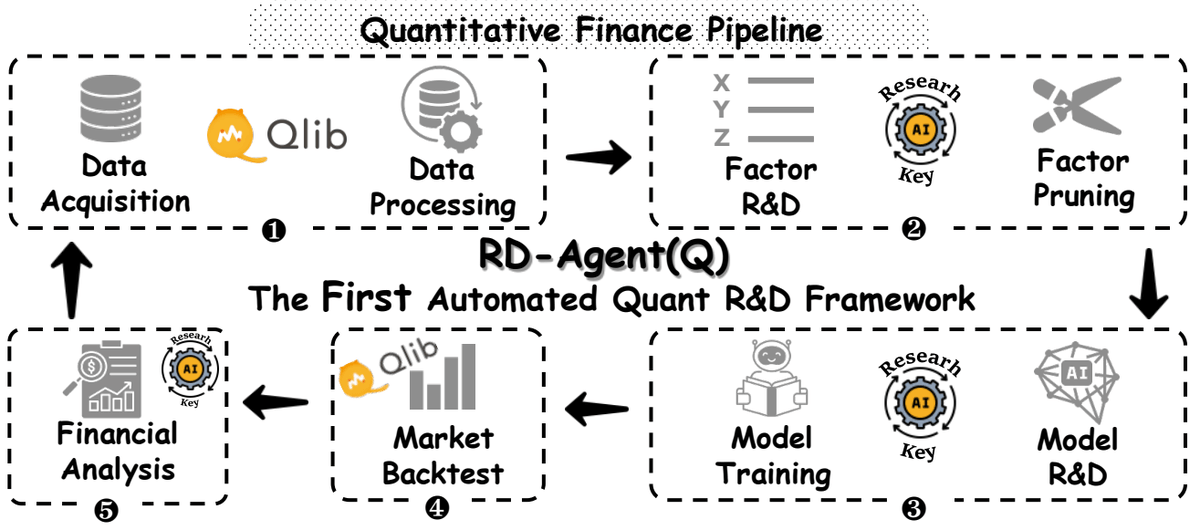
Takeaways
- Microsoft's Qlib + RD-Agent stack automates the full quant R&D loop: hypothesis generation, factor coding, backtesting, and iteration.
- RD-Agent(Q) achieves ~2x higher annualized returns than classical factor libraries (Alpha158, Alpha360) using 70% fewer factors, at under $10 per run.
- The paper was accepted at NeurIPS 2025; results generalize across CSI 300, CSI 500, and NASDAQ 100 markets.
- Qlib ships with 20+ pre-built model architectures (LightGBM, LSTM, Transformer, GATs, etc.) and a fast columnar data server outperforming HDF5 and MySQL.
- RD-Agent also leads the MLE-bench leaderboard for general ML engineering, scoring 30.22% across 75 Kaggle competitions.
- Both repos are MIT-licensed; RD-Agent currently requires Linux + Docker, and the official Qlib dataset is temporarily unavailable.
Quantitative finance has always been a game of edge: finding the right signals in noisy data before anyone else does. That process , forming a hypothesis, writing factor code, running a backtest, interpreting results, and iterating , takes experienced researchers weeks per cycle. Microsoft's open-source Qlib platform, now integrated with RD-Agent, automates that entire loop with LLM-powered agents, and the results are hard to ignore.
Two repos, one pipeline
Qlib is the foundation: an open-source, AI-oriented quantitative investment platform that covers the full ML pipeline from data ingestion and feature engineering to model training, backtesting, portfolio optimization, and live trading. It supports diverse machine learning modeling paradigms, including supervised learning, market dynamics modeling, and reinforcement learning. Think of it as the execution layer , the environment where strategies live and die.
RD-Agent is the brain on top. Research and development is crucial for industrial productivity, especially in the AI era, where the core aspects of R&D are focused on data and models , and RD-Agent is committed to automating these high-value processes, letting AI drive data-driven AI. Together, the two repos form a closed loop: RD-Agent proposes and implements ideas; Qlib runs and evaluates them.

The research loop that used to take weeks
The core innovation in RD-Agent(Q) , the quant-specific variant , is how it structures the R&D cycle. RD-Agent(Q) decomposes the quant process into two iterative stages: a Research stage that dynamically sets goal-aligned prompts, formulates hypotheses based on domain priors, and maps them to concrete tasks, and a Development stage that employs a code-generation agent, Co-STEER, to implement task-specific code, which is then executed in real-market backtests.
The two stages are connected through a feedback stage that thoroughly evaluates experimental outcomes and informs subsequent iterations, with a multi-armed bandit scheduler for adaptive direction selection. A multi-armed bandit here means the system learns which research directions are most promising and allocates more exploration budget toward them , the same idea used in online A/B testing, applied to factor discovery.