
Meta Open-Sources Ax to Kill Expensive Hyperparameter Tuning Forever
Meta open-sourced Ax 1.0, a Bayesian optimization platform used at scale internally, alongside a peer-reviewed paper benchmarking it against top hyperparameter tuning libraries.
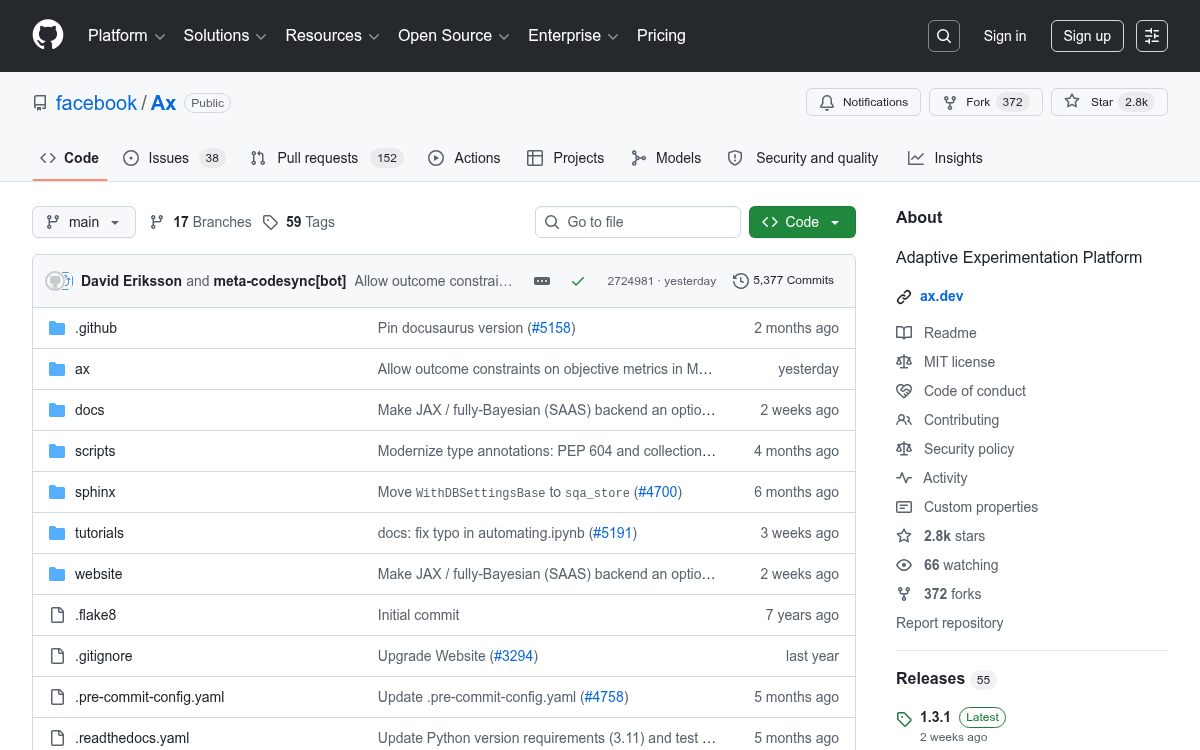
Takeaways
- Meta released Ax 1.0, an open-source Bayesian optimization platform used internally at scale across AI, infra, and hardware teams.
- A peer-reviewed paper at AutoML 2025 formally benchmarks Ax against Optuna, SMAC3, HEBO, Vizier, and SyneTune, claiming state-of-the-art results.
- Ax uses Gaussian processes and expected improvement acquisition functions, powered by Meta's BoTorch library on PyTorch.
- Real-world Meta use cases include LLM data mixture search, Instagram recommender tuning, AR/VR hardware design, and concrete formulation for data centers.
- The API lets you define parameters, set an objective, and run an adaptive loop -- Ax proposes the next trial, you evaluate it, repeat.
- Free, MIT-licensed, installable via
pip install ax-platform; requires Python 3.11+.
Hyperparameter tuning and system optimization are among the most expensive, repetitive tasks in ML engineering. You run a grid of configurations, wait hours or days for results, and repeat. Meta's Adaptive Experimentation team built a smarter answer to this problem internally, and has now fully open-sourced it: Ax, an adaptive experimentation platform that uses Bayesian optimization to guide experiments automatically. The 1.0 release came alongside a peer-reviewed paper at the AutoML 2025 conference, making this the first time Meta has formally documented and benchmarked the platform against the broader ecosystem.
The Problem It Solves
Optimizing industry-scale ML systems involves resource-intensive black-box optimization. Adaptive experimentation substantially improves the sample efficiency of such tasks compared with naive baselines like grid or random search, by utilizing surrogate models and sequential optimization algorithms. The key word is sequential: instead of evaluating all candidates upfront, the system learns from each result and proposes the next best candidate to try.
The platform employs machine learning to guide resource-intensive experimentation processes, addressing optimization challenges in AI model development, production infrastructure tuning, and hardware design. That last one is not a typo -- Meta used Ax to design AR/VR hardware components.
How It Works Under the Hood
Ax's default strategy is Bayesian optimization (BO). The idea: instead of blindly sampling the parameter space, BO fits a probabilistic model (called a surrogate model) to the results seen so far, then uses that model to decide where to sample next. It balances two competing goals:
- Exploration