
Meta FAIR Pushes DINOv2 Into Medical Imaging With Three Specialized Models
Meta FAIR extends the DINOv2 repository with three specialized backbones for cell microscopy, multi-channel biology imagery, and chest X-ray analysis.
 Pro
Takeaways
- Meta FAIR added Cell-DINO, Channel-Adaptive DINO, and XRay-DINO to the DINOv2 repo in December 2025.
- Cell-DINO beats supervised ViTs by 20% on average and 70% at 1% label budgets on HPA.
- XRay-DINO trained on 873k chest X-rays across CheXpert, MIMIC, NIH-14, PadChest datasets.
- Channel-Adaptive DINO handles imaging modalities with non-RGB channel counts natively.
- All three load through
torch.hubusing the existing DINOv2 interface. - Cell-DINO paper appears in PLOS Computational Biology; weights use FAIR noncommercial license.
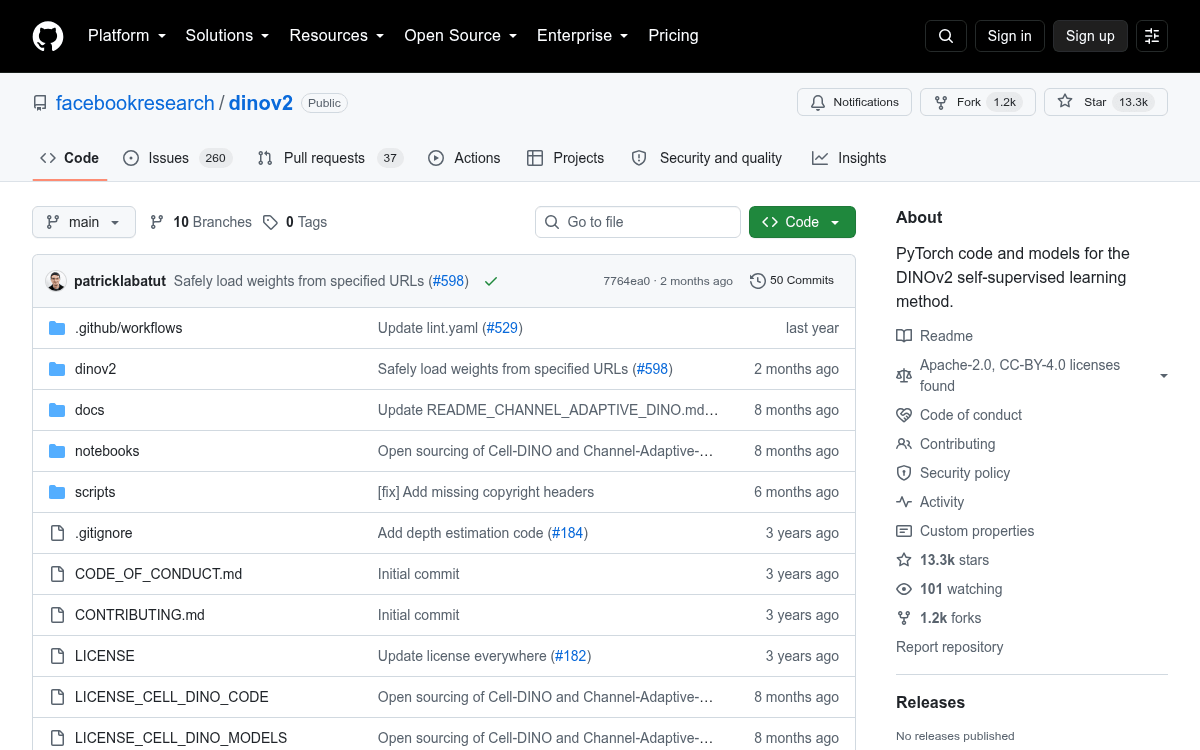
Meta FAIR quietly shipped a batch of domain-specialized additions to the DINOv2 repository, extending the self-supervised vision framework beyond natural images into fluorescent microscopy, multi-channel biological assays, and chest X-rays. The updates land inside the same codebase that already hosts the ViT-S through ViT-g backbones, so pulling them is a one-line change in torch.hub.load. Even with DINOv3 out in the wild, this drop signals that Meta is treating DINOv2 as the base recipe for scientific vision.
What actually landed
Three additions were pushed to the repo in mid-December, each paired with a research paper and its own set of pretrained weights:
- Cell-DINO for cell fluorescent microscopy, following a paper published in PLOS Computational Biology.
- Channel-Adaptive DINO, following Scaling Channel-Adaptive Self-Supervised Learning, which handles the fact that biology images often have more or different channels than RGB.
- XRay-DINO (also called RayDINO), following Advancing human-centric AI for robust X-ray analysis through holistic self-supervised learning.
All three plug into the existing DINOv2 hub interface. Once you request the weights through Meta's model forms, you clone the repo and load a backbone like this:
import torch
REPO_DIR = "path/to/dinov2"
xray = torch.hub.load(REPO_DIR, "xray_dino_vitl16",
                      source="local",
                      weights="<URL_OR_PATH>")
cell = torch.hub.load(REPO_DIR, "cell_dino_cp_vits8",
                      source="local",
                      pretrained_path="<CHECKPOINT>")