
MemOS Gives AI Agents Long-Term Memory With 43% Accuracy Boost
MemOS gives LLM agents a persistent, inspectable memory layer with graph-based storage, hybrid retrieval, and reported 43.70% accuracy gains over OpenAI Memory.
Takeaways
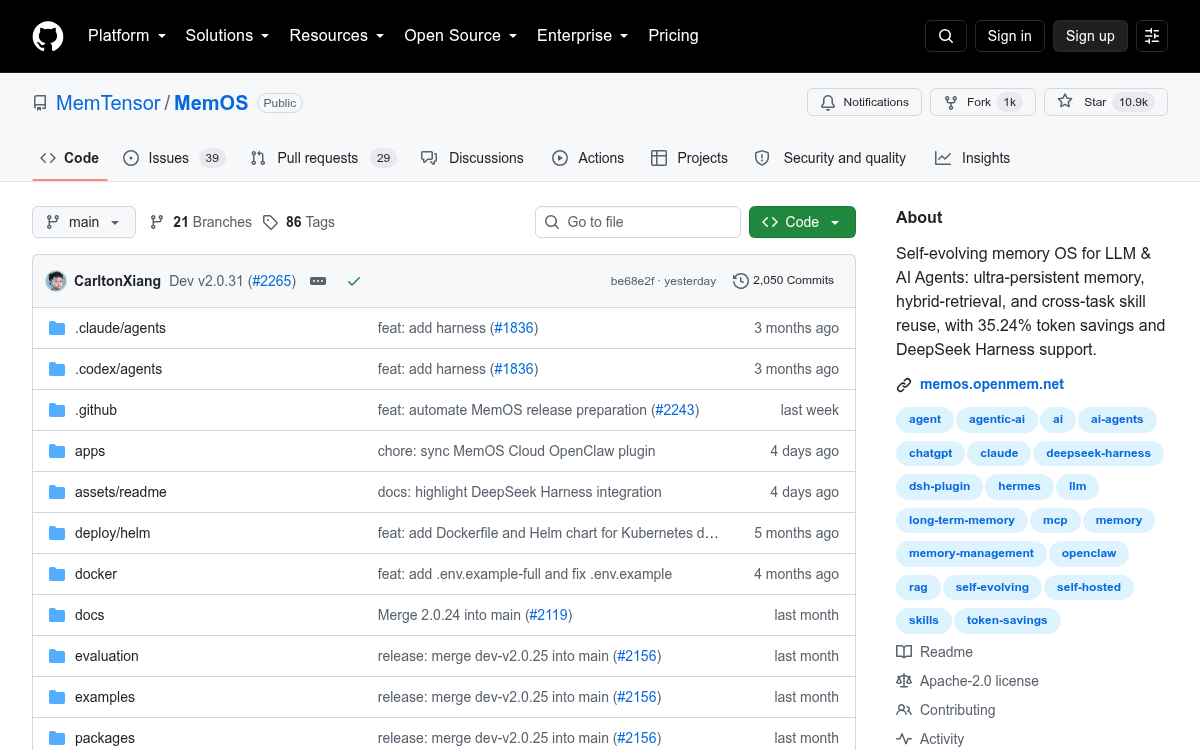
- MemOS is an open-source memory OS for LLM agents, now at 9.5k GitHub stars under Apache 2.0.
- Claims 43.70% accuracy gain over OpenAI Memory and 35.24% token savings on benchmarks.
- Graph-structured memory you can inspect and edit, not a black-box embedding store.
- Handles text, images, tool traces, and personas through composable MemCube containers.
- Supports OpenAI, Qwen, DeepSeek, MiniMax, Ollama, HuggingFace, and vLLM as backends.
- Design details in the MemOS paper on arXiv.
Every conversation with a stateless LLM starts from zero. MemOS is trying to fix that, and the project has quietly grown into one of the more ambitious attempts at giving language models a real long-term memory subsystem rather than a bolt-on vector database.
MemOS bills itself as a Memory Operating System for LLMs and AI agents, unifying storage, retrieval, and management of long-term memory to enable context-aware, personalized interactions across knowledge bases, multi-modal inputs, and tool traces. The framing matters. Instead of treating memory as an embedding blob you dump into Pinecone, MemOS treats it as a first-class OS-level resource with its own scheduler, lifecycle, and API surface.
Memory as a graph you can actually read
The core primitive is the MemCube, a composable container that holds memories as a graph you can inspect and edit. The unified API lets you add, retrieve, edit, and delete entries directly, rather than through a black-box embedding store. That design choice alone separates it from most RAG stacks, where debugging why the model recalled the wrong thing usually means squinting at cosine similarity scores.
Multi-modal support covers text, images, tool traces, and personas, all retrieved and reasoned over in one system. Multi-cube management lets you handle several knowledge bases as composable units, enabling isolation, controlled sharing, and dynamic composition across users, projects, and agents.