
MemoriLabs' Memori Gives AI Agents Persistent Memory at 97% Fewer Tokens
Memori turns agent execution traces into structured memory, hitting 87% LoCoMo accuracy while using under 3% of full-context tokens.
Takeaways
- Memori is an agent-native memory layer that structures execution traces into persistent state, LLM-agnostic and framework-agnostic.
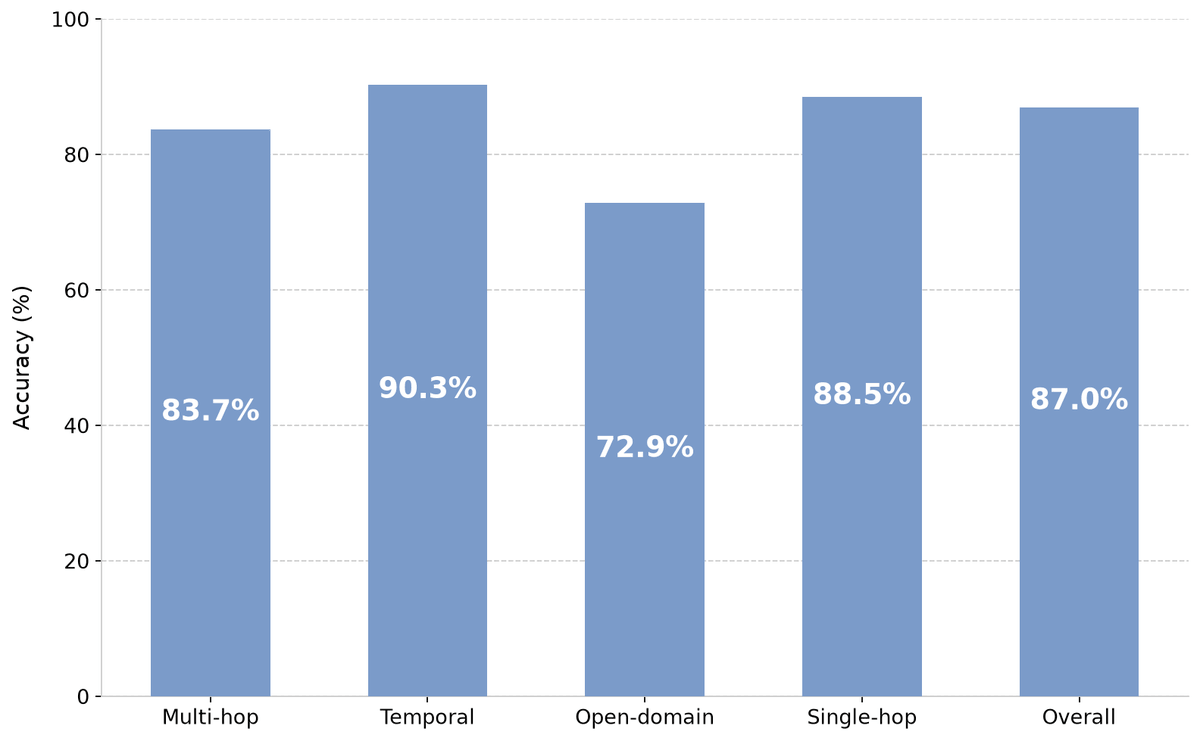
- Hits 87% accuracy on LoCoMo using only 721 tokens per query, 2.8% of full-context cost.
- Outperforms Zep (78.94%), LangMem (78.05%), and Mem0 (62.47%) in the peer-reviewed benchmark.
- Advanced Augmentation extracts semantic triples plus summaries, embedded with Gemma-300 and indexed in FAISS.
- Two-line SDK integration for Python and TypeScript, plus one-command MCP setup for Claude Code, Cursor, Codex, and Warp.
- Apache 2.0 license, free tier for developers, and a BYODB option for keeping memory in your own database.
AI agents have a persistent amnesia problem. Every new session, they forget your stack, your preferences, your project conventions. Memori from MemoriLabs is a memory layer that addresses this by structuring what happened during agent execution, rather than replaying the conversation transcript.
The repo has crossed 16k stars, and the pitch is simple: an LLM-agnostic layer that turns agent execution and conversation into structured, persistent state for production systems, designed for enterprise use and compatible with the data infrastructure you already run. It ships as a Python SDK, a TypeScript SDK, and an MCP server, under Apache 2.0.
Memory as a data structuring problem
The core thesis behind Memori is that stuffing raw chat history into every prompt is the wrong primitive. Its Advanced Augmentation pipeline converts unstructured dialogue into compact semantic triples and conversation summaries, enabling precise retrieval and coherent reasoning. Memori implements this as a persistent memory layer that incrementally distills conversational data into structured representations.
Concretely, every LLM interaction gets processed in the background to extract facts, preferences, skills, events, relationships, and rules. Those get stored as retrievable assets rather than as an ever-growing blob of transcript. Rather than treating memory as compressed chat history, Memori turns agent execution traces into reusable state: what tools were called, what worked, what failed, what decisions were made, and what patterns should carry forward. That gives agents a much stronger memory primitive.