
Local Deep Research Hits 95% Accuracy Running Privately on a Single GPU
An open-source research agent hits ~95% on SimpleQA using Qwen3.6-27B on a single RTX 3090, with everything running locally and encrypted.
Takeaways
- Local Deep Research reports ~95% SimpleQA and 77% xbench-DeepSearch fully local on a single RTX 3090.
- Uses a
langgraph-agentstrategy where the LLM picks engines, searches, and synthesizes autonomously. - Ships integrations for arXiv, PubMed, Semantic Scholar, GitHub, Wikipedia, SearXNG, Tavily, Brave, and more.
- Per-user SQLCipher AES-256 encrypted databases, zero telemetry, Cosign-signed Docker images with SLSA provenance.
- Exposes Python API, REST API, LangChain retriever hooks, and an MCP server for Claude Desktop.
- Install via
pip install local-deep-researchor Docker Compose, supports Ollama, LM Studio, llama.cpp, and major cloud providers.
Running deep research locally without shipping your queries to OpenAI or Perplexity used to mean accepting a serious accuracy penalty. Local Deep Research (LDR) is pushing back on that assumption with benchmark numbers that would have looked implausible a year ago on consumer hardware.
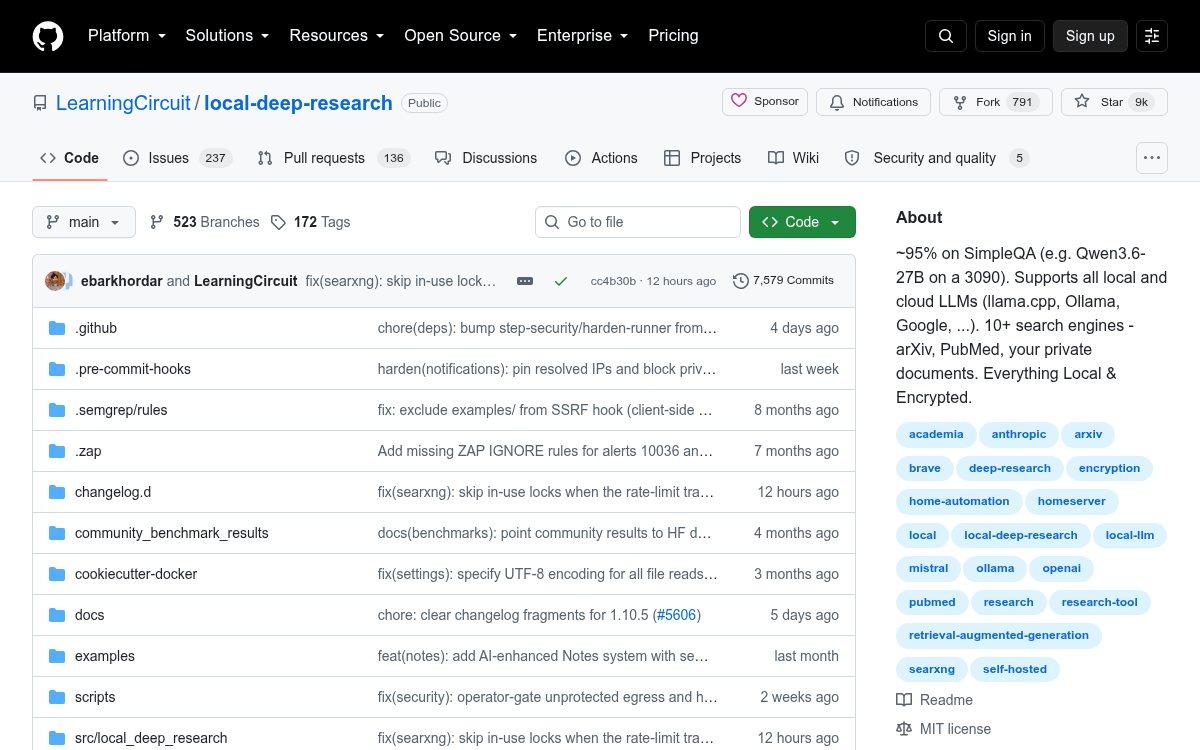
The project claims to be the first fully-local open-source system, running on a single RTX 3090 with Qwen3.6-27B, to report ~95% on SimpleQA (n=500) and 77% on xbench-DeepSearch (n=100). The result was announced on r/LocalLLaMA and is backed by a community-maintained dataset on Hugging Face. The repo has crossed 8.9k stars and is climbing fast.
What it actually does
LDR is an agentic research assistant you self-host. You give it a question, and it decides which search engines to hit, pulls sources, synthesizes an answer with citations, and optionally downloads the sources into an encrypted local library that becomes searchable in future sessions.
Four research modes are exposed in the UI:
- Quick Summary: cited answers in roughly 30 seconds to 3 minutes
- Detailed Research: structured multi-iteration analysis
- Report Generation: full markdown reports with sections and a table of contents
- Document Analysis: question answering over your private files
How it hits those numbers
The headline accuracy comes from a specific strategy called langgraph-agent. The creators describe it as "deep, agentic research": autonomous investigation cycles where the model decides what to search, which specialized engines to query, and when to synthesize findings into cited reports. Rather than treating retrieval as a one-shot lookup like most RAG systems, LDR plans, executes, and refines its approach based on intermediate findings.