
llmwiki Compiles Your AI Knowledge Once so Agents Stop Rediscovering It
A TypeScript CLI that turns raw sources into a citation-traceable markdown wiki, so agents stop re-reading the same files on every query.
Takeaways
- llmwiki compiles raw sources into a typed, interlinked markdown wiki with citations, review state, and freshness metadata
- Concrete implementation of Karpathy's LLM Wiki pattern, moving synthesis from query time to compile time
- Version 1.0 adds Configurable Lifecycle Profiles for typed entities, workflows, and runtime trust gates
- Built-in
autosciandnewsroomtemplates demonstrate research and editorial domain packs - Ships CLI, TypeScript SDK, and MCP server; supports Anthropic, OpenAI, Ollama, and Copilot providers
- MIT-licensed on GitHub and installable via
npm install -g llm-wiki-compiler
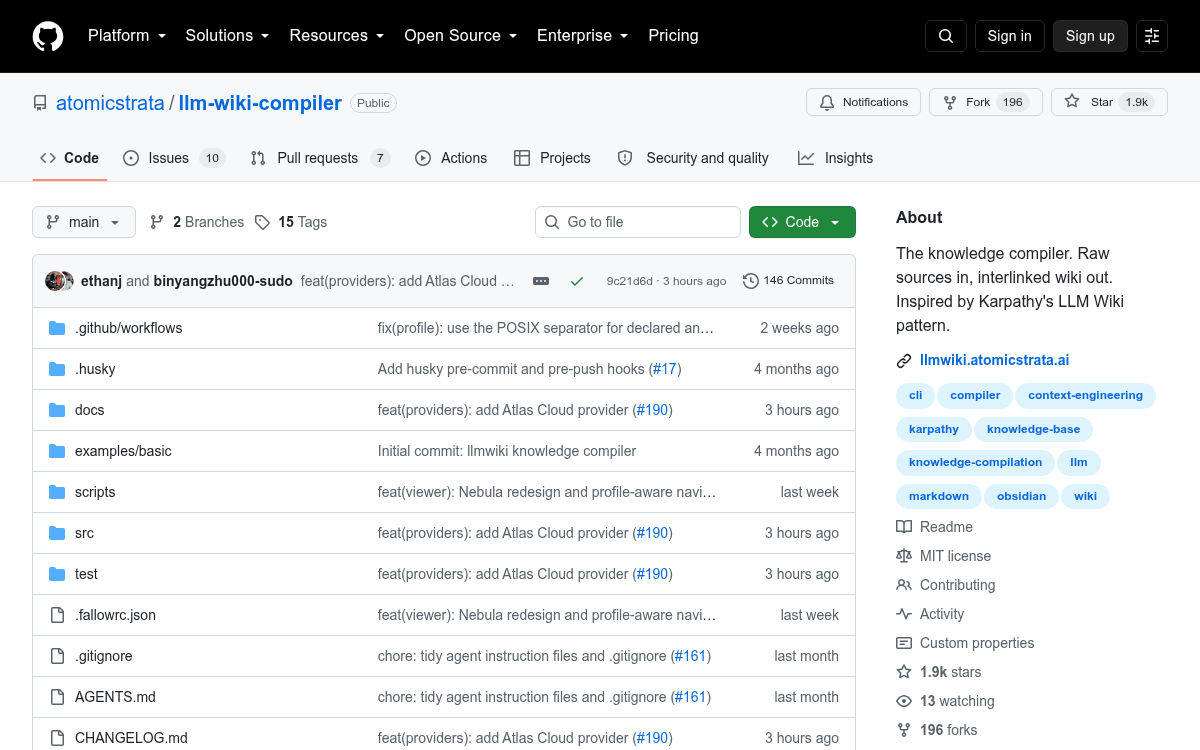
Retrieval-augmented generation has a compounding problem: every query re-discovers the same relationships in the same raw chunks. llmwiki, an open-source TypeScript CLI from atomicstrata, takes a different route. It compiles your sources once into a typed, interlinked markdown wiki that agents and humans can browse, query, and reuse without paying for re-synthesis on every call.
The project sits at 1.9k stars on GitHub and implements a pattern Andrej Karpathy sketched in a gist earlier this year. The LLM Wiki idea is simple: use an LLM to read your sources, synthesize their contents into structured, interlinked wiki pages, then run all your queries against that compiled artifact. llmwiki turns that sketch into a working compiler with lint, eval, review queues, and an MCP server.
Compile once, query forever
The mental model is borrowed from software engineering. Rather than re-discovering knowledge from raw files at query time, llmwiki compiles it once into durable pages that accumulate structure, provenance, review state, and retrieval metadata. A two-phase LLM pipeline first extracts concepts, then generates typed pages, currently concept, entity, comparison, and overview.
The output is plain markdown with YAML frontmatter rather than a vector store or graph database. Paragraphs cite their source files and line ranges, and