
Letta Ditches Its Python Framework and Rebuilds as a Memory-First Coding Agent
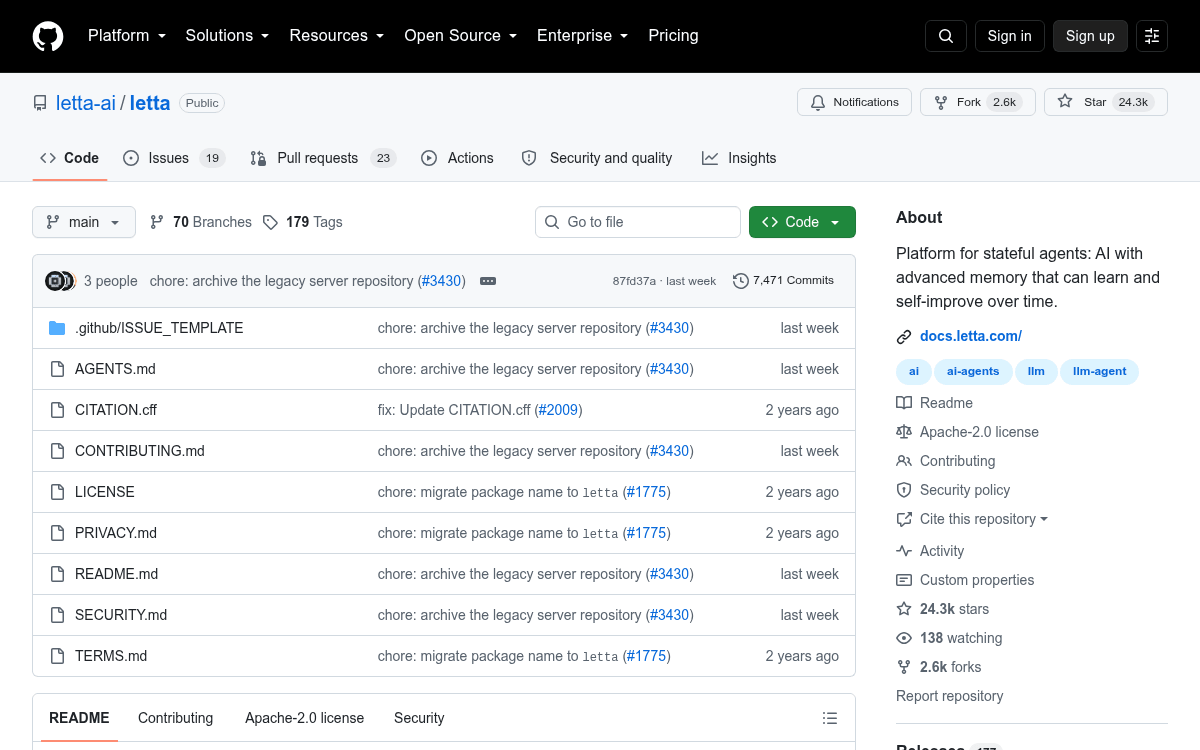
The original letta-ai/letta repository has been retired, with active development shifting to letta-code, a memory-first coding agent with git-backed context.
 Pro
Takeaways
- The letta-ai/letta repo has been retired and now serves as a landing page.
- Active development moved to letta-ai/letta-code, a memory-first coding agent harness.
- Letta Code ships as an npm package with CLI, desktop app, and browser clients.
- All agent memory is tracked in git via MemFS and can sync to a GitHub repo.
- Supports subagents, skills, hooks, crons, and remote environments across machines.
- Model-agnostic across Claude, GPT, Gemini, GLM, Kimi, plus local Ollama and LM Studio.
The GitHub repository that once housed MemGPT, and later the flagship Letta stateful agents framework, has quietly become a landing page. The letta-ai/letta repo now points visitors to a new home, letta-ai/letta-code, where the team is consolidating everything into a single memory-first coding agent.
The old repository now serves as a signpost. The retired Letta V1 server source is preserved on the archive branch for historical reference, and tags and releases from the V1 server remain available for reproducibility. If you were pulling from the old codebase, that path is done. New installation, development, and deployment instructions live entirely in the letta-code README.
From framework to full agent harness
Letta started as MemGPT, the Berkeley research project that introduced OS-inspired virtual context management for LLMs, using a memory hierarchy to give models effectively unlimited context. The V1 platform expanded that idea into a REST API server for building stateful agents with memory blocks, archival storage, and multi-agent orchestration.
Letta-code has a different shape. It ships as an npm package (