
Latitude's Open-Source Tool Turns Agent Failures Into Auto-Fixed PRs
Latitude is an open-source, MIT-licensed observability stack that groups failing agent traces into issues and can dispatch a coding agent to fix them.
Takeaways
- Latitude is an open-source, MIT-licensed observability platform for LLM agents, styled as Sentry for LLMs.
- It groups failing traces into tracked issues with status, trend, and affected users instead of raw logs.
- An Agent Dispatch loop hands issues to Claude Code or Cursor, which opens a PR with a fix.
- SDKs support OpenAI, Anthropic, Bedrock, Vercel AI SDK, LangChain, and any OTLP backend.
- Hosted free tier includes 20K credits per month, 30-day retention, and unlimited seats.
- Includes an MCP server, semantic search over 100% of traces, and human-aligned evals.
If you have ever tried to debug a production LLM agent by scrolling through raw traces, you know the pain. A repo called latitude-llm from Latitude has been picking up steam as an open-source take on that problem, positioning itself as Sentry, but for agents and LLMs. It ingests OpenTelemetry traces from your agent, groups recurring failures into tracked issues, and can even hand those issues off to a coding agent to patch.
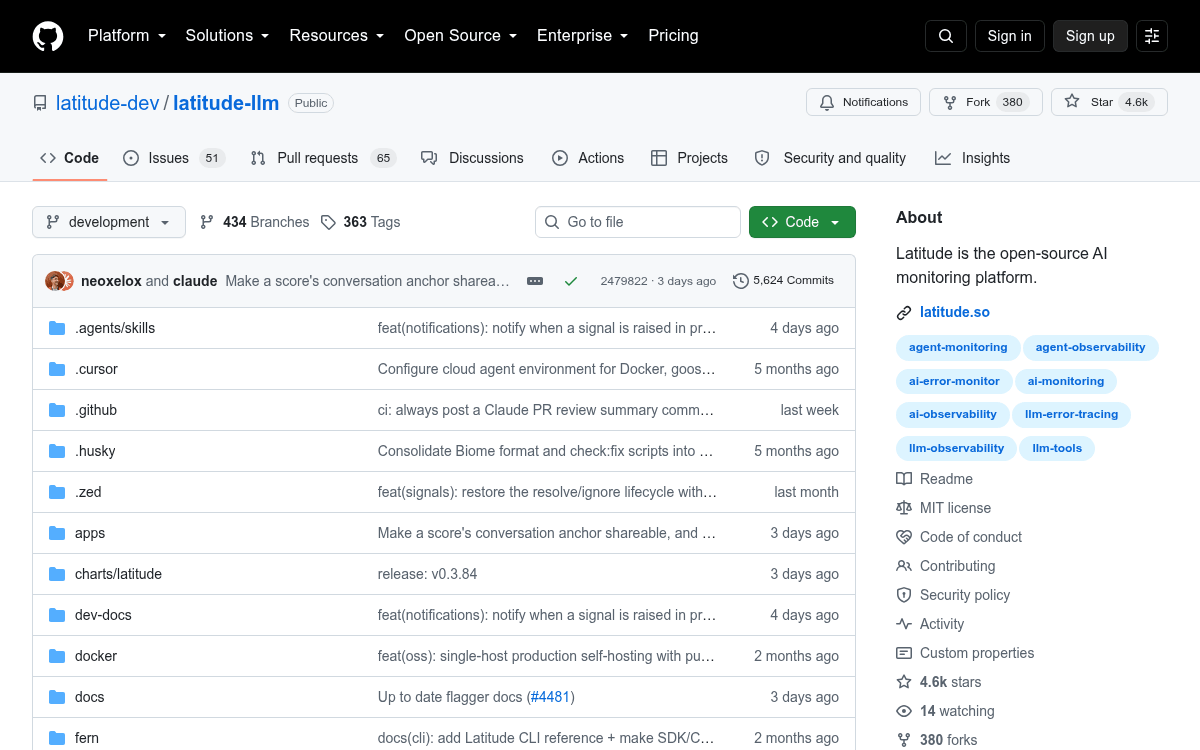
The project is a TypeScript monorepo (with Python SDK support) that has crossed 4,000 stars and ships under an MIT license, so you can self-host the whole platform or use the hosted tier.
Why raw traces fall short
Traditional APM tools treat every failing request as an isolated log line. Agents break differently: a bad tool call, a hallucinated argument, or a policy violation might show up across thousands of sessions before anyone notices a pattern. Latitude analyzes completed sessions to extract what the conversation was actually about, what happened, and where things got spicy, then clusters those failures.
The pitch on the landing page is blunt: trace your agent in production, find the failures, and dispatch your coding agent to fix them. Agent bugs become first-class issues with a status, size, and trend, rather than a firehose of spans you have to sample.