
LangChain4j 1.14.0 Ships Encrypted Reasoning, MCP Upgrades, and Multimodal Support
LangChain4j 1.14.0 lands with expanded OpenAI Responses API support, richer agent tooling, reasoning summaries, and MCP session tracking for JVM apps.
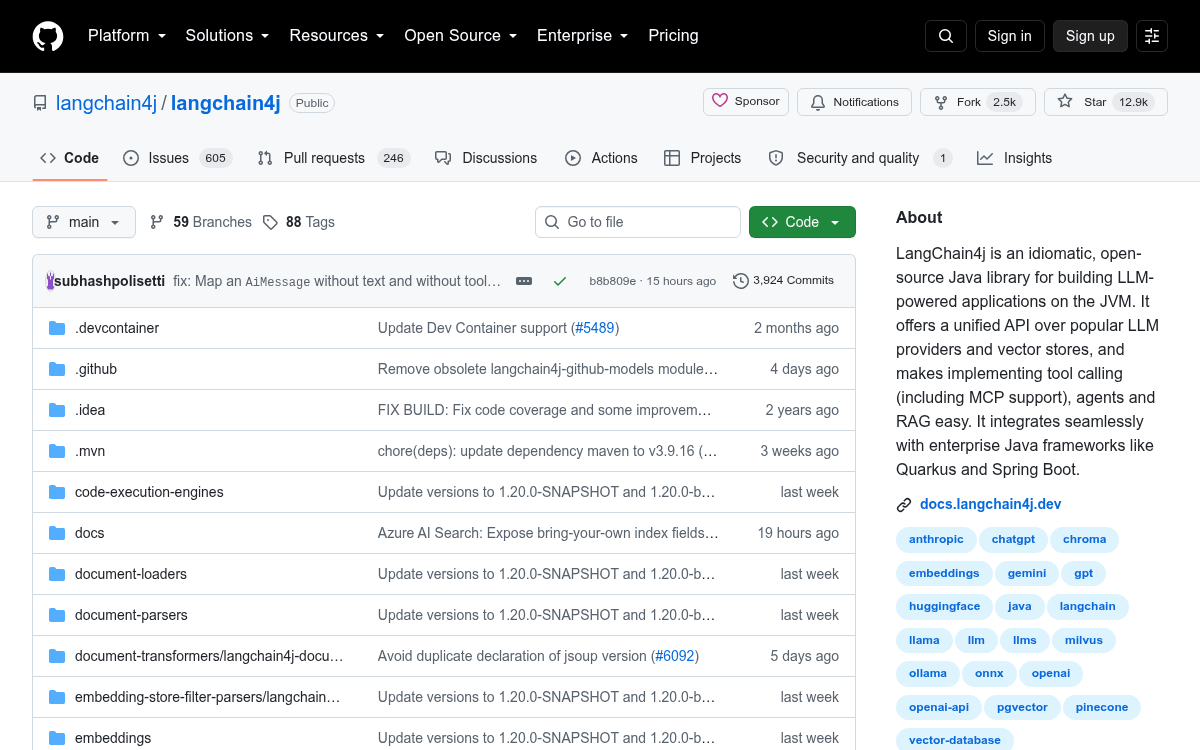
Takeaways
- LangChain4j 1.14.0 released for JVM developers building LLM apps, under Apache-2.0.
- AI Services gain polymorphic return types and a new IMMEDIATE_IF_LAST tool return mode.
- OpenAI Responses API refactored with reasoning summaries, encrypted reasoning, and server tools.
- Anthropic thinkingDisplay, Gemini imageConfig, Bedrock CacheTTL, Mistral audio and PDF support added.
- MCP transport now exposes session IDs and supports multiple listeners plus more event types.
- Revapi now enforces automated backward compatibility checks across the public API.
The Java ecosystem's most active LLM framework just cut a new minor release, and it is stacked. LangChain4j 1.14.0 pulls in dozens of pull requests spanning the OpenAI Responses API, agent orchestration, Model Context Protocol (MCP) plumbing, and provider-specific additions for Anthropic, Gemini, Bedrock, Mistral, and Ollama.
For newcomers, LangChain4j is a Java framework that simplifies integrating Large Language Models into JVM applications. It offers unified APIs for 25+ providers, high-level abstractions for patterns like AI Services and agentic systems, and tooling for chatbots, agents, and RAG pipelines. It plugs directly into Quarkus and Spring Boot, which is why enterprise Java shops keep gravitating to it.
AI Services get smarter about types
The headline change in 1.14.0 lives in the AI Services layer, LangChain4j's declarative interface-based abstraction. Two additions stand out:
- Polymorphic return types and tool parameters: AI Services can now return and accept parent classes or interfaces, and the framework resolves the concrete subtype. That removes a long-standing awkwardness where you had to expose only concrete DTOs.
- ReturnBehavior.IMMEDIATE_IF_LAST: A new tool-return mode that short-circuits the loop when a tool is invoked last, skipping the extra round-trip to the model. Useful when a tool's output is already the final answer.