
LangChain's Open SWE Turns Stripe, Ramp, and Coinbase's Shared Blueprint Into Open-Source
LangChain open-sources the internal coding agent architecture independently built by Stripe, Ramp, and Coinbase -- now yours to customize
 Pro
Takeaways
- Open SWE released: LangChain open-sources an internal coding agent framework modeled after production systems at Stripe, Ramp, and Coinbase.
- Convergent architecture: Three companies independently built coding agents and landed on the same patterns -- isolated sandboxes, curated tools, Slack-first invocation, and subagent orchestration.
- Built on Deep Agents + LangGraph: Composable, not forked -- upstream improvements flow in automatically without breaking your customizations.
- Trigger from anywhere: Mention
@openswein Slack, Linear, or a GitHub PR comment; the agent spins up a sandbox, writes code, and opens a PR. - Fully customizable: Swap the model (defaults to Claude Opus 4.6), sandbox provider (Modal, Daytona, Runloop), tools, and middleware for your org's needs.
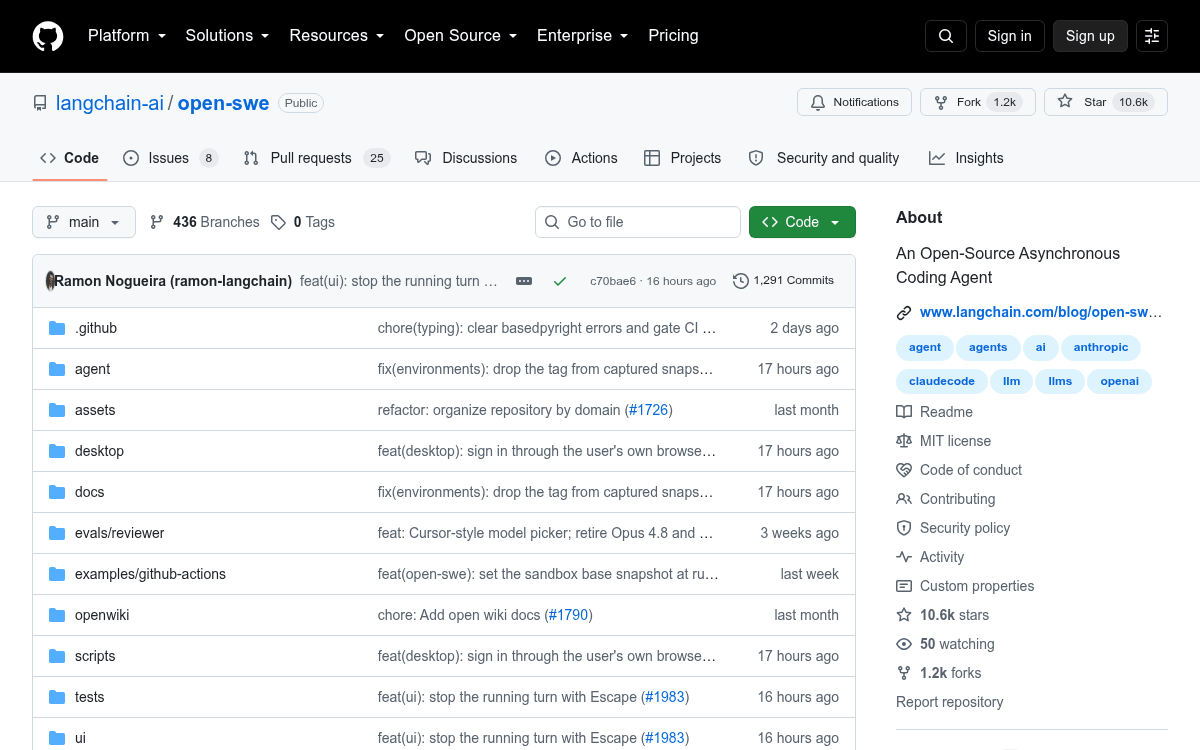
- MIT licensed, 6,200+ stars in days: Available now at github.com/langchain-ai/open-swe.
Open SWE is LangChain's attempt to answer a question that's been quietly circulating in engineering circles: if Stripe, Ramp, and Coinbase all independently built internal coding agents and landed on nearly identical architectures, what does that tell us about what actually works? The answer, apparently, is worth open-sourcing.
Three companies, one blueprint
Over the past year, several engineering organizations built internal coding agents that operate alongside their development teams. Stripe developed Minions, Ramp built Inspect, and Coinbase created Cloudbot. They had no shared codebase, no coordination, and no common framework -- yet they all converged on remarkably similar architectures.
Those shared patterns include isolated cloud sandboxes, curated toolsets, subagent orchestration, and integration with developer workflows. LangChain noticed the convergence and open-sourced the pattern. The result is Open SWE: an MIT-licensed framework that gives any engineering org the same starting point those companies spent months building from scratch.
What it actually is (and isn't)
It's not a product you deploy and use out of the box. It's a composable starting point -- a set of proven architectural decisions that you customize for your codebase, your workflows, and your team. Think of it less like Cursor and more like a well-designed internal platform template.
Open SWE positions itself as the open-source framework for enterprise internal agents. While Cursor and Claude Code target individual developers with proprietary IDEs, Open SWE gives engineering organizations a customizable, self-hosted solution. No per-seat licensing. No vendor lock-in. You own the infrastructure and adapt it to your workflows.
The architecture, layer by layer
The framework is built on two LangChain primitives: Deep Agents (an agent harness for complex, long-running tasks) and LangGraph (the orchestration layer). Deep Agents handles the heavy lifting -- context management for long runs, planning via a built-in to-do tool, and subagent spawning. LangGraph wires the execution graph together.