
LangChain's Open Deep Research Beats Black-Box Rivals at a Fraction of the Cost
LangChain's open-source deep research agent runs on any LLM and search tool, hitting #6 on the Deep Research Bench leaderboard with a fully configurable, MIT-licensed architecture.
Takeaways
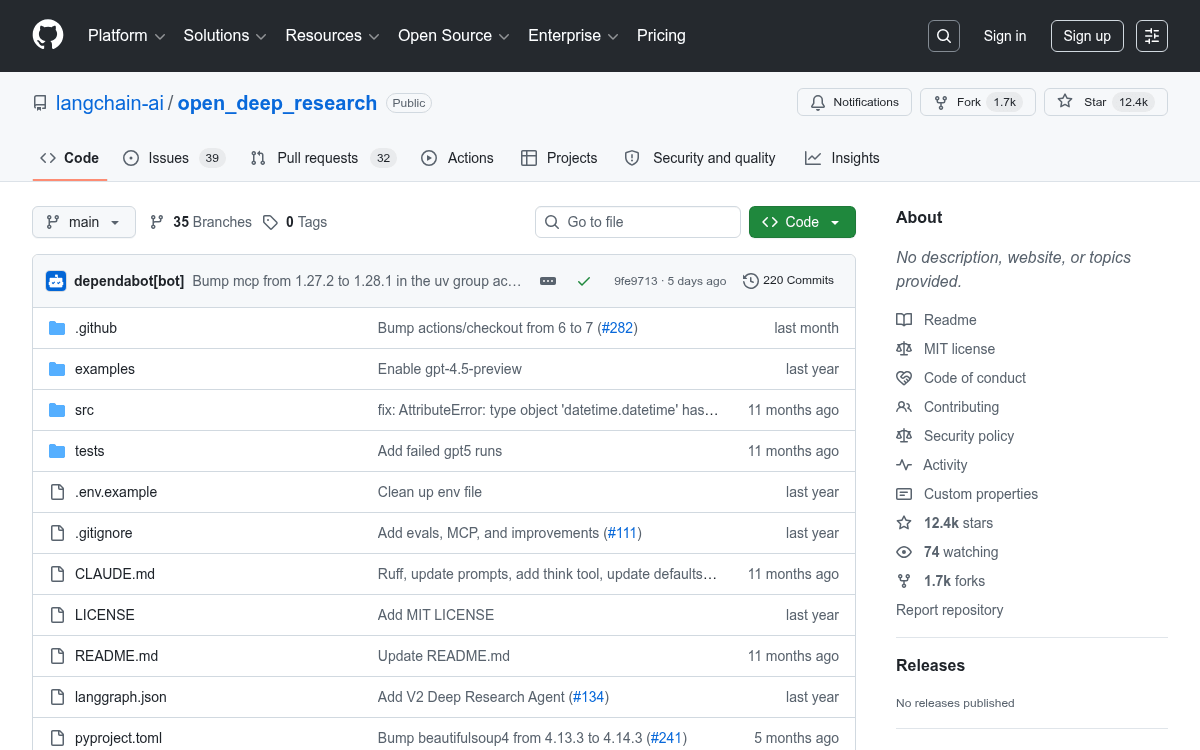
- Open Deep Research is LangChain's MIT-licensed, open-source deep research agent built on LangGraph, now with 11.5k+ GitHub stars.
- It ranked #6 on the Deep Research Bench leaderboard with a RACE score of 0.4344, competitive with commercial products like OpenAI and Perplexity Deep Research.
- The architecture uses a three-phase Scope → Research → Write pipeline with a supervisor agent that spawns parallel sub-agents per sub-topic.
- Fully configurable: plug in any LLM provider (OpenAI, Anthropic, Ollama, OpenRouter), search API (Tavily, native web search), or MCP server.
- Adding GPT-5 as the research model pushed the RACE score to 0.4943; default GPT-4.1 config costs ~$46 for 100 benchmark tasks.
- Available now via GitHub, PyPI, or the no-code Open Agent Platform; free course on LangChain Academy.
Open Deep Research is LangChain's answer to a problem the whole AI industry is racing to solve: how do you build a research agent that adapts to the task at hand, rather than blindly firing off queries and stitching together whatever comes back? The result is a fully open-source, MIT-licensed agent built on LangGraph that you can wire up to virtually any LLM, search API, or MCP server you already use.
The problem it's solving
Deep research has become one of the most popular agent applications. OpenAI, Anthropic, Perplexity, and Google all ship deep research products that produce comprehensive reports from multiple sources. Every one of those products is a black box. You can't swap in your own model, point it at an internal database, or modify the search strategy for your domain.
Research is also open-ended: the best strategy for answering a user request can't be known in advance. A product comparison needs breadth. A fact-check needs depth and source quality. A ranking task needs open-ended search followed by synthesis. Open Deep Research is designed to flex across all of those shapes.
How it works
The agent runs three sequential phases: Scope, Research, and Report Writing. Each phase has a distinct job.
Phase 1: Scope. Before any search happens, the agent clarifies what the user actually wants. It runs a two-step pipeline: first asking follow-up questions if context is missing, then compressing the entire conversation into a focused research brief. That brief becomes the north star for everything that follows, preventing the agent from drifting as the context window grows.