
IWE Turns Plain Markdown Files Into a Queryable Knowledge Graph for AI Agents
IWE turns plain Markdown files into a structured knowledge graph that both you and AI agents can query, navigate, and refactor — no cloud, no embeddings, no lock-in.
Takeaways
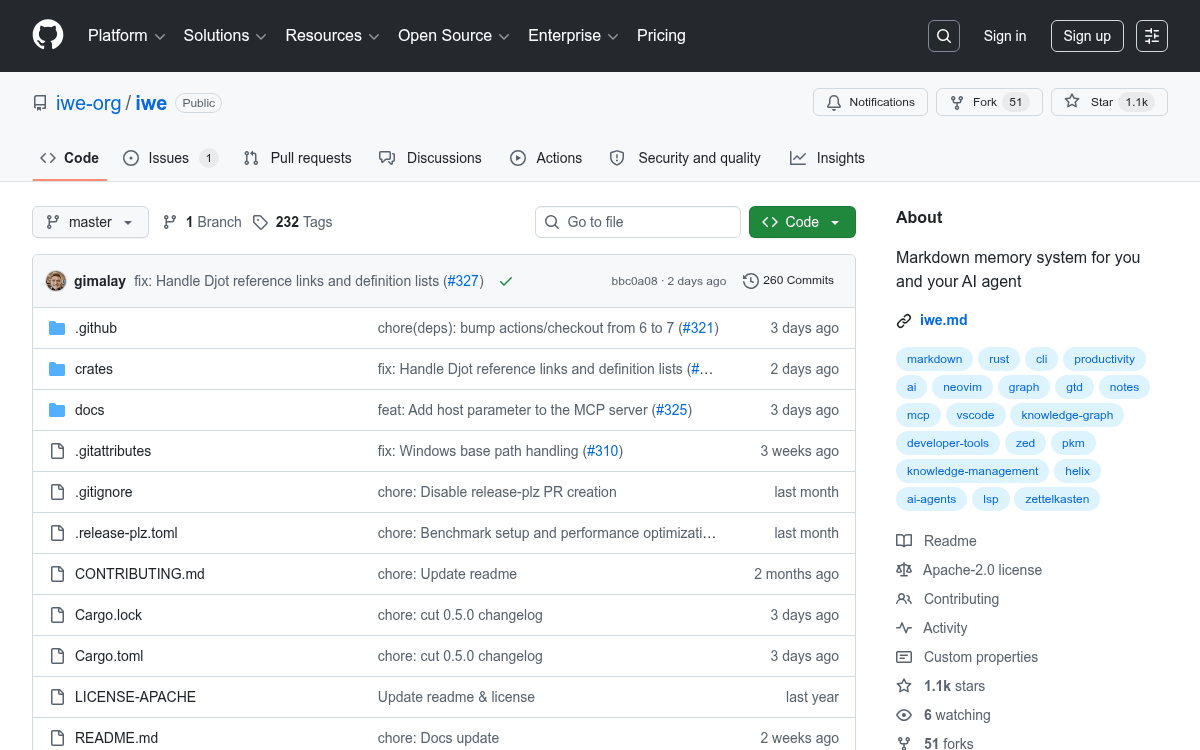
- What it is: IWE is an open-source, Rust-powered tool that turns Markdown files into a structured knowledge graph for humans and AI agents.
- Dual interface: An LSP server gives editors (VS Code, Neovim, Zed, Helix) IDE-like features; an MCP server gives AI agents (Claude, Cursor, Windsurf) structured access to the same files.
- Inclusion links: A link on its own line creates a parent-child relationship, enabling polyhierarchy — one note can live under multiple topics without duplication.
- Deterministic retrieval: No embeddings or vector similarity — agents query the graph directly and get exactly the connected documents, controllable by depth.
- Performance: Built in Rust, processes 20,000 files in under a second; fully local-first with no cloud dependency.
- Free & open source: Apache 2.0 license; install via
brew install iweorcargo install iwe iwes iwec.
IWE is an open-source tool that turns a directory of plain Markdown files into a queryable knowledge graph , one that both you and your AI agents can navigate through the same interface. No vector database, no cloud sync, no proprietary format. Just .md files, a Rust-powered engine, and two access layers: an LSP server for your editor and an MCP server for your agents.
The problem it actually solves
Most knowledge management tools are built for humans. When you try to give an AI agent access to your notes, you're stuck choosing between dumping everything into the context window (expensive and noisy) or building a RAG pipeline with embeddings (fragile and probabilistic). IWE takes a different approach.
The retrieval is deterministic. No embedding similarity thresholds, no "maybe relevant" results. The agent gets exactly the documents in your knowledge graph that connect to the topic. This matters a lot in practice: when an agent needs to understand your authentication system, it gets the auth subtree , not a bag of loosely similar chunks.
The core mechanic: inclusion links
The key innovation is a concept called inclusion links. When you place a markdown link on its own line, IWE treats it as a structural relationship , the current document becomes the "parent" of the linked document. This lets you organize knowledge into hierarchies without folders, and a single document can have multiple parents.
This is fundamentally different from how folders or tags work:
- Folders force single placement. A "Performance Optimization" note can't live in both frontend and backend directories.