
Ironclad's Rivet Turns Messy LLM Agent Code Into Visual Debuggable Graphs
Ironclad's open-source Rivet gives you a node-based canvas for building, debugging, and shipping LLM agents as embeddable TypeScript graphs.
Takeaways
- Rivet is an open-source visual IDE from Ironclad for building LLM agent graphs.
- Ships with a TypeScript library (
@ironclad/rivet-node) to execute graphs inside your app. - Supports OpenAI, Anthropic Claude 3, AssemblyAI, Pinecone, and Hugging Face out of the box.
- Graphs saved as YAML files, enabling git diffs and normal code review workflows.
- Live and remote debugging let you inspect agent execution in production Node services.
- Includes Trivet testing framework, Prompt Designer with A/B variations, and Chat Viewer.
Building LLM agents in plain code often devolves into nested prompts, brittle string templates, and print-statement debugging. Rivet, an open-source project from contract-lifecycle company Ironclad, takes a different route by turning prompt chains and agent logic into a visual graph you can edit, run, and step through like a circuit diagram, then export as a file your TypeScript app calls at runtime.
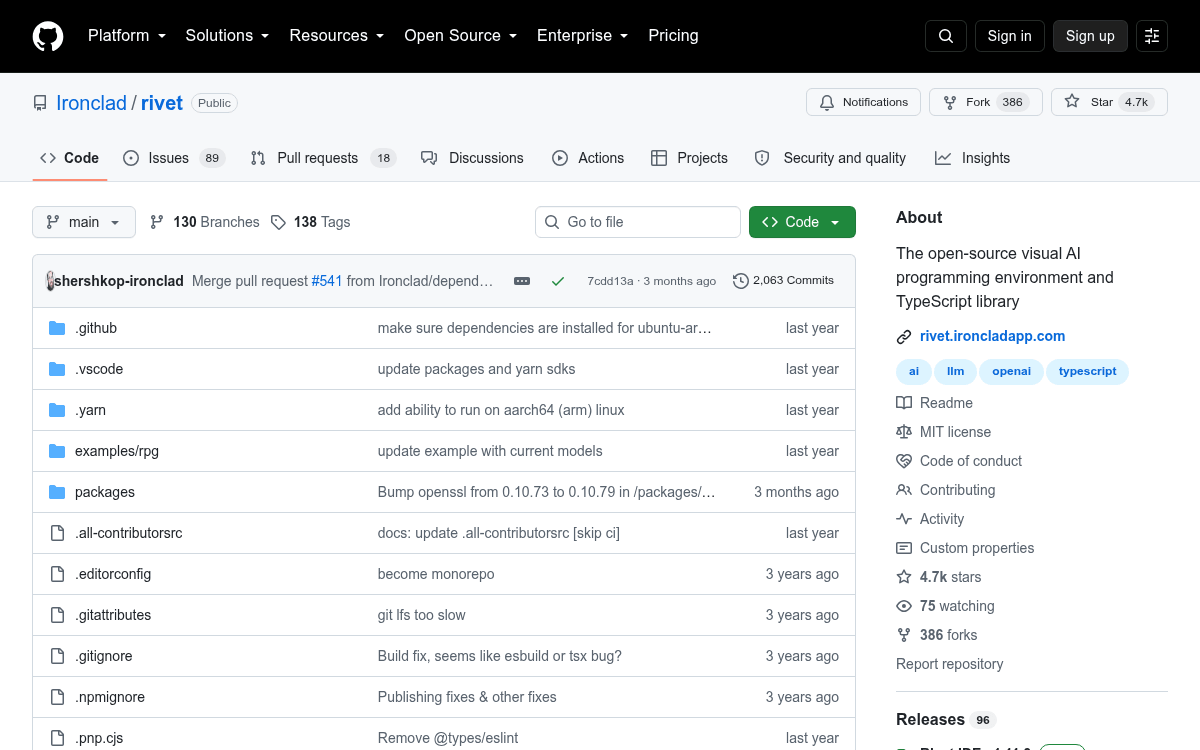
The repo has crossed 4.5k stars on GitHub and ships under an MIT license, with the core written in TypeScript. Two pieces work together: a desktop IDE for designing graphs, and a set of libraries (@ironclad/rivet-core and @ironclad/rivet-node) that execute those graphs inside your own application.
The anatomy of a Rivet graph
Rivet is a node-based editor where each node performs one step in an agent pipeline: calling a model, extracting structured data, looping, branching, or hitting an external API. You wire nodes together with connections that carry typed data between them. The documentation highlights the standard building blocks:
- Text and Chat nodes for prompts and LLM calls
- Match for branching on regex or string patterns
- Loop Controller for iterative agent loops with break conditions
- Extract YAML and Extract JSON