
InkOS Lets 10 AI Agents Write a 450K-Word Novel Without Forgetting Anything
InkOS is an open-source, 10-agent pipeline that autonomously writes, audits, and revises full-length novels with persistent state and human review gates
Takeaways
- What it is: InkOS is an open-source CLI that uses a 10-agent pipeline to autonomously write, audit, and revise full-length novels with persistent state tracking.
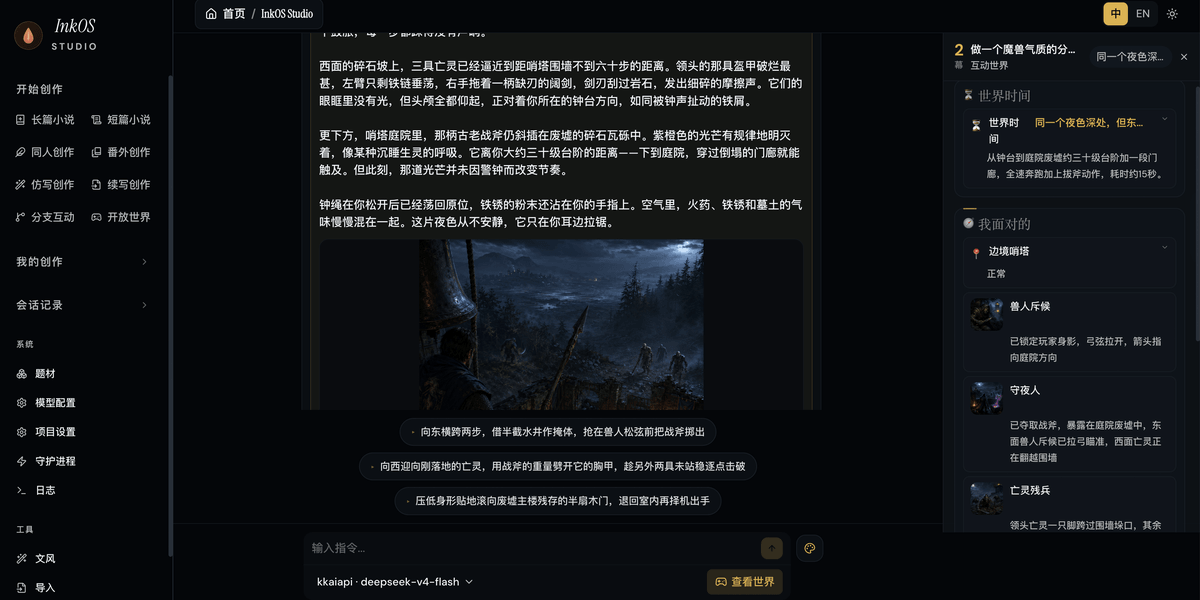
- v1.5.0 adds InkOS Play: an interactive open-world mode where you define world rules in natural language and the system maintains evolving character, item, and relationship states.
- Core innovation: a SQLite temporal memory database and JSON-delta state updates solve context bloat, keeping per-chapter costs stable regardless of book length.
- 37-dimension auditing: a dedicated Auditor agent checks every chapter draft for continuity, hook payoff, AI voice, and narrative pacing before it is accepted.
- Multi-model routing: different agents (Writer, Auditor, Radar) can be assigned different LLM providers to balance quality and cost.
- Free to use: install via
npm i -g @actalk/inkosunder AGPL-3.0; you pay only for your own LLM API calls.
InkOS is an open-source TypeScript CLI that does something most AI writing tools cannot: write a coherent chapter 30 of a novel without forgetting what happened in chapters 1 through 29. It orchestrates a pipeline of 10 specialized AI agents to draft, audit, and revise long-form fiction autonomously, while keeping humans in the loop at configurable checkpoints. The repo has crossed 7,000 GitHub stars and 1,400 forks, and its latest release, v1.5.0, adds a full interactive open-world mode on top of the existing novel-writing engine.
The problem it actually solves
AI-generated fiction has a deep consistency problem. Ask any LLM to write chapter 1 of a novel and it does a decent job. Ask it to write chapter 30 and it has no idea what happened in the first 29. The practical failure modes are well-known to anyone who has tried:
- Continuity breaks: characters remember things they never witnessed, weapons reappear after being lost, relationships reset between chapters
- Context bloat: injecting all previous state into each prompt caused 400 errors and made each chapter cost $200+ in API calls before selective retrieval was introduced
- Hook accumulation: the model loves planting hooks but never pays them off , after 30 chapters you can end up with 40+ open threads, none resolving
- AI voice: every genre includes a fatigue word list (e.g., "delve", "tapestry", "testament", "intricate", "pivotal" for LitRPG) , the auditor flags these automatically so your prose doesn't read like every other AI-generated novel
Ten agents, one pipeline
InkOS orchestrates a multi-agent pipeline , Radar, Planner, Composer, Architect, Writer, Observer, Reflector, Normalizer, Auditor, Reviser , to generate, audit, and revise novel content with zero human intervention per chapter. Each agent has exactly one job:
- Radar: scans platform trends and reader preferences (pluggable, can be skipped)
- Planner: reads author intent and memory, produces a chapter intent with must-keep and must-avoid lists
- Composer: selects only the relevant context from the book's state files rather than injecting everything
- Writer: produces prose from the composed context, with length governance and dialogue-driven scene guidance
- Observer: over-extracts 9 categories of facts from the finished chapter text