
Hugging Face's Burtenshaw Rebuilds Karpathy's autoresearch Into a 4-Agent Open-Source Lab
Ben Burtenshaw's open-source repo upgrades Karpathy's autoresearch loop into a 4-agent system that runs ML experiments on HuggingFace GPUs autonomously, 24/7.
 Pro
Takeaways
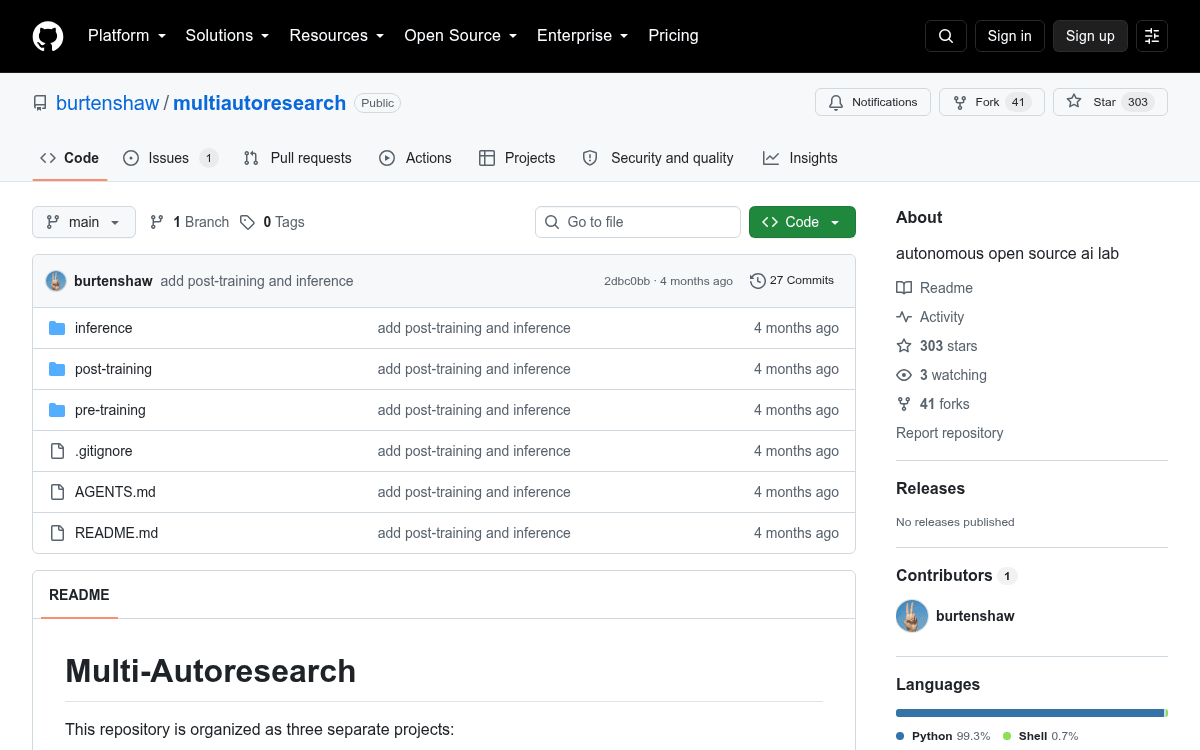
- What it is: multiautoresearch by HuggingFace's Ben Burtenshaw extends Karpathy's autoresearch into a 4-agent autonomous ML lab.
- 4 specialized agents: Researcher (reads HF papers), Planner (queues experiments), Workers (run parallel GPU jobs), Reporter (monitors and summarizes results).
- Live results: In a 4-hour run, the system launched 32 HuggingFace GPU jobs with up to 8 running concurrently.
- Key infra: OpenCode for agent control, HuggingFace Jobs with H200s for execution, shared HF buckets for storage, Trackio for observability.
- Two hard problems solved: Preventing the orchestrator from doing work itself, and enforcing structured formats for inter-agent communication.
- Free and open: MIT-licensed, works with Claude Code, Codex, or OpenCode; no proprietary APIs required.
Andrej Karpathy's autoresearch project showed that a single coding agent, given a training script and a clear objective, could run 700 ML experiments in two days and find 20 real optimizations a human researcher had missed. In its first major run, the system completed 700 experiments in 2 days, discovered 20 additive optimizations, and cut GPT-2 training time by 11%, all without a human touching the code. The community took notice fast. Now Ben Burtenshaw from Hugging Face has published multiautoresearch, a hands-on open-source guide that takes the original single-agent loop and rebuilds it as a coordinated team of specialized agents, running on open models, with cloud GPU execution and real-time observability baked in.
From one agent to a research team
The core insight behind the upgrade is division of labor. The original autoresearch is built around a stripped-down LLM training framework condensed into a single-GPU setup, where an AI agent autonomously edits a training script to experiment with improvements. That works, but a single agent doing everything, reading papers, planning experiments, writing code, and monitoring results, is a cognitive bottleneck. Burtenshaw's system splits those responsibilities across four dedicated roles:
- Researcher: Scouts Hugging Face papers for ideas and defines research directions.
- Planner: Acts as a central coordinator, owning the experiment queue and proposing hypotheses.
- Worker Agents: Execute experiments, fetching code and testing hypotheses. Multiple workers run in parallel.
- Reporter: Monitors the progress of jobs, synchronizes status, and provides an overview of active jobs and anomalies.
This multi-agent approach allows for a systematic and automated exploration of hyperparameters and model architectures, leading to more efficient and effective research cycles. In a live 4-hour run, the system launched 32 jobs across up to 8 concurrent HuggingFace GPU instances with 4 agents active simultaneously.