
HKUDS's CLI-Anything Lets AI Agents Control Any Real Software With 18,000 Stars
HKUDS releases CLI-Anything, an open-source framework that auto-generates agent-ready CLI wrappers for any software using a 7-phase AI pipeline, with 18,000+ GitHub stars at launch.
 Pro
Takeaways
- What: HKUDS releases CLI-Anything, an open-source framework that auto-generates agent-ready CLI wrappers for any software codebase.
- How: A 7-phase AI pipeline (run via Claude Code, Codex, OpenCode, etc.) analyzes source code and builds a full Python Click CLI with REPL, JSON output, and tests.
- Scale: Ships with 18 ready-made harnesses and 2,461 passing tests at 100% pass rate, covering Blender, GIMP, LibreOffice, Ollama, Godot, and more.
- Hub: CLI-Hub package manager (
pip install cli-anything-hub) lets you browse and install community CLIs in one command. - Agents: A meta-skill lets SKILL-compatible agents (Claude Code, OpenClaw, Nanobot) autonomously discover and install the right CLI for any task.
- Limits: Requires frontier-class models for reliable generation; closed-source binaries and complex apps may need multiple refinement passes.
CLI-Anything, released by the HKUDS lab, tackles one of the most underappreciated bottlenecks in agentic AI: the fact that most professional software was designed for humans, not agents. The project lets you point an AI coding agent at any codebase or GitHub repo and automatically generate a production-grade command-line interface that agents can actually use -- no GUI automation, no brittle screen-scraping, no custom API wrappers.
The repo has attracted over 18,000 GitHub stars since launch, with 1,546 forks, signaling strong interest from the agentic AI community. It ships with ready-made harnesses for 18 applications and a companion package manager called CLI-Hub for browsing and installing community-built CLIs.
The problem it's solving
AI agents are increasingly capable reasoners, but they struggle to interact with real professional software. The three dominant workarounds each have serious drawbacks:
- GUI automation (RPA) -- takes screenshots, clicks pixels, breaks constantly when UIs change
- Official APIs -- only exist for a fraction of software, and often expose a tiny subset of features
- Custom reimplementations -- expensive to build, miss 90% of the original tool's functionality
CLI-Anything's answer is to generate a structured CLI that calls the real software backend directly. When you generate a Blender CLI, it invokes blender --background. When you generate a LibreOffice CLI, it calls libreoffice-headless. There are no toy reimplementations -- the actual application does the rendering.

How the 7-phase pipeline works
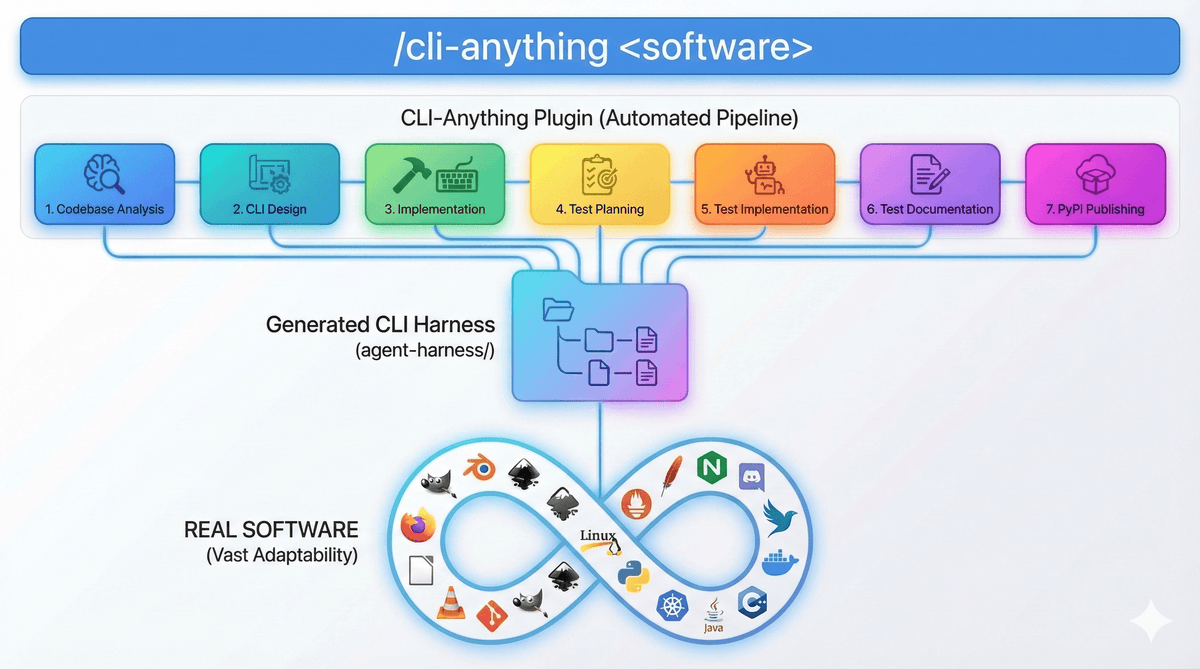
The core of CLI-Anything is a methodology called HARNESS.md -- a detailed standard operating procedure that a frontier-class AI coding agent (Claude Code, Codex, OpenCode, etc.) follows to build the CLI. You install the plugin into your agent, point it at a codebase, and run /cli-anything ./your-software. The agent then executes seven phases automatically:
- Analyze -- scans source code, maps GUI actions to underlying APIs
- Design -- architects command groups, state model, and output formats
- Implement -- builds a Python Click CLI with REPL mode, JSON output, and undo/redo
- Plan Tests -- creates a
TEST.mdwith unit and E2E test plans - Write Tests -- implements the full test suite
- Document -- updates
TEST.mdwith results - Publish -- creates
setup.pyand installs the CLI to PATH
Every generated CLI gets a --json flag on every command for machine-readable output, plus a stateful REPL mode for interactive agent sessions. A SKILL.md file is also auto-generated so that SKILL-compatible agents (OpenClaw, Nanobot, Claude Code) can discover and use the CLI autonomously.
# Install the hub package manager
pip install cli-anything-hub
# Browse and install a ready-made CLI
cli-hub install gimp
cli-hub launch gimp
# Or build a new one inside Claude Code
/plugin marketplace add HKUDS/CLI-Anything
/plugin install cli-anything
/cli-anything ./your-software
What's already in the registry
The project ships with harnesses for 18 diverse applications, validated against 2,461 tests at a 100% pass rate (1,732 unit + 579 end-to-end + 19 Node.js). The coverage spans domains that were previously almost entirely inaccessible to agents:
- Creative tools: GIMP (107 tests), Blender (208), Inkscape (202), Audacity (161), Krita, Kdenlive, Shotcut
- 3D/CAD/Scientific: FreeCAD (258 commands), QGIS, RenderDoc, Nsight Graphics, Uni-Mol Tools
- Productivity: LibreOffice (158), Zoom, OBS Studio (153), Zotero, Joplin, Obsidian
- AI/ML platforms: ComfyUI (70), Ollama (98), NotebookLM
- Dev tools: LLDB, WireMock, n8n, Dify Workflow, Exa
- Game engines: Godot 4.x, s&box (244 tests)
The test strategy is layered: unit tests run against synthetic data, native E2E tests verify generated project file structure (ODF ZIP, MLT XML, SVG), true backend E2E tests invoke the real application and check output (magic bytes, pixel analysis, audio RMS), and CLI subprocess tests confirm the installed command works end-to-end.
The real unlock: agents that can use real tools
The deeper implication here goes beyond convenience. Once you have a CLI harness for a GUI application, you can also synthesize benchmarks and evaluators entirely in code -- no human in the loop, no GUI state to manage. An agent can run Blender, check the rendered PNG, and iterate, all through terminal commands. This is a meaningful step toward agents that can do real creative and scientific work, not just text tasks.
The project also introduces a CLI-Hub meta-skill: install it once with npx skills add HKUDS/CLI-Anything --skill cli-hub-meta-skill -g -y, and your agent can autonomously discover, install, and use the right CLI for any task without you specifying which tool to use.
Limitations worth knowing
CLI-Anything is not magic. A few real constraints to keep in mind:
- Requires frontier models -- the HARNESS.md pipeline is designed for Claude Opus/Sonnet 4.x or GPT-5.x class models. Smaller models produce incomplete or incorrect harnesses.
- Needs source code -- the pipeline analyzes source. Closed-source binaries degrade quality significantly.
- May need multiple refinement passes -- a single
/cli-anythingrun often doesn't cover all capabilities. The/cli-anything:refinecommand exists for iterative expansion.
The project is open-source under Apache 2.0 and actively accepting community contributions -- both new harnesses and improvements to the HARNESS.md methodology itself. A technical report from the HKUDS team (Yuhao Yang, Tianyu Fan, and Chao Huang) accompanies the release with a deeper treatment of the design principles.
