
HKU's OpenSpace Teaches AI Agents to Remember, Cutting Token Costs 46%
OpenSpace gives any AI agent a memory that compounds — slashing token costs by 46% while multiplying output quality across professional tasks
Takeaways
- OpenSpace is an open-source self-evolving skill engine from HKU that plugs into any MCP-compatible agent (Claude Code, Codex, Cursor, etc.).
- Skills automatically FIX themselves when broken, DERIVE new versions from successes, and CAPTURE novel patterns from task executions.
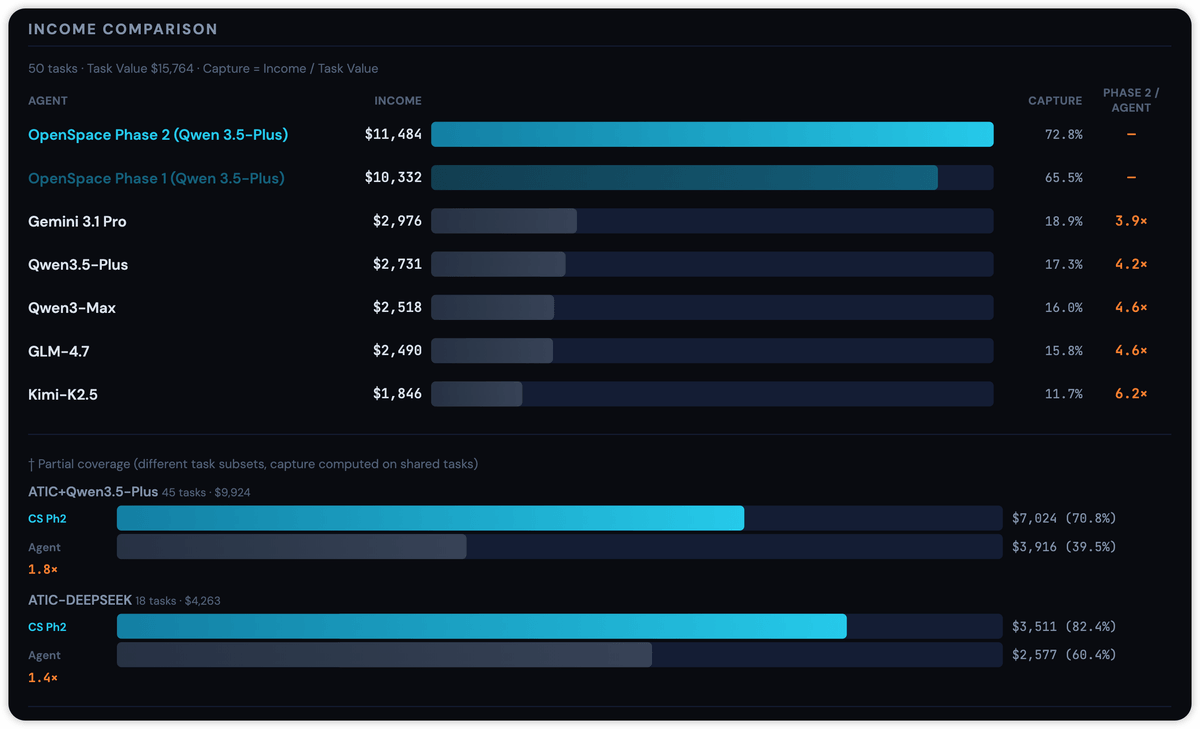
- On the GDPVal benchmark, OpenSpace agents earned 4.2x more income and used 46% fewer tokens vs a baseline agent using the same LLM.
- A cloud skill community at open-space.cloud lets agents share evolved skills across teams with public/private/group access controls.
- The framework evolved 165 skills autonomously across 50 professional tasks — mostly error-recovery and execution-reliability patterns, not domain knowledge.
- Free and MIT-licensed on GitHub; cloud features require a free API key registration.
Traditional AI agents operate as stateless tools, re-reasoning from scratch for every new task, which leads to high token costs and inconsistent performance. Every time you fire up Claude Code or Codex on a new project, it has no memory of the last time it solved the same class of problem. It burns tokens rediscovering what it already knew. OpenSpace shifts this paradigm by implementing a self-evolution loop that captures, repairs, and reuses skills, addressing the economic inefficiency of LLM-based automation where costs often scale linearly with task complexity.
OpenSpace by HKUDS (University of Hong Kong) is an open-source self-evolving skill engine that empowers AI agents to automatically learn, reuse, and optimize skills from every task, making automation smarter and significantly more token-efficient. It plugs into your existing agent stack via MCP (Model Context Protocol , the standard interface for connecting agents to external tools) and adds a compounding memory layer that persists and improves across runs. The framework was open-sourced and has rapidly gained traction in the AI agent community.
The Stateless Agent Tax
The problem OpenSpace targets is real and expensive. Every LLM call costs money, and today's agents pay a "stateless tax" , they re-derive solutions they've already found, re-encounter errors they've already fixed, and re-build pipelines they've already assembled. The 165 skills OpenSpace evolved autonomously tell a story about where agent intelligence actually lives. It's not in the model weights. It's in the accumulated knowledge of what breaks, what works around those breaks, and how to verify the output , and that's the kind of learning that compounds.
Memory has become a first-class architectural primitive in 2026, not an afterthought bolted onto a vector database. OpenSpace is a direct answer to that need , not through fine-tuning or RAG over documents, but through a living library of executable skills that get better with every task.
Three Ways Skills Evolve
The core of OpenSpace is its skill engine. Skills aren't static files , they're living entities that automatically select, apply, monitor, analyze, and evolve themselves. Full lifecycle management runs from discovery to application to evolution, all without human intervention. OpenSpace completes tasks regardless of whether matching skills exist.