
Google's Open-Source gws CLI Unifies All Workspace APIs Into One Tool
gws is a Rust-built, open-source CLI that unifies every Google Workspace API behind one command surface, with 100+ built-in AI agent skills and dynamic command generation from Google's Discovery Service.
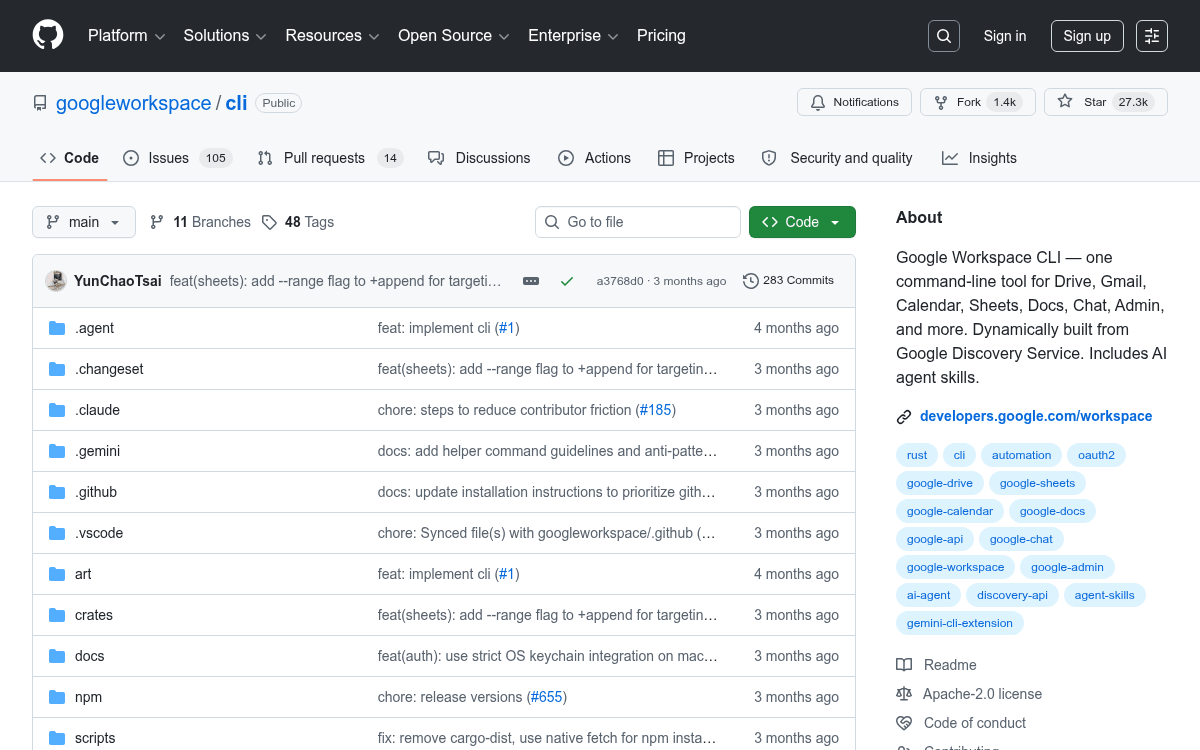
Takeaways
- Single CLI for all of Google Workspace: gws covers Drive, Gmail, Calendar, Sheets, Docs, Chat, Admin, and more from one binary.
- Dynamic command generation: Commands are built at runtime from Google's Discovery Service — new API endpoints appear automatically without a tool update.
- 100+ AI agent skills included: Pre-built SKILL.md files plug directly into Claude Code, Cursor, and Gemini CLI with near-zero context overhead.
- MCP server mode available: Run
gws mcpto expose Workspace APIs as structured tools for Claude Desktop, VS Code, and other MCP clients. - Setup friction is real: OAuth scope limits (~25 for unverified apps), skills path mismatches, and pre-v1.0 breaking changes are known issues.
- Free and open-source: Apache 2.0 license, installable via
npm install -g @googleworkspace/cli, Homebrew, or pre-built binaries.
Every developer who has tried to automate Google Workspace knows the pain: a separate OAuth flow for Gmail, another SDK for Drive, a different pagination pattern for Sheets, and custom glue code that rots the moment Google changes an endpoint. Google Workspace CLI , invoked as gws , is a single open-source tool that collapses all of that into one command surface, built for both humans at the terminal and AI agents running in the background.
Written in Rust and licensed under Apache 2.0, the CLI is designed to serve both human operators and AI agent workflows, shipping with structured JSON output and over 100 bundled agent skills. It has already crossed 26,000 GitHub stars and 1,400 forks.
The architecture that makes it different
Most CLIs ship a static list of commands that someone has to maintain by hand. gws takes a different approach entirely.
Unlike traditional CLI tools that ship with a static list of commands, gws reads Google's own Discovery Service at runtime and builds its entire command surface dynamically. When Google adds or updates an API endpoint, the CLI picks up the change automatically without requiring a new release. Discovery Service is Google's machine-readable catalog of all its APIs , essentially a live schema document that gws fetches and turns into a fully navigable command tree on the fly.
The internal flow works in two phases: gws reads the first argument to identify the service (e.g. drive), fetches that service's Discovery Document (cached for 24 hours), builds a full command tree from it, then re-parses your remaining arguments, authenticates, and fires the HTTP request. All output , success, errors, pagination metadata , comes back as structured JSON.
What you actually get
For humans, gws means you stop writing curl calls against REST docs. It gives you