
Google Research's TimesFM 2.5 Gets Smaller yet Sees 8x Further Into the Future
TimesFM 2.5 cuts parameters by 60%, expands context 8x to 16K, and lands directly in BigQuery SQL — no ML setup required
 Pro
Takeaways
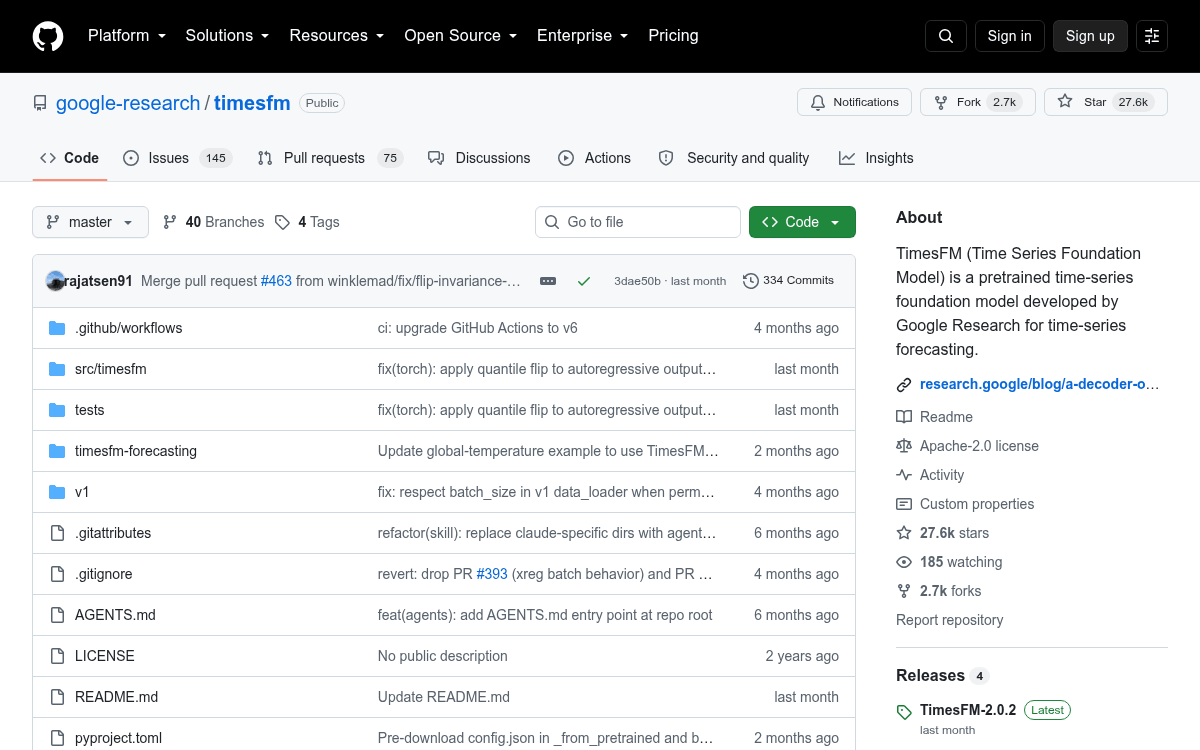
- TimesFM 2.5 released: Google Research cuts parameters from 500M to 200M while expanding context window 8x to 16,384 time-steps.
- BigQuery GA:
AI.FORECASTandAI.EVALUATEare now generally available, enabling zero-shot forecasting via SQL with no ML setup. - Probabilistic forecasting: Optional 30M quantile head adds uncertainty estimates for up to 1,000 forecast steps ahead.
- LoRA fine-tuning added: Domain adaptation now possible via HuggingFace PEFT without retraining 200M parameters from scratch.
- Benchmark leader — with caveats: #1 on GIFT-Eval (28 datasets), but Chronos-2 leads overall and TimesFM remains weak on multivariate and high-frequency data.
- Open source, Apache 2.0: Install via
pip install timesfm[torch]; checkpoints on Hugging Face.
Google Research's TimesFM just got a major overhaul. Version 2.5 shrinks the model from 500M to 200M parameters while simultaneously expanding its context window eightfold , from 2,048 to 16,384 time-steps. That's a rarer combination than it sounds: most model upgrades trade one for the other. The result is a leaner, faster forecasting engine that can now see decades of history in a single pass.
The "BERT moment" for time series
For years, time-series forecasting has been stuck in a frustrating loop: collect data, pick a model (ARIMA, DeepAR, PatchTST), train it on your specific dataset, tune it, deploy it , and repeat for every new domain. Just as BERT triggered a pre-training revolution in NLP in 2018, time-series foundation models are approaching the same inflection point. TimesFM is Google's bet on what that looks like in practice: a single pre-trained model that forecasts out-of-the-box, across domains, without retraining.
The key insight is treating time-series forecasting like language modeling. Just as GPT learned patterns across billions of text sequences, TimesFM learned patterns across massive amounts of time-series data , producing a model that generalizes across domains without ever seeing your specific data before.
What changed in 2.5
The parameter reduction (500M to 200M) while simultaneously extending context (2,048 to 16,384) is the headline architectural achievement. Google Research achieved this by improving the efficiency of the attention mechanism and the representation of time-series patches.
Here's the full list of what's new:
- 16K context window: TimesFM 2.5 processes 16K timesteps of context , roughly 44 years of daily data or 333 years of weekly data. For seasonal patterns and long-term regime changes, this is a qualitatively different capability.
- Probabilistic forecasting: An optional 30M continuous quantile head enables up to 1,000-step forecasting with full uncertainty estimates , not just a point prediction.
- No frequency indicator: The removal of the frequency indicator , a feature in 2.0 that required users to specify whether their data was daily, weekly, monthly , simplifies the interface and removes a common source of user error.