
Ghostwright's Phantom Builds Its Own Infrastructure and Remembers Everything
Phantom is an open source AI co-worker that runs on its own dedicated machine, rewrites its own config after every session, and builds its own tools.
Takeaways
- Phantom is an open source AI co-worker that runs on its own dedicated VM, built on the Claude Agent SDK.
- Self-evolves through a six-step pipeline with five validation gates and cross-model judges to prevent self-enhancement bias.
- Three-tier vector memory in Qdrant plus dynamic MCP tools the agent creates at runtime and persists across restarts.
- Ships channels for Slack, Telegram, email, webhooks, and a browser chat at
/chat; also acts as an MCP server. - Bring your own model: Anthropic, Z.AI GLM-5.1, OpenRouter, Ollama, vLLM, LiteLLM, or any Anthropic-compatible endpoint.
- Deploy via Docker or use the free-preview Phantom Cloud with a per-agent public URL and Slack identity.
Most AI assistants forget everything the moment you close the tab. Phantom, an Apache 2.0 project from Ghostwright with around 1,400 stars, takes the opposite bet: give the agent its own computer, a persistent memory, and permission to build whatever tools it decides it needs. It runs on Slack, Telegram, email, or a browser chat at /chat, and it is built on the Claude Agent SDK.
Your laptop stays yours. The agent lives on a VM with a public URL, installs its own software, spins up its own databases, and serves dashboards and APIs that anyone with the link can reach. Day one it is generic. Day thirty it knows your codebase, your deploy quirks, and which client always asks about uptime before renewing.
Agents that build their own infrastructure
The most interesting thing about Phantom is what production instances have done unprompted. In one example on the repo, a Phantom asked to help with data analysis installed ClickHouse on its own VM, loaded the full Hacker News dataset of roughly 28.7 million rows, built an interactive dashboard, exposed a REST API, and then registered that API as an MCP tool so future sessions and other agents could query it. Nobody asked for the stack. It decided analytics would be useful and built it.
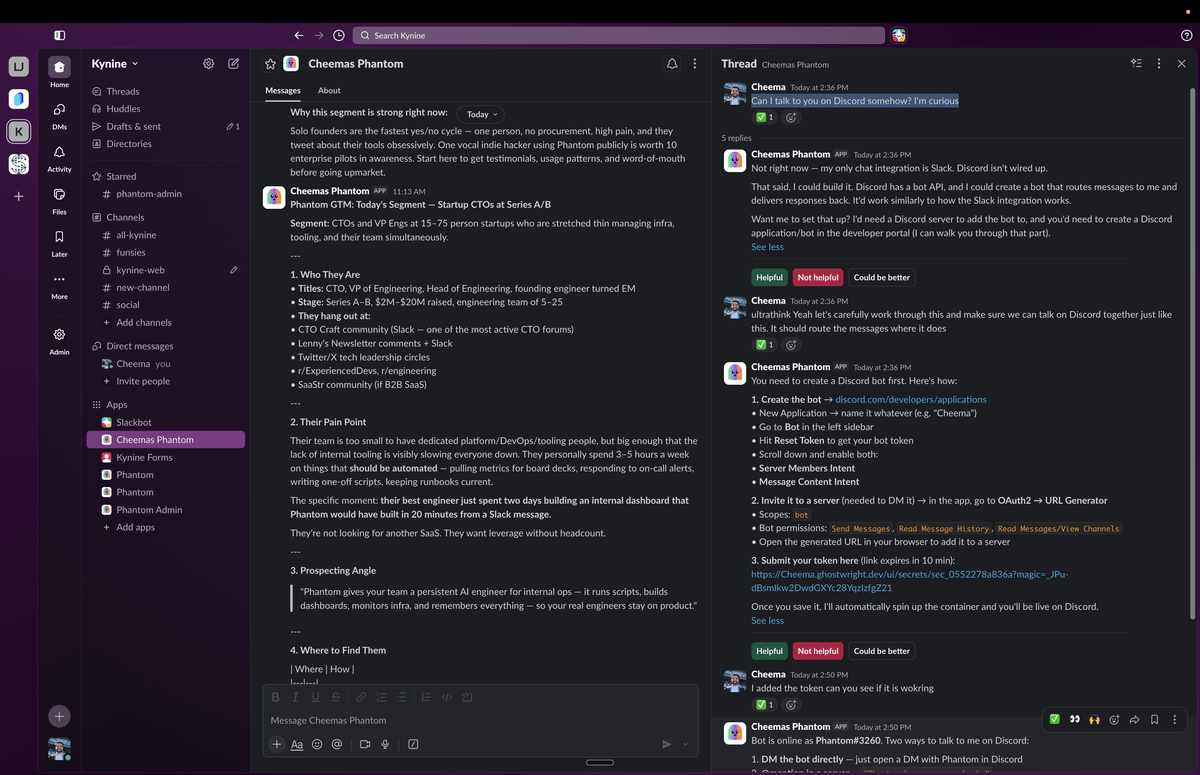
Another Phantom, asked by a user whether it was reachable on Discord, admitted it was not, walked the user through creating a Discord application, collected the token through a secure form, and spun up its own Discord container. It gained a communication channel it was never designed with. A third integrated an obscure 3-star system monitor called Vigil into its ClickHouse pipeline and started watching its own service health.