
GenericAgent Beats Claude Code Using 6x Fewer Tokens and 9 Tools
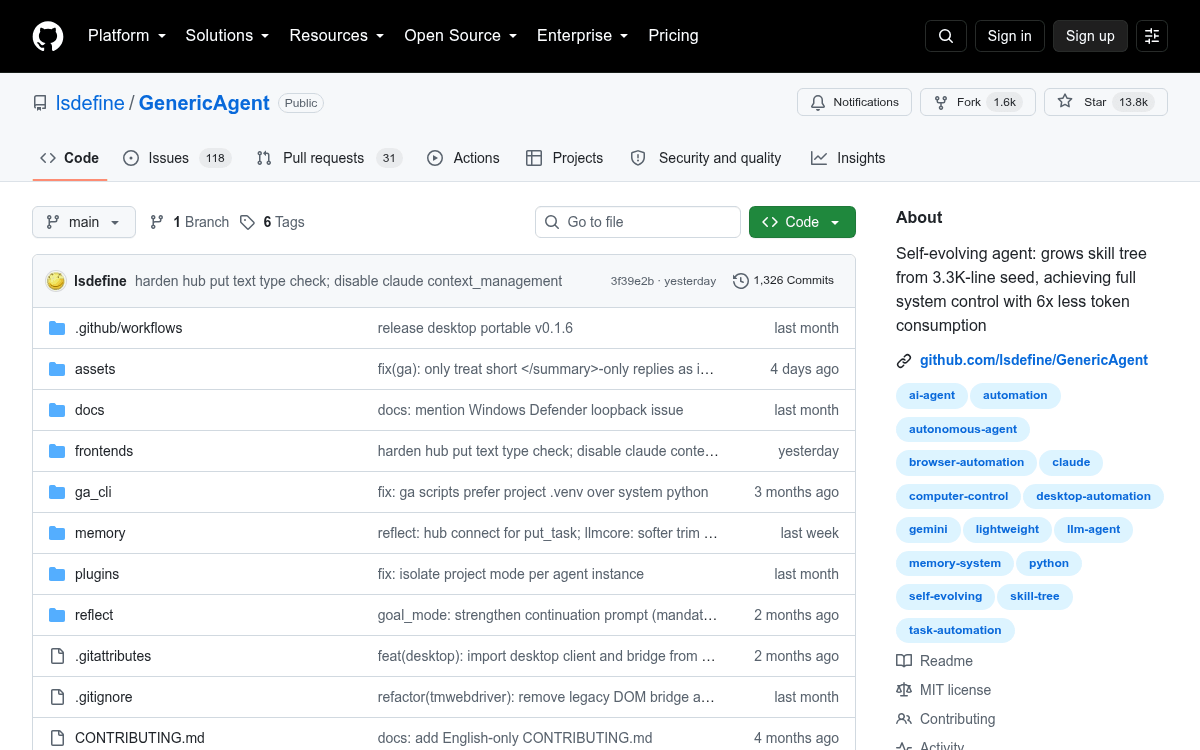
GenericAgent is a self-evolving agent framework that grows a personal skill tree from 3K lines of seed code, using 6x fewer tokens than Claude Code or OpenClaw
Takeaways
- Self-evolving framework: GenericAgent starts from ~3K lines of seed code and grows a personal skill tree by crystallizing each completed task into a reusable SOP.
- 6x token efficiency: Uses only 222K input tokens on Lifelong AgentBench vs. 800K for Claude Code and 1.43M for OpenClaw, while matching or beating their accuracy.
- 9 atomic tools only: Replaces 53+ tools found in competing frameworks with a minimal set covering code execution, file I/O, browser control, and memory management.
- Real browser injection: TMWebDriver runs in a persistent Chrome session preserving login state, passing major bot-detection services including reCAPTCHA v3 at 0.9 human score.
- Free and open source: MIT license, supports Claude / Gemini / Kimi / MiniMax, with frontends for Terminal, Streamlit, Telegram, Discord, WeChat, and more.
- Backed by arXiv paper: Technical report formalizes the "contextual information density maximization" principle behind the design.
GenericAgent is a minimal, open-source autonomous agent framework with a genuinely unusual design bet: instead of shipping a massive toolkit upfront, it starts with roughly 3,000 lines of seed code and grows its own capabilities over time. Every task it completes gets crystallized into a reusable Skill, stored in a persistent memory tree that belongs entirely to your instance. The longer you run it, the more capable it becomes, without you writing a single line of integration code.
The project has crossed 12,900 GitHub stars and 1,500 forks, and the team has backed it with a formal technical report on arXiv comparing it head-to-head against Claude Code and OpenClaw across five evaluation dimensions.
The context problem every agent hits
Most long-running LLM agents fail for the same reason: as a task drags on, the context window fills up with tool descriptions, retrieved memories, and raw environment feedback. Useful signal gets crowded out by noise, and the model starts hallucinating or looping. The standard fix is to throw more context at it, which is why many agent frameworks operate with 200K to 1M token windows.
GenericAgent's core is just ~3K lines of code, and through 9 atomic tools plus a ~100-line Agent Loop, it grants any LLM system-level control over a local computer, covering browser, terminal, filesystem, keyboard/mouse input, screen vision, and mobile devices via ADB. The key insight from the paper is that long-horizon performance is determined not by context length, but by how much decision-relevant information fits in a finite context budget. GA calls this principle contextual information density maximization.
How the skill tree actually works
The design philosophy is: don't preload skills, evolve them. Every time GenericAgent solves a new task, it automatically crystallizes the execution path into a Skill for direct reuse later. The longer you use it, the more skills accumulate, forming a skill tree that belongs entirely to you.
The self-evolution loop looks like this:
- A new task arrives. The agent has no pre-built handler for it.
- It autonomously explores: installs dependencies, writes scripts, debugs, verifies.
- Once successful, the execution path is distilled into a reusable SOP (Standard Operating Procedure) and saved to the memory layer.