
Espressif's ESP-Claw Turns a $3 Chip Into an AI Agent
Espressif's ESP-Claw turns a $3 ESP32 chip into a conversational AI agent that senses, decides, and acts at the edge — no cloud required for execution.
Takeaways
- Espressif released ESP-Claw, an open-source AI agent framework that lets you program ESP32 devices through natural-language chat.
- Uses a hybrid LLM + Lua engine: the LLM generates behavior scripts dynamically, which are then saved and run deterministically on-chip — even offline.
- Supports MCP as both server and client, making ESP32 boards first-class participants in multi-agent workflows alongside tools like Claude Desktop.
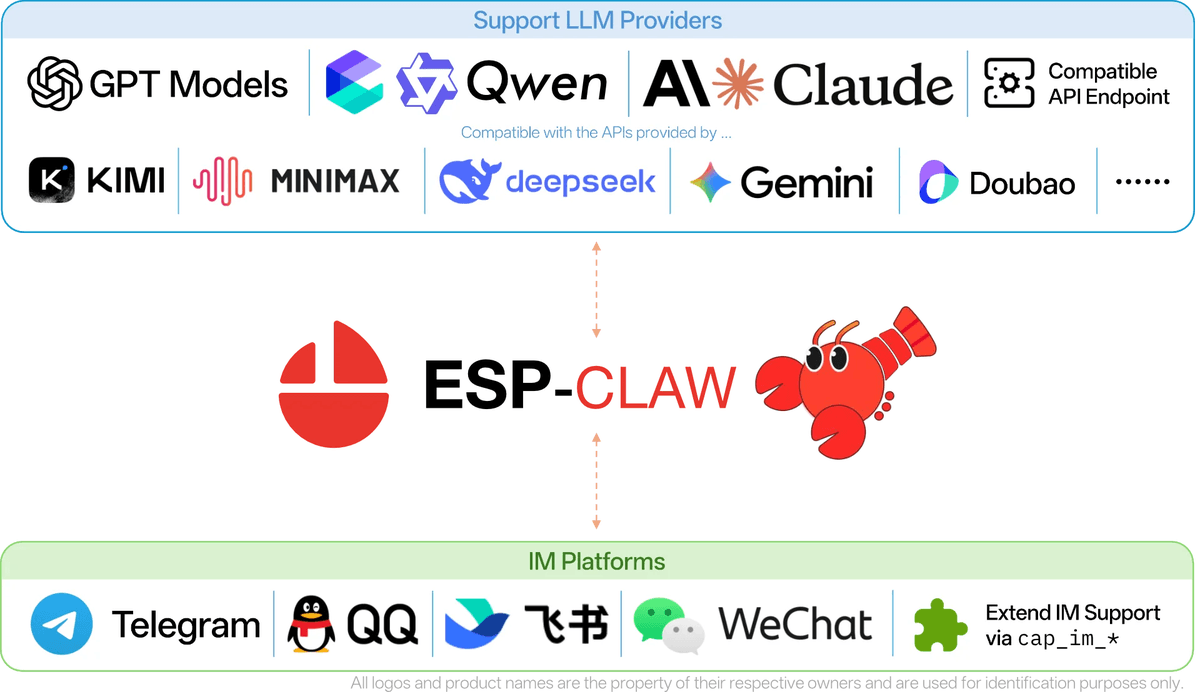
- Works with OpenAI, Anthropic, DeepSeek, and Qwen APIs; IM interfaces include Telegram, WeChat, QQ, and Feishu.
- Requires only 8MB Flash + 8MB PSRAM; supports ESP32-S3, P4, C5 boards with browser-based one-click flashing for supported hardware.
- Free under Apache 2.0; still under active development with ESP32-P4 and broader board support expanding.
Espressif, the company behind the ubiquitous ESP32 microcontroller, has released ESP-Claw, an open-source AI agent framework that lets you program IoT devices through plain-language chat. Instead of writing firmware, you describe what you want your device to do over Telegram or WeChat, and the framework handles the rest , generating code, loading it onto the chip, and running it locally.
ESP-Claw is Espressif's "Chat Coding" AI agent framework for IoT devices. It defines device behavior through conversation and completes the full loop of sensing, decision-making, and execution locally on Espressif chips. Inspired by the OpenClaw concept and reimplemented in C, ESP-Claw is lightweight and continuously evolving , and it runs on an ESP32-series chip that costs only a few dollars.
The problem it actually solves
Traditional IoT stops at simple connectivity. Devices can connect but not think; execute but not decide. Heavy cloud reliance and rigid rules keep them purely passive. ESP-Claw pushes the Agent Runtime directly to the edge, transforming ESP chips from passive "execution nodes" into active "decision centers" that perceive, reason, and act locally.
The key insight here is that you don't need a full LLM running on the microcontroller. This is not a full language model running on a tiny microcontroller. It is a local agent runtime on Espressif hardware, tied to external models when reasoning is required, and to local scripts when predictable action is required.
How the LLM + Lua hybrid works
One of ESP-Claw's most powerful features is its dynamic Lua scripting engine. When a user sends a message like "Turn on the LED when the temperature exceeds 30 degrees," the LLM generates Lua code that is loaded and executed on the device in real time. Once validated, those scripts can be stored locally, ensuring reliable operation even without a connection to the LLMs that created them. This hybrid model , LLM-generated logic combined with deterministic Lua execution , offers both flexibility and stability.