
dev-browser Gives Claude Code Real Browser Eyes at 40% Less Cost
dev-browser gives Claude Code a real browser to verify its own work, beating Playwright MCP on speed, cost, and turn count
Takeaways
- dev-browser is a free, MIT-licensed Claude Code skill giving agents a real browser to verify their own work.
- Scripts run in a QuickJS WASM sandbox with zero access to the host filesystem or network, keeping agent-generated code contained.
- Benchmarks show it completes tasks in 3m 53s at $0.88 vs Playwright MCP's 4m 31s at $1.45, using 29 turns vs 51.
- Pages persist across script executions, so agents can build up sessions incrementally without re-navigating or re-authenticating.
- Install with
npm install -g dev-browser && dev-browser install; works with Claude Code, Amp, and Codex. - Best for agent dev loops and quick visual verification; Playwright MCP remains the choice for CI and cross-browser test suites.
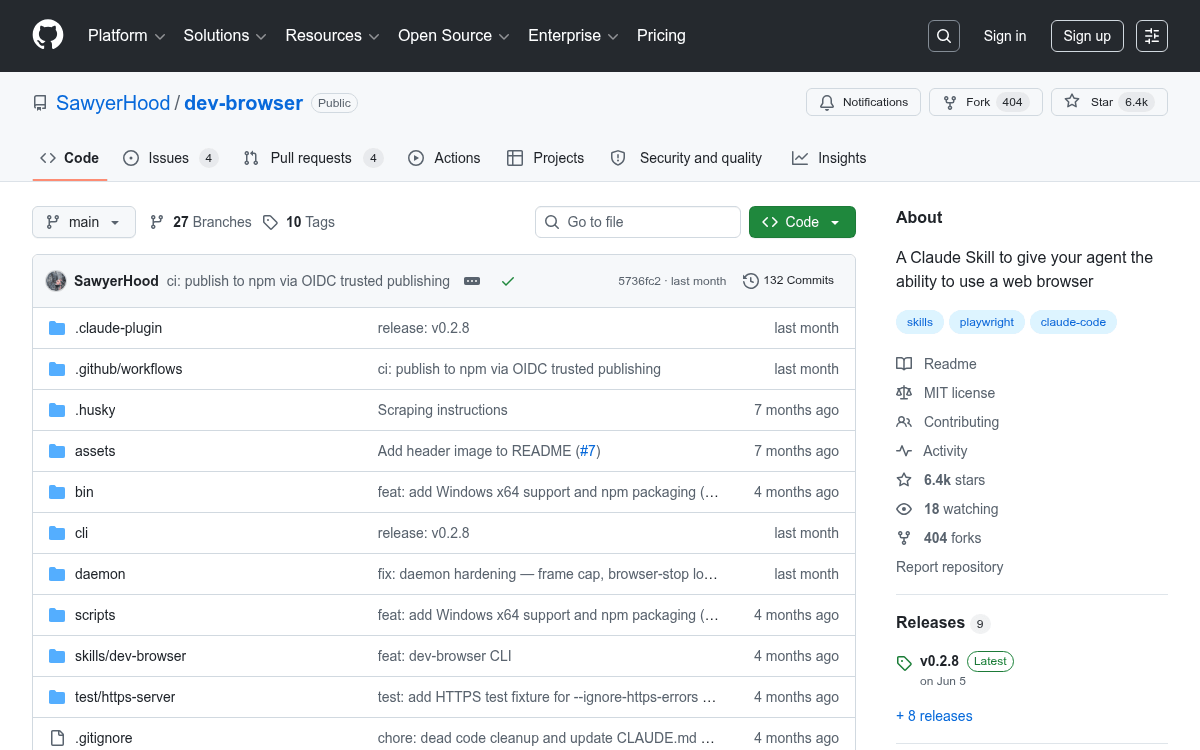
There's a persistent frustration with AI coding agents: they write the code, say it should work, and leave you to open a browser and check. dev-browser closes that loop. It's an open-source tool by Sawyer Hood that gives Claude Code the ability to actually open a browser, navigate to your app, click around, and verify that what it just built actually works. The repo has crossed 6,200 stars, and the reason is simple: it solves a problem every developer using Claude Code runs into daily.
The problem with "it should work"
AI coding agents have a blind spot. Tools like Claude Code have changed how we write and debug code, but until recently, they couldn't see what was happening inside a browser. The standard workaround was Playwright MCP, which exposes browser control as a set of individual tool calls. The issue? Token consumption is heavy. Every page interaction returns a full accessibility tree, which can be 50,000 or more tokens on complex pages. On a long testing session, you can burn through your context window quickly.
There's also an authentication problem. Playwright MCP spins up a fresh browser instance. If your app requires login, you need to handle authentication programmatically or manually sign in each time. For a quick sanity check during development, this is a lot of overhead.
Scripts, not tool calls
dev-browser takes a fundamentally different approach. Instead of exposing each browser action as a separate tool call that the model issues one at a time, it's a sandboxed browser automation tool built specifically for AI agents to interact with web pages during development. It runs scripts in a QuickJS WASM sandbox, meaning your agent's browser automation code has zero access to the host filesystem or network.
QuickJS is a lightweight, embeddable JavaScript engine. Running it inside WebAssembly (WASM) means the agent's code executes in a fully isolated environment. The agent's JS runs in QuickJS WASM, not in your actual system. So even if the agent writes something dodgy, it's contained. No accidental