
Deta's Open-Source Surf Replaces NotebookLM With Local AI Control
Deta open-sourced Surf, a local-first AI notebook that pulls PDFs, YouTube, tweets and files into a single research canvas with your choice of models.
Takeaways
- Deta open-sourced Surf, a local-first AI notebook combining files, PDFs, YouTube and web pages.
- Built in Svelte, TypeScript and Rust, running on MacOS, Windows and Linux under Apache 2.0.
- Data lives on disk in the transparent SFFS format with vector embeddings alongside original files.
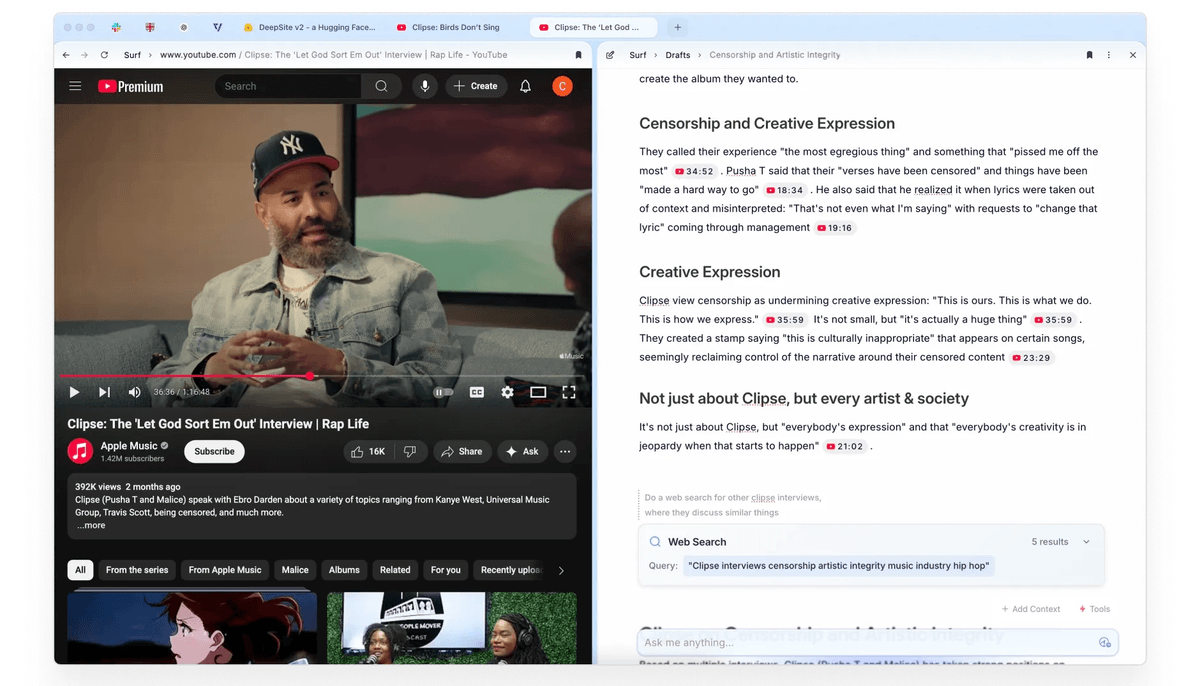
- Smart Notes generate content with deeplinked citations back to PDF pages, video timestamps and webpage sections.
- Surflets let the AI generate small runnable applets and charts inside your notes.
- Bring your own model: OpenAI, Anthropic, DeepSeek, or local via Ollama for offline use.
Most knowledge tools force you to pick a lane: a note editor for writing, a browser for reading, a chat window for asking questions, and a separate folder somewhere for PDFs. Deta's open-source Surf collapses all of that into one desktop app, with local storage and a plug-and-play model layer that can talk to OpenAI, Anthropic, or a model running on your own machine through Ollama.

One app instead of seven tabs
Deta Surf is an AI notebook that pulls files and the web into a single workspace so you can explore and think across your digital material without juggling windows, scrolling, and copy-pasting into a chatbot. It runs on macOS, Windows, and Linux, works offline, and positions itself as an open-source alternative to Google's NotebookLM that treats websites, PDFs, and local files as first-class research inputs.
Under the hood, the app is built in Svelte, TypeScript, and Rust (roughly 44/38/16% of the codebase), packaged with Electron, and licensed under Apache 2.0.
A library you can actually read on disk
Rather than pushing content into a proprietary sync bucket, Surf keeps everything on disk in a format you can inspect. The library sits on a local storage engine called SFFS (Surf Flat File System), which writes files, database entries, and vector embeddings for text content in open, transparent formats.