
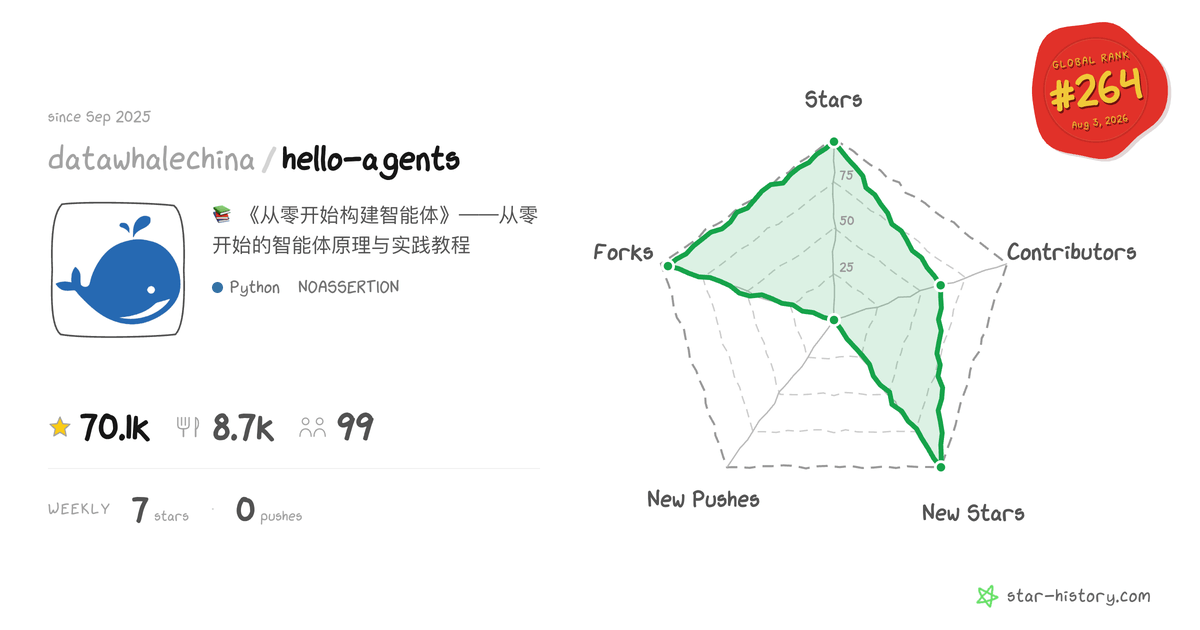
Datawhale's Hello-Agents Hits 31K Stars Teaching Devs to Build AI Agents From Scratch
Datawhale's Hello-Agents hits 31K GitHub stars with a free, 16-chapter curriculum for building AI-native agents from scratch — including a custom framework, Agentic RL, and multi-agent protocols.
 Pro
Takeaways
- 31K+ GitHub stars: Hello-Agents by Datawhale is a free, 16-chapter open-source curriculum for building AI-native agents from scratch.
- Build your own framework: Chapter 7 guides you through creating the HelloAgents framework on top of the raw OpenAI API, with no hidden abstractions.
- Covers the full stack: From ReAct and Plan-and-Solve paradigms to MCP/A2A protocols, RAG memory, context engineering, and multi-agent coordination.
- Agentic RL included: Chapter 11 walks through a full SFT-to-GRPO training pipeline — the same RL technique behind DeepSeek-R1's reasoning gains.
- Real projects: Capstone cases include a multi-agent travel assistant, a DeepResearch agent replication, and a social simulation called Cyber Town.
- Free and bilingual: Available online at hello-agents.datawhale.cc; PDF on the releases page; English README and select chapters available.
Hello-Agents, an open-source curriculum from the Datawhale community, has crossed 31,000 GitHub stars and over 3,500 forks. It is not a framework you install and forget. It is a 16-chapter, hands-on textbook that walks you through building AI-native agents from first principles , and then challenges you to build your own framework from scratch.
The gap it fills
Most tutorials focus on API calls for specific frameworks, leaving learners "knowing how but not knowing why," still feeling powerless when facing complex requirements. If 2024 was the year of the "Battle of a Hundred Models," then 2025 has undoubtedly ushered in the "Year of Agents" , the focus of technology is shifting from training larger foundation models to building smarter agent applications. However, systematic, practice-oriented tutorials are extremely scarce, which is exactly why the Hello-Agents project was launched.
Today, agent development is mainly divided into two schools: software engineering-oriented agents like Dify, Coze, and n8n, which are essentially process-driven software development with LLMs serving as data processing backends; and AI-native agents, truly AI-driven agents. Hello-Agents is not a plug-and-play SaaS platform, but a systematic educational engineering project designed to teach you how to understand, design, and implement true "AI Native" agents from the bottom up.
What the curriculum actually covers
The course is split into five parts across 16 chapters. Each part builds directly on the last, so the structure matters:
- Part 1 (Chapters 1-3): Foundations. Agent definitions, the history from symbolic AI to LLM-driven agents, and core LLM concepts like Transformers and prompting.
- Part 2 (Chapters 4-7): Building single agents.