
Crucix Turns 27 Public Government APIs Into a Self-Hosted Jarvis Dashboard
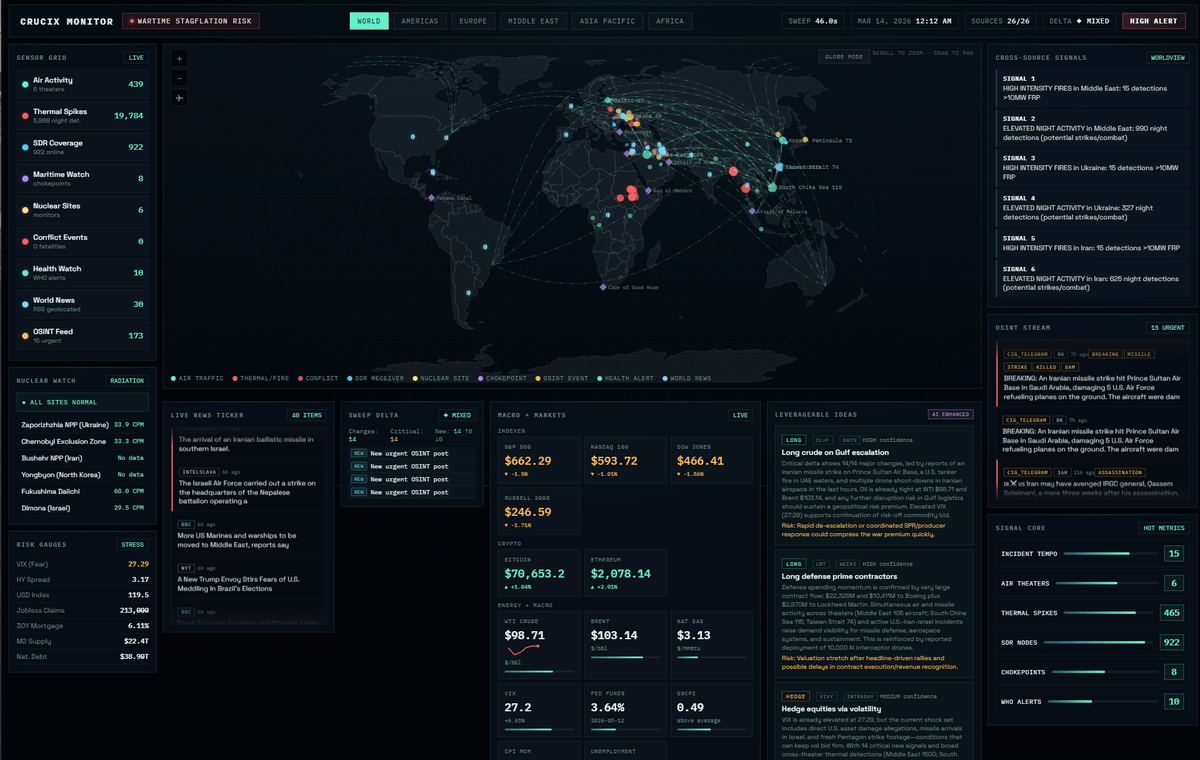
Crucix is a self-hosted, open-source intelligence terminal that fuses 27 live data feeds — from satellite fire detection to conflict events — into a single Jarvis-style dashboard with LLM-powered alerts.
 Pro
Takeaways
- 27 live data feeds, one dashboard: Crucix aggregates satellite fire detection, flight tracking, radiation, conflict events, economic indicators, and social sentiment into a self-hosted Jarvis-style HUD.
- Fully self-hosted, zero cloud: Runs on Node.js with Express as the only hard dependency; no telemetry, no subscriptions, deployable via Docker.
- LLM-powered two-way alerts: Supports 8 LLM providers (Claude, GPT, Gemini, Grok, etc.) for AI-classified FLASH/PRIORITY/ROUTINE alerts pushed to Telegram and Discord with interactive slash commands.
- Most data is free: 18+ sources need no API key; three free registrations (FRED, NASA FIRMS, EIA) unlock the most valuable feeds.
- Rapid community traction: Hit GitHub Trending in March 2026, now at 11,300+ stars and 1,800+ forks; mixed reception with praise for technical choices and some reports of setup issues.
- Open source and extensible: AGPL-3.0 licensed; adding a new data source requires only a single module export — GitHub repo here, live demo at crucix.live.
Crucix is the kind of project that makes you wonder why nobody built it sooner. It is a self-hosted, open-source intelligence dashboard that aggregates 27 real-time data sources , including satellite fire detection, flight tracking, radiation monitoring, conflict events, economic indicators, and social sentiment , into a single Jarvis-style HUD. The whole thing runs on your machine, with no cloud, no telemetry, and no subscription fees. It has already crossed 11,300 GitHub stars.
Crucix pulls data from 27 public sources every 15 minutes and renders it on a dashboard running on your own machine. Hook up an LLM, and it becomes a two-way assistant you can query from your phone. The pitch is simple: the world's real-time intelligence is already public, it is just scattered across dozens of government APIs and research feeds that nobody has time to check individually.
What it actually watches
Crucix pulls from 27 open-source data feeds , satellite fire detection, flight tracking, radiation monitoring, conflict data, market prices, maritime AIS, economic indicators, and more , every 15 minutes, and renders everything on a WebGL globe dashboard. The sources are organized into five tiers:
- Geopolitical (11 sources): GDELT global news events, OpenSky ADS-B flight tracking, NASA FIRMS satellite fire detection, maritime vessel tracking (including dark ships and sanctions evasion), Safecast radiation monitoring, ACLED armed conflict events, ReliefWeb UN humanitarian data, WHO disease outbreaks, and OFAC/OpenSanctions sanctions lists.
- Economic & Financial (7 sources): FRED (22 key indicators including yield curve, CPI, VIX), US Treasury, BLS, EIA energy data, NY Fed Global Supply Chain Pressure Index, USAspending, and UN Comtrade strategic commodity flows.
- Environment, Social & SIGINT (7 sources): NOAA weather alerts, EPA RadNet radiation monitoring, USPTO patent filings in strategic tech areas, Bluesky and Reddit social sentiment, 17 curated Telegram OSINT channels, and KiwiSDR global HF radio receivers.