
Companion's Feynman Brings a Full AI Research Assistant to Your Terminal
An open source terminal agent runs paper search, multi-agent deep research, replication audits, and citation verification from a single CLI.
Takeaways
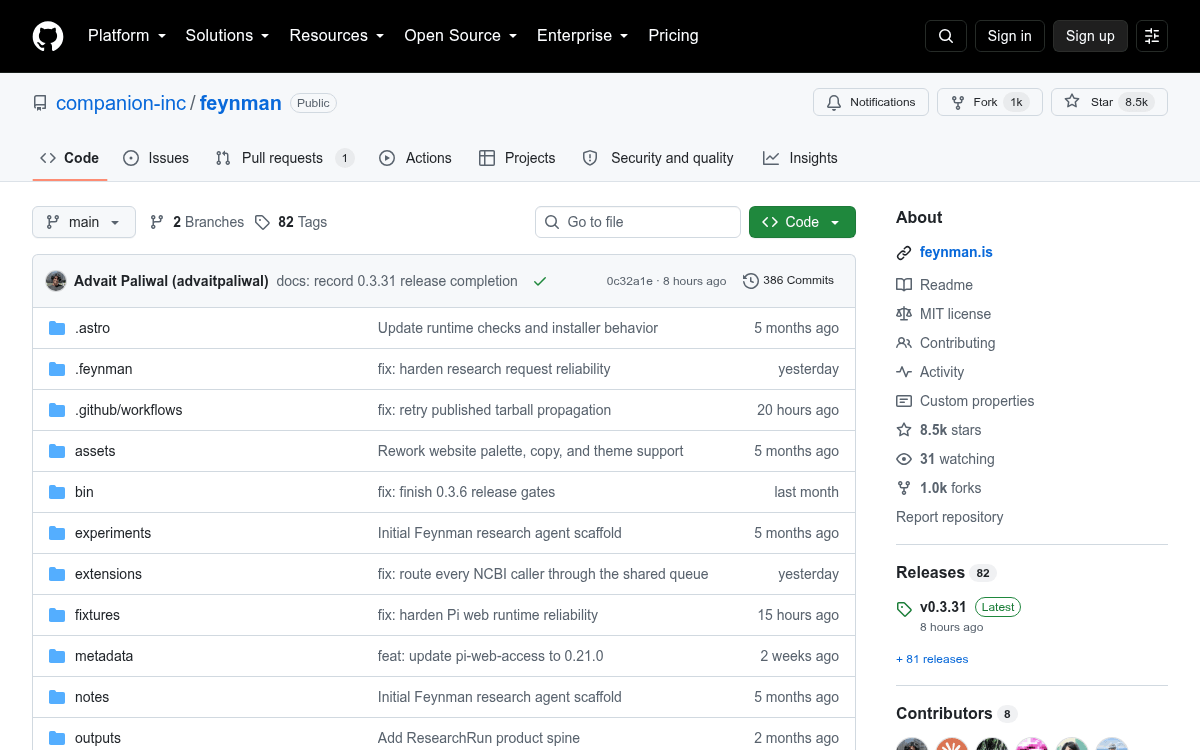
- Feynman is an open source terminal research agent from Companion, MIT licensed with ~8.5k stars.
- Ships four agents: Researcher, Reviewer, Writer, and Verifier for citation and URL checking.
- Workflows include deepresearch, lit review, paper-vs-code audit, replication planning, and PaperRank.
- Local science workbench adds notebooks, artifact previews, provenance, and lineage.
- Supports local models via LM Studio, LiteLLM, Ollama, or vLLM; hosted via OpenRouter and Copilot.
- Optional GPU execution through Docker, Modal, and RunPod, gated behind explicit environment choice.
A new open source project called Feynman pitches itself as a full research assistant that lives in your terminal. It reads papers, searches the web, drafts write-ups, plans experiments, and checks citations, all through a single CLI plus an optional local web app for artifacts and notebooks.
The project comes from Companion and is built on Pi for the agent runtime and alphaXiv for paper search. It is MIT licensed, sits at nearly 8.5k stars on GitHub, and installs as a standalone native bundle with its own pinned Node.js runtime.

Four agents that argue with each other
The core design is a small crew of specialists that a workflow prompt can call on when a task needs to be decomposed. The bundled roles are a Researcher that gathers evidence across papers, web, repos and docs; a Reviewer that provides severity-graded critique; a Writer that turns notes into structured drafts; and a Verifier that checks inline citations and removes dead links.
That last one matters. Most "deep research" agents happily fabricate references, so a dedicated pass that verifies source URLs and strips broken ones is one of the more pragmatic design choices here.