
Claude Code's Black Box Cracked Open by 12,000-Star Research Repository
A community study of Claude Code's internal architecture hit 12k stars, mapping the 12 layered mechanisms that turn a while-loop into a production coding agent.
 Pro
Takeaways
- learn-coding-agent hit 12k stars mapping Claude Code's architecture from publicly available sources
- Documents 12 progressive harness mechanisms that turn a basic agent loop into a production tool
- Covers permission pipeline, tool interface, MCP transports, sub-agents, and context compaction patterns
- Based on Claude Code v2.1.88, compiled from public references, not leaked source code
- Includes a companion arXiv paper analyzing Claude Code design principles
- Strictly educational, commercial use is prohibited by the repository's own disclaimer
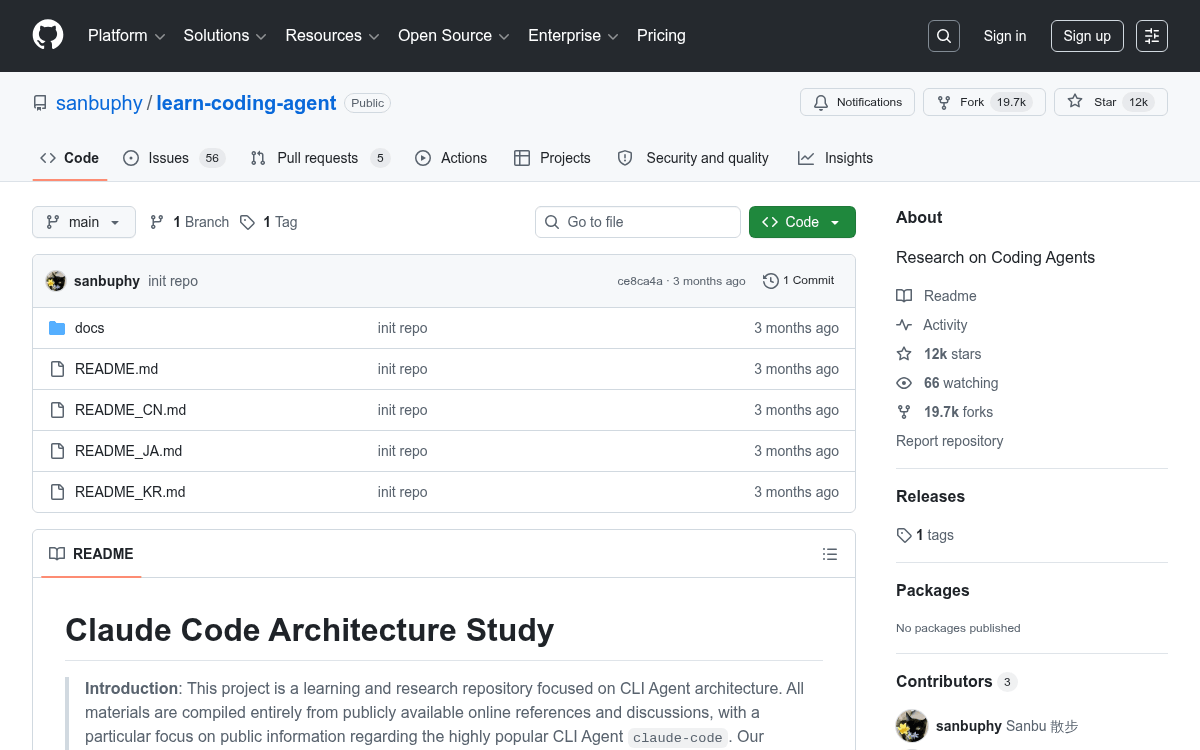
A community-maintained research repository called learn-coding-agent has quietly climbed to over 12,000 stars by doing something surprisingly rare: sitting down with the publicly available information about Claude Code and drawing a full architectural map of how a production CLI agent actually works. It is not source code, not a fork, and not a leak. It is a learning and research repository focused on CLI Agent architecture, with materials compiled entirely from publicly available online references and discussions, with a particular focus on public information regarding the popular CLI Agent claude-code.
For anyone building their own coding agent, the value is that it turns a black box into a blueprint. Most production-grade tools are black boxes: you can observe inputs and outputs, but the internal loop, how permissions are enforced, how sub-agents coordinate, how telemetry flows, remains opaque. This opacity matters when you are deciding whether to trust a tool with production codebases, or when you are architecting your own agent system and need production patterns to study.
From one while-loop to a real product
The repo's central thesis is that a working agent is basically a small loop, but a shippable agent is that loop wrapped in a dozen support systems. It defines the minimal loop as messages going to the model, checking whether the stop reason is